Skip to main content
Anatomy & Physiology
My Course
Learn
Exam Prep
AI Tutor
Study Guides
Textbook Solutions
Flashcards
Explore
Try the app
My Course
Learn
Exam Prep
AI Tutor
Study Guides
Textbook Solutions
Flashcards
Explore
Try the app
Back
Introduction to Lung Physiology definitions
8 students found this helpful
You can tap to flip the card.
Ventilation
You can tap to flip the card.
👆
Ventilation
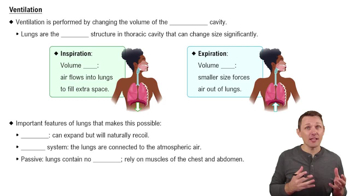
The process of moving air in and out of the lungs by changing the thoracic cavity volume.
Track progress
Control buttons has been changed to "navigation" mode.
1/15
Related flashcards
Related practice
Recommended videos
Introduction to Lung Physiology quiz #1
Introduction to Lung Physiology
40 Terms
Introduction to Lung Physiology quiz #2
Introduction to Lung Physiology
39 Terms
Introduction to Lung Physiology quiz #3
Introduction to Lung Physiology
39 Terms
Introduction to Lung Physiology
22. The Respiratory System
5 problems
Topic
Pressure in the Lungs and Pleural Cavity
22. The Respiratory System
4 problems
Topic
Jason
22. The Respiratory System - Part 1 of 2
5 topics
9 problems
Chapter
Bruce
22. The Respiratory System - Part 2 of 2
1 topic
2 problems
Chapter
4:28
Ventilation
8090
views
191
rank
1
comments
5:55
Ventilation and Respiration
11951
views
355
rank
1
comments
1:37
Introduction to Lung Physiology Example 1
8110
views
218
rank
1
comments
Terms in this set (15)
Hide definitions
Ventilation
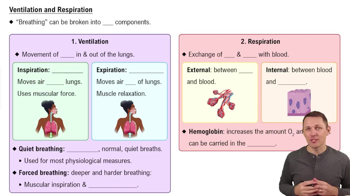
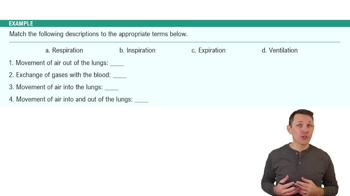
The process of moving air in and out of the lungs by changing the thoracic cavity volume.
Respiration
The exchange of gases, specifically oxygen and carbon dioxide, between blood and tissues.
Inspiration
The act of inhaling air into the lungs, primarily using the diaphragm muscle.
Expiration
The act of exhaling air out of the lungs, typically involving muscular relaxation.
Eupnea
Normal, restful breathing that occurs without conscious effort.
Forced Breathing
Deeper, more strenuous breathing using additional muscles for both inhalation and exhalation.
External Respiration
Gas exchange between air in the alveoli and blood, involving oxygen and carbon dioxide.
Internal Respiration
Gas exchange between blood and body tissues, delivering oxygen and removing carbon dioxide.
Cellular Respiration
The metabolic process of breaking down molecules like sugar to produce ATP and carbon dioxide.
Diaphragm
The primary muscle of respiration that contracts to increase thoracic cavity volume during inhalation.
Thoracic Cavity
The space within the rib cage that changes size to facilitate lung ventilation.
Alveoli
Tiny air sacs in the lungs where external respiration occurs, exchanging gases with the blood.
Hemoglobin
A blood molecule that increases oxygen and carbon dioxide transport capacity.
Elasticity
The property of the lungs that allows them to expand and recoil naturally.
Passive Structures
Refers to the lungs' lack of muscle, relying on external muscles to change size.
 BackBack

 4:28
4:28