The myelin sheath insulates axons to increase the speed of electrical impulse conduction.
Which types of glial cells are found in the central nervous system?
The types of glial cells found in the central nervous system include astrocytes, oligodendrocytes, microglia, and ependymal cells.
The neuron cell is part of what body system?
The neuron cell is part of the nervous system.
What type of conduction takes place in unmyelinated axons?
In unmyelinated axons, continuous conduction takes place.
Where are unmyelinated axons found?
Unmyelinated axons are found in both the central and peripheral nervous systems.
What is the purpose of the myelin sheath?
The purpose of the myelin sheath is to insulate axons and increase the speed of nerve impulse transmission.
Which type of glial cell produces the myelin sheath in the PNS?
Schwann cells produce the myelin sheath in the peripheral nervous system (PNS).
Which is the correct description for motor neurons?
Motor neurons carry signals from the central nervous system to muscles and glands.
Afferent neurons are what type of neurons?
Afferent neurons are sensory neurons that carry information towards the central nervous system.
What type of neuron carries impulses from all parts of the body to the central nervous system?
Sensory neurons carry impulses from all parts of the body to the central nervous system.
Which of the neuroglial cell types shown form myelin sheaths within the CNS?
Oligodendrocytes form myelin sheaths within the central nervous system (CNS).
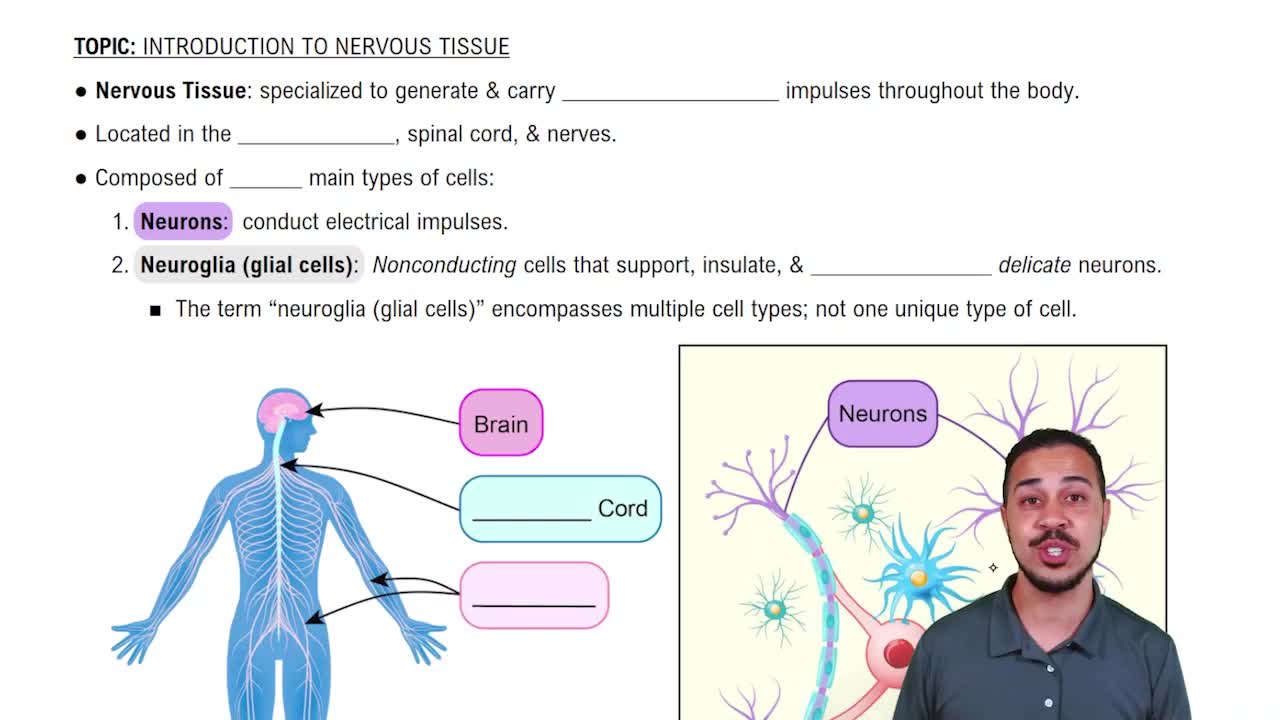
What is the function of nervous tissue?
The function of nervous tissue is to generate and carry electrical impulses throughout the body.
Which neuroglial cells insulate axons in the central nervous system?
Oligodendrocytes insulate axons in the central nervous system.
How do the DNA and genes in a muscle cell compare to the DNA and genes in a nerve cell?
The DNA and genes in a muscle cell are the same as those in a nerve cell, but they express different genes to perform their specific functions.
What occurs at the nodes of an axon?
At the nodes of an axon, action potentials are regenerated, allowing for rapid signal transmission along myelinated axons.
Which term describes all neurons that carry signals towards the CNS?
Afferent neurons describe all neurons that carry signals towards the central nervous system.
Which type of neuron carries information from the CNS to the body?
Efferent neurons, or motor neurons, carry information from the central nervous system to the body.
What components of the nervous system are made of gray matter?
Neuron cell bodies and dendrites
Which type of nerve are motor neurons?
Motor neurons are efferent nerves.
What is not a function of the nervous system?
Hormone secretion
What characteristic is not true of nervous tissue?
Stores energy
Which receive information from the axon terminals of the neuron? Select three options. A) Dendrites B) Axon hillock C) Synaptic cleft D) Postsynaptic membrane
A) Dendrites, C) Synaptic cleft, D) Postsynaptic membrane
What type of glial cell is found in the peripheral nervous system?
Schwann cells
What is the structure within a nerve that surrounds individual axons?
The endoneurium is the structure within a nerve that surrounds individual axons.
In what way is the DNA of a nerve cell different from the DNA of a muscle cell?
The DNA of a nerve cell is not different from the DNA of a muscle cell; they have the same DNA but express different genes.
What is not a function of dendrites?
Generate action potentials
What is true about axons?
They transmit signals away from the cell body
Which type of neuron is classified as unipolar?
Sensory neuron
Which cells protect the neurons and help them function?
Neuroglia, or glial cells, protect the neurons and help them function.
What part of the nervous system sends signals to the muscles that are voluntarily controlled?
The somatic nervous system sends signals to the muscles that are voluntarily controlled.
Where are the neuron cell bodies located?
Neuron cell bodies are located in the gray matter of the brain and spinal cord, and in ganglia of the peripheral nervous system.
Which types of cells are supporting cells of the peripheral nervous system?
Schwann cells and satellite cells are supporting cells of the peripheral nervous system.
Most nerves are what type of nerve?
Most nerves are mixed nerves, containing both sensory and motor fibers.
What cells form the myelin sheaths around nerve fibers in the PNS?
Schwann cells form the myelin sheaths around nerve fibers in the peripheral nervous system (PNS).
Which cell type is not found in the peripheral nervous system? A) Schwann cells B) Satellite cells C) Oligodendrocytes D) Neurons
C) Oligodendrocytes
What is a characteristic of an axon?
Transmits signals away from the cell body
What wraps around and insulates the axons of neurons?
The myelin sheath wraps around and insulates the axons of neurons.
Which kind of tissue transmits signals across a synapse?
Nervous tissue transmits signals across a synapse.
 Back
Back

 04:36
04:36