Skip to main content
Anatomy & Physiology
My Course
Learn
Exam Prep
AI Tutor
Study Guides
Textbook Solutions
Flashcards
Explore
Try the app
My Course
Learn
Exam Prep
AI Tutor
Study Guides
Textbook Solutions
Flashcards
Explore
Try the app
Back
Introduction to Special Senses definitions
4 students found this helpful
You can tap to flip the card.
General senses
You can tap to flip the card.
👆
General senses
Senses distributed throughout the body, including temperature, pain, and pressure.
Track progress
Control buttons has been changed to "navigation" mode.
1/15
Related flashcards
Related practice
Recommended videos
Introduction to Special Senses quiz #1
Introduction to Special Senses
39 Terms
Introduction to Special Senses quiz #2
Introduction to Special Senses
18 Terms
Introduction to Special Senses quiz #3
Introduction to Special Senses
10 Terms
Introduction to Special Senses
15. The Special Senses
5 problems
Topic
Bruce
Structure of the Eyeball
15. The Special Senses
2 problems
Topic
15. The Special Senses
8 topics
13 problems
Chapter
Bruce
5:05
Special Senses
10203
views
264
rank
2
comments
3:08
Introduction to Special Senses Example 1
6671
views
150
rank
Terms in this set (15)
Hide definitions
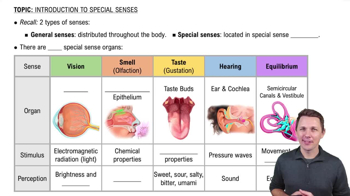
General senses
Senses distributed throughout the body, including temperature, pain, and pressure.
Special senses
Senses located in specific organs in the head, including vision, smell, taste, hearing, and equilibrium.
Vision
The sense that measures electromagnetic radiation, perceived as brightness and color.
Olfactory epithelium
Tissue in the nasal cavity responsible for detecting chemical properties perceived as odors.
Gustation
The sense of taste, detecting chemical properties of food as sweet, sour, salty, bitter, and umami.
Cochlea
A spiral-shaped organ in the ear that detects pressure waves, perceived as sound.
Equilibrium
The sense that measures movement and gravity, helping determine orientation and balance.
Electromagnetic radiation
Energy waves, including light, that are detected by the eyes for vision.
Olfactory bulb
A brain structure connected to the olfactory epithelium, processing smell information.
Taste buds
Sensory organs on the tongue that detect the five basic tastes.
Semicircular canals
Structures in the inner ear involved in detecting rotational movement for balance.
Vestibule
Part of the inner ear that helps sense linear movement and gravity for balance.
Brightness
The intensity of electromagnetic radiation perceived by the eyes.
Color
A perception based on the wavelength of light entering the eyes.
Pressure waves
Vibrations in the air detected by the ear, perceived as sound.
 BackBack
 5:05
5:05