Introduction to the Autonomic Nervous System quiz #1 Flashcards

Introduction to the Autonomic Nervous System quiz #1
Control buttons has been changed to "navigation" mode.
1/40
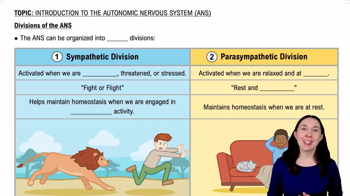
  • What are the two divisions of the autonomic nervous system?
    The two divisions of the autonomic nervous system are the sympathetic and parasympathetic divisions.
  • Which of the following would cause vasodilation of arterioles? A) Sympathetic activation B) Parasympathetic activation C) Increased heart rate D) Decreased heart rate
    B) Parasympathetic activation
  • Where is the vasomotor center located?
    The vasomotor center is located in the medulla oblongata of the brainstem.
  • Which nursing intervention can prevent a client from experiencing autonomic dysreflexia?
    Ensuring the bladder is emptied regularly and monitoring for bowel impaction can prevent autonomic dysreflexia.
  • Which of the following is not a function of the autonomic nervous system? A) Regulating heart rate B) Controlling digestion C) Voluntary muscle movement D) Managing blood pressure
    C) Voluntary muscle movement
  • Which of the following are controlled by the autonomic nervous system? A) Skeletal muscles B) Cardiac muscles C) Voluntary movements D) Reflex actions
    B) Cardiac muscles
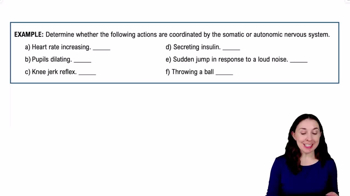
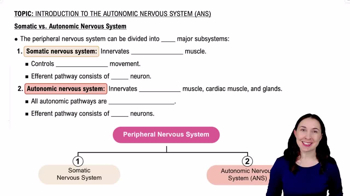
  • What is the primary difference between the somatic nervous system and the autonomic nervous system?
    The somatic nervous system controls voluntary movements, while the autonomic nervous system controls involuntary functions.
  • Which nursing intervention is the priority for a client in myasthenic crisis?
    Ensuring airway patency and providing respiratory support is the priority intervention.
  • Which of the following is controlled by the autonomic nervous system? A) Breathing B) Walking C) Writing D) Speaking
    A) Breathing
  • Which interview technique should you use when addressing a geriatric patient?
    Use clear, simple language and allow extra time for responses.
  • Which actions are functions of the somatic nervous system? Check all that apply. A) Walking B) Breathing C) Heartbeat D) Reflex actions
    A) Walking, D) Reflex actions
  • Which of the following is not an autonomic nervous system (ANS) function? A) Heart rate regulation B) Digestion control C) Voluntary muscle movement D) Blood pressure management
    C) Voluntary muscle movement
  • Which of the following adrenergic receptors increase cAMP levels? A) Alpha-1 B) Alpha-2 C) Beta-1 D) Beta-2
    C) Beta-1, D) Beta-2
  • Which of the following is a clinical characteristic of neurogenic shock? A) Hypertension B) Bradycardia C) Tachycardia D) Hyperthermia
    B) Bradycardia
  • Which target organ receives dual innervation?
    The heart receives dual innervation from both the sympathetic and parasympathetic nervous systems.
  • Which of the following is true regarding the autonomic nervous system? A) It controls voluntary movements B) It operates under conscious control C) It regulates involuntary functions D) It only affects skeletal muscles
    C) It regulates involuntary functions
  • The autonomic division of the PNS regulates the activity of which of these? A) Skeletal muscles B) Cardiac muscles C) Voluntary movements D) Reflex actions
    B) Cardiac muscles
  • Which of the following is correct about the autonomic nervous system (ANS)? A) It is part of the central nervous system B) It controls voluntary actions C) It regulates involuntary bodily functions D) It only affects the digestive system
    C) It regulates involuntary bodily functions
  • What is a function of the somatic nervous system?
    The somatic nervous system controls voluntary muscle movements.
  • What is the appropriate nursing intervention in dealing with a suicidal client?
    Ensure the client is in a safe environment and provide constant supervision.
  • What is the difference between the somatic and autonomic nervous systems?
    The somatic nervous system controls voluntary movements, while the autonomic nervous system controls involuntary functions.
  • Which cranial nerve is not involved in the parasympathetic nervous system? A) CN III B) CN VII C) CN IX D) CN XII
    D) CN XII
  • Which nervous system regulates conscious activities?
    The somatic nervous system regulates conscious activities.
  • Which of the following is not a vasoconstrictor? A) Norepinephrine B) Epinephrine C) Acetylcholine D) Angiotensin II
    C) Acetylcholine
  • Which of the following structures is not associated with the autonomic nervous system? A) Sympathetic chain ganglia B) Vagus nerve C) Spinal cord D) Skeletal muscles
    D) Skeletal muscles
  • Which part of the nervous system directly controls the digestive system?
    The autonomic nervous system, specifically the parasympathetic division, directly controls the digestive system.
  • Which behavior does the nurse observe in the client with anxious or fearful personality disorder?
    The client may exhibit avoidance of social situations and excessive worry.
  • Which nursing goal is a priority when caring for a client newly diagnosed with vertigo?
    Preventing falls and ensuring safety is a priority goal.
  • What are the differences between the somatic nervous system and autonomic nervous system?
    The somatic nervous system controls voluntary movements, while the autonomic nervous system controls involuntary functions.
  • Which of the following lowers blood pressure by reducing the sympathetic vasomotor response? A) Beta-blockers B) Alpha agonists C) Diuretics D) Calcium channel blockers
    A) Beta-blockers
  • Clinical manifestations of neurogenic shock include which of the following? Select all that apply. A) Hypotension B) Bradycardia C) Warm, dry skin D) Tachycardia
    A) Hypotension, B) Bradycardia, C) Warm, dry skin
  • Which of the following is true for preganglionic neurons? A) They are part of the somatic nervous system B) They release acetylcholine C) They are located in the central nervous system D) They innervate skeletal muscles
    B) They release acetylcholine, C) They are located in the central nervous system
  • Which of the following is a characteristic of the somatic nervous system? A) Involuntary control B) Single neuron pathway C) Dual innervation D) Controls cardiac muscles
    B) Single neuron pathway
  • The nervous system can trigger vasoconstriction and vasodilation. What effect does this have?
    Vasoconstriction increases blood pressure, while vasodilation decreases blood pressure.
  • Venoconstriction increases which of the following? A) Blood flow to the heart B) Blood pressure C) Heart rate D) Oxygen levels
    B) Blood pressure
  • What is the difference between the somatic and autonomic nervous system?
    The somatic nervous system controls voluntary movements, while the autonomic nervous system controls involuntary functions.
  • What is the difference between the autonomic nervous system and the somatic nervous system?
    The autonomic nervous system controls involuntary functions, while the somatic nervous system controls voluntary movements.
  • Which is an important strategy for a patient with receptive aphasia?
    Use simple language and visual aids to enhance understanding.
  • Which is usually under involuntary control?
    The autonomic nervous system is usually under involuntary control.
  • Which of these cranial nerves contains preganglionic parasympathetic fibers? A) CN III B) CN V C) CN VII D) CN X
    A) CN III, C) CN VII, D) CN X