Pearson+ LogoPearson+ Logo

Introduction to the Autonomic Nervous System quiz #2 Flashcards

Back
Introduction to the Autonomic Nervous System quiz #2
Control buttons has been changed to "navigation" mode.
1/40
  • What are priority actions for a client who is threatening self-harm?

    Ensure the client is in a safe environment and provide constant supervision.
  • Which treatment should take place immediately in a client experiencing autonomic dysreflexia?

    Elevate the head of the bed and remove any triggering stimuli.
  • What does it mean that the autonomic nervous system has “dual innervation”?

    Dual innervation means that most organs receive input from both the sympathetic and parasympathetic divisions, often with opposing effects.
  • Where would you not find a cholinergic nicotinic receptor? A) Neuromuscular junction B) Autonomic ganglia C) Adrenal medulla D) Cardiac muscle

    D) Cardiac muscle
  • Which part of the nervous system controls digestion?

    The autonomic nervous system, specifically the parasympathetic division, controls digestion.
  • Which of these effects on digestion is not produced by the parasympathetic nervous system? A) Increased salivation B) Increased gastric motility C) Decreased gastric secretion D) Relaxation of sphincters

    C) Decreased gastric secretion
  • Which of the following cranial nerves functions in parasympathetic processes? A) CN II B) CN III C) CN V D) CN X

    B) CN III, D) CN X
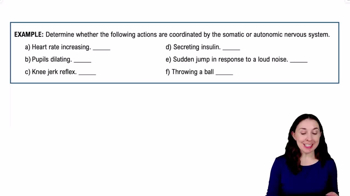
  • What is the difference between the somatic and autonomic division of the nervous system?

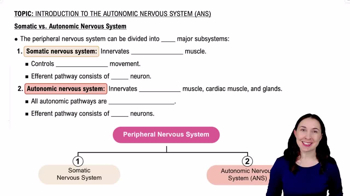
    The somatic division controls voluntary movements, while the autonomic division controls involuntary functions.
  • What are the origins of parasympathetic preganglionic neurons?

    Parasympathetic preganglionic neurons originate in the brainstem and sacral spinal cord.
  • Which of the following cranial nerves is not involved in the parasympathetic nervous system? A) CN III B) CN VII C) CN IX D) CN XI

    D) CN XI
  • Which one of the following divisions of the nervous system predominates during the relaxed state? A) Sympathetic B) Parasympathetic C) Somatic D) Central

    B) Parasympathetic
  • Which of the following statements concerning the autonomic nervous system is not true? A) It controls voluntary actions B) It regulates involuntary functions C) It has sympathetic and parasympathetic divisions D) It affects cardiac and smooth muscles

    A) It controls voluntary actions
  • The vasomotor center of the reticular formation does which of the following? A) Controls voluntary movements B) Regulates blood vessel diameter C) Manages digestive processes D) Controls skeletal muscles

    B) Regulates blood vessel diameter
  • Which of the following is true about the autonomic nervous system? A) It is part of the central nervous system B) It controls voluntary actions C) It regulates involuntary bodily functions D) It only affects the digestive system

    C) It regulates involuntary bodily functions
  • Where is the vasomotor center of the reticular formation located?

    The vasomotor center of the reticular formation is located in the medulla oblongata.
  • Cell bodies of pre-ganglionic autonomic motor neurons are found where?

    Cell bodies of pre-ganglionic autonomic motor neurons are found in the central nervous system.
  • Which of these statements is true about drinking alcohol and driving?

    Drinking alcohol impairs judgment and reaction time, making driving dangerous.
  • What are the two branches of the somatic nervous system?

    The somatic nervous system does not have branches like the autonomic system; it primarily controls voluntary movements.
  • Which nervous system is comprised of the somatic and autonomic nervous systems?

    The peripheral nervous system is comprised of the somatic and autonomic nervous systems.
  • How are the functions of the autonomic nervous system and the somatic nervous system different?

    The autonomic nervous system controls involuntary functions, while the somatic nervous system controls voluntary movements.
  • Which function is the somatic nervous system responsible for?

    The somatic nervous system is responsible for voluntary muscle movements.
  • Somatic nervous system controls?

    The somatic nervous system controls voluntary movements and reflex arcs.
  • What does the vagus nerve (CN X) innervate?

    The vagus nerve innervates the heart, lungs, and digestive tract, among other organs.
  • What are the two main divisions of the autonomic nervous system?

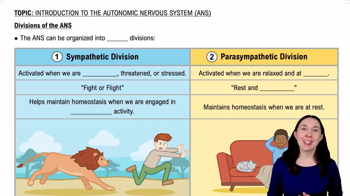
    The two main divisions are the sympathetic and parasympathetic nervous systems.
  • How does the somatic nervous system differ from the autonomic nervous system in terms of control?

    The somatic nervous system controls voluntary movements, while the autonomic nervous system controls involuntary functions.
  • Which types of tissues are innervated by the autonomic nervous system?

    The autonomic nervous system innervates smooth muscle, cardiac muscle, and glands.
  • How many neurons are involved in the efferent pathway of the autonomic nervous system?

    The autonomic nervous system uses two neurons in its efferent pathway.
  • When is the sympathetic division of the autonomic nervous system activated?

    The sympathetic division is activated during strong emotional arousal, stress, or physical activity.
  • What is the fight or flight response?

    The fight or flight response is the body's physiological reaction to perceived threats, mobilizing energy for action.
  • When is the parasympathetic division of the autonomic nervous system activated?

    The parasympathetic division is activated when the body is relaxed, calm, and at rest.
  • What is the primary function of the parasympathetic division?

    The parasympathetic division maintains homeostasis during rest and supports healthy digestion.
  • Do the sympathetic and parasympathetic divisions innervate the same organs?

    Yes, both divisions usually innervate the same organs but have opposite effects.
  • What is the main effect of the sympathetic division on the body during physical activity?

    It helps maintain homeostasis by increasing heart rate, blood flow to muscles, and oxygen intake.
  • What is the role of the autonomic nervous system in homeostasis?

    It maintains homeostasis by automatically adjusting bodily functions without conscious effort.
  • What type of response does the parasympathetic division produce in the body?

    It produces a calming, energy-conserving response.
  • What is an example of a situation that activates the sympathetic division?

    Feeling threatened, stressed, or excited, such as before a big presentation.
  • What is the main neurotransmitter used by the sympathetic division at the target organ?

    Norepinephrine is the main neurotransmitter at the target organ for the sympathetic division.
  • What is the effect of the sympathetic division on the digestive system?

    It inhibits digestion.
  • What is the general effect of the sympathetic division on the pupils of the eyes?

    It dilates the pupils.
  • What is the main difference in the efferent pathways of the somatic and autonomic nervous systems?

    The somatic system uses one neuron, while the autonomic system uses two neurons in its efferent pathway.