Pearson+ LogoPearson+ Logo
Back

Introduction to the Central Nervous System quiz #5

Control buttons has been changed to "navigation" mode.
1/39
  • What is the primary function of the central nervous system?

    The CNS functions as the control center for the human body, regulating basic life functions and higher cognitive processes.
  • What are the three main subdivisions of the diencephalon?

    The diencephalon consists of the thalamus, hypothalamus, and epithalamus.
  • What are the three major subdivisions of the brain stem?

    The brain stem consists of the midbrain, pons, and medulla oblongata.
  • Which part of the brain is responsible for complex cognitive processing, language, memory, and creativity?

    The cerebrum is responsible for complex cognitive processing, language, memory, and creativity.
  • Where is the diencephalon located within the brain?

    The diencephalon is located in the central part of the forebrain, internally within the brain.
  • What embryonic structure gives rise to the central nervous system?

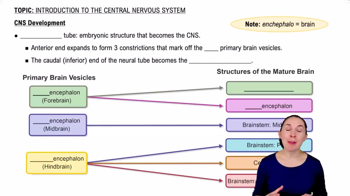
    The neural tube is the embryonic structure that develops into the CNS.
  • Which adult brain structures develop from the prosencephalon?

    The prosencephalon develops into the cerebrum and diencephalon.
  • Which structures arise from the rhombencephalon during development?

    The rhombencephalon develops into the pons, medulla oblongata, and cerebellum.
  • What is white matter primarily composed of?

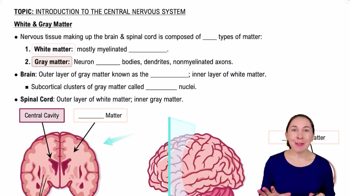
    White matter is primarily composed of myelinated axons.
  • What components make up gray matter?

    Gray matter consists of neuron cell bodies, dendrites, and nonmyelinated axons.
  • Where is the white matter located in the brain?

    White matter is located beneath the gray matter cortex in the brain.
  • What are basal nuclei?

    Basal nuclei are clusters of gray matter located beneath the cerebral cortex in the brain.
  • Which part of the CNS is responsible for regulating smooth and coordinated movement?

    The cerebellum is responsible for regulating smooth and coordinated movement.
  • What is the main function of the hypothalamus?

    The hypothalamus regulates homeostatic functions such as temperature, hunger, and hormone release.
  • What is the function of the pons?

    The pons relays signals between the cerebrum and cerebellum and assists in regulating breathing.
  • At what stage of embryonic development do the primary brain vesicles form?

    The primary brain vesicles form between the 3rd and 4th week of embryonic development.
  • What is the main difference between the forebrain, midbrain, and hindbrain in terms of their adult derivatives?

    The forebrain forms the cerebrum and diencephalon, the midbrain remains as the midbrain, and the hindbrain forms the pons, medulla oblongata, and cerebellum.
  • What is the function of the epithalamus?

    The epithalamus is involved in regulating circadian rhythms and includes the pineal gland.
  • What does the term 'central nervous system' refer to in human anatomy?

    The term 'central nervous system' refers to the brain and spinal cord, which function as the control center for the human body.
  • Which organs make up the central nervous system?

    The central nervous system is made up of the brain and the spinal cord.
  • What are the two main divisions of the nervous system?

    The two main divisions of the nervous system are the central nervous system (CNS) and the peripheral nervous system (PNS).
  • What are the primary components of the central nervous system?

    The primary components of the central nervous system are the brain and the spinal cord.
  • Which structures are included in the central nervous system?

    The central nervous system includes the brain and the spinal cord.
  • What are the major regions of the brain within the central nervous system?

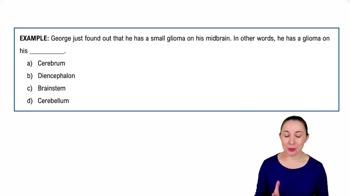
    The major regions of the brain are the cerebrum, diencephalon, brainstem, and cerebellum.
  • What is the function of the central nervous system?

    The central nervous system functions as the control center for the body, regulating basic functions like motor activity and survival, as well as complex processes such as cognition, language, memory, and creativity.
  • Which part of the brain is responsible for complex cognitive processing and creativity?

    The cerebrum is responsible for complex cognitive processing, language, memory, and creativity.
  • What is the role of the cerebellum in the central nervous system?

    The cerebellum coordinates and regulates motor activity, ensuring smooth and coordinated movement.
  • What are the subdivisions of the diencephalon?

    The diencephalon consists of the thalamus, hypothalamus, and epithalamus.
  • Which structures make up the brainstem?

    The brainstem is made up of the midbrain, pons, and medulla oblongata.
  • What is the largest part of the brain and what does it contain?

    The cerebrum is the largest part of the brain and contains the cerebral cortex.
  • How are white matter and gray matter distributed in the brain?

    In the brain, gray matter forms the outer layer called the cortex, while white matter is found beneath it. There are also subcortical clusters of gray matter called basal nuclei.
  • How are white matter and gray matter distributed in the spinal cord?

    In the spinal cord, white matter forms the outer layer and gray matter is found in the inner layer.
  • What embryonic structure gives rise to the central nervous system?

    The neural tube is the embryonic structure that develops into the central nervous system.
  • Which brain regions develop from the prosencephalon during embryonic development?

    The prosencephalon (forebrain) develops into the cerebrum and diencephalon.
  • Which brain region develops from the mesencephalon?

    The mesencephalon (midbrain) develops into the midbrain, which is part of the brainstem.
  • Which structures develop from the rhombencephalon?

    The rhombencephalon (hindbrain) develops into the pons, medulla oblongata, and cerebellum.
  • What is the main function of the brainstem?

    The brainstem connects the cerebrum to the spinal cord and is involved in basic life-sustaining functions.
  • What is the cerebral cortex and what is its appearance?

    The cerebral cortex is the outer layer of gray matter in the cerebrum, characterized by a wrinkled appearance.
  • What are basal nuclei and where are they located?

    Basal nuclei are clusters of gray matter located beneath the cortex (subcortical) in the brain.