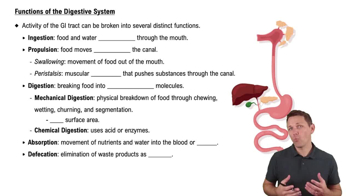
Which function is not part of the digestive system?
Respiration
Which statement about essential body fat is false?
It is stored in the liver
What is peristalsis?
Peristalsis is an involuntary muscular wave of contraction that pushes substances through the alimentary canal.
What is the most likely cause of choking among these options?
Eating dry bread
Which digestive organ has both endocrine and exocrine functions? a) Liver b) Stomach c) Gallbladder d) Pancreas
d) Pancreas
Which enzyme is important for the digestion of fat?
Lipase
Which liver function contributes to the process of digestion?
The liver produces bile, which helps in the emulsification of fats.
Which digestive organ has a highly folded surface?
The small intestine has a highly folded surface to increase surface area for absorption.
What essential role do large intestine bacteria play in the body?
Vitamin K production
What is an example of a monogastric animal?
Human
What type of macromolecule does pepsin digest?
Pepsin digests proteins.
What is the primary function of the large intestine?
The primary function of the large intestine is water absorption and waste excretion.
What breaks up the fat in a fat-soluble vitamin in our bodies?
Bile breaks up the fat in a fat-soluble vitamin to aid in its digestion and absorption.
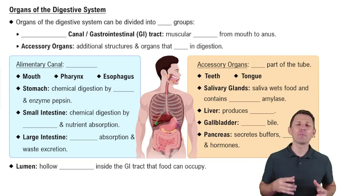
Which organ is not an accessory organ of digestion?
Esophagus
Which interventions would be recommended for a client with dysphagia? Select all that apply. a) Thickened liquids b) Pureed foods c) Carbonated beverages d) Large meals
a) Thickened liquids, b) Pureed foods
What is ingestion in the context of digestion?
Ingestion is the process of taking food and liquids into the mouth.
Which organ produces and secretes enzymes essential for proper digestion?
Pancreas
What are the three phases of gastric secretion?
The three phases of gastric secretion are the cephalic phase, gastric phase, and intestinal phase.
Which two organs help to break food down mechanically?
The teeth and the stomach help to break food down mechanically.
What is chyme?
Chyme is the partially digested food mixed with gastric juices found in the stomach and small intestine.
What is the most popular meal-planning approach used by diabetics?
The carbohydrate counting method is the most popular meal-planning approach used by diabetics.
Which organ(s) works with the digestive system to regulate blood sugar levels?
The pancreas works with the digestive system to regulate blood sugar levels by producing insulin and glucagon.
When caring for a client with acute pancreatitis, what is the most important nursing intervention?
The most important nursing intervention is to ensure the client is NPO (nothing by mouth) to rest the pancreas.
As wastes navigate the large intestine, what is primarily absorbed?
Water is primarily absorbed as wastes navigate the large intestine.
How is chyme different from a bolus?
Chyme is partially digested food mixed with gastric juices in the stomach, while a bolus is chewed food mixed with saliva in the mouth and esophagus.
Which large blood vessel transports nutrients from the small intestine directly to the liver?
The hepatic portal vein transports nutrients from the small intestine directly to the liver.
Nutrition support is needed if burns cover what proportion of total body surface area?
Nutrition support is needed if burns cover more than 20% of the total body surface area.
Which organ is not an accessory organ of the digestive system?
Stomach
What is the outermost layer of the digestive tract wall?
The outermost layer of the digestive tract wall is the serosa.
What foods should not be eaten while on spironolactone?
Foods high in potassium, such as bananas and oranges, should be avoided while on spironolactone.
Which of the enzymes produced in pancreatic juice breaks down carbohydrates into smaller components?
Amylase is the enzyme in pancreatic juice that breaks down carbohydrates into smaller components.
Which of these is an organ that helps produce enzymes for the digestive process? a) Liver b) Stomach c) Pancreas d) Gallbladder
c) Pancreas
What is the function of the cecum?
The cecum is involved in the absorption of fluids and salts that remain after intestinal digestion and absorption.
A client vomits postoperatively. What is the most important nursing intervention?
The most important nursing intervention is to ensure the client's airway is clear and to prevent aspiration.
What is the estimated average intake (EAR)?
The Estimated Average Requirement (EAR) is the daily nutrient intake level estimated to meet the requirements of half the healthy individuals in a particular life stage and gender group.
What statement does not pertain to the cephalic phase of gastric secretion?
The cephalic phase does not involve the direct presence of food in the stomach; it is triggered by the sight, smell, or thought of food.
The teeth and tongue contribute to which function of the digestive system?
The teeth and tongue contribute to mechanical digestion by chewing and manipulating food.
What is the role of the gut microbiome in human digestion?
The gut microbiome aids in the digestion of certain carbohydrates, synthesizes vitamins, and protects against harmful bacteria.
What is the inactive precursor of pepsin?
The inactive precursor of pepsin is pepsinogen.
What is the function of the enzymes secreted from the small intestine and the pancreas?
The enzymes secreted from the small intestine and the pancreas aid in the chemical digestion of carbohydrates, proteins, and fats.
 Back
Back
 4:06
4:06