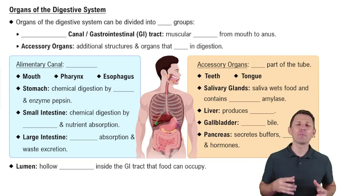
The two main groups are the alimentary canal (GI tract) and accessory organs.
Name three accessory organs of the digestive system.
Three accessory organs are the teeth, liver, and pancreas.
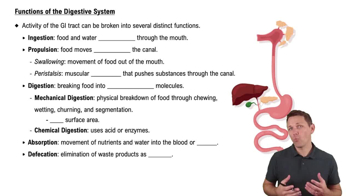
List the five key digestive processes.
The five key digestive processes are ingestion, propulsion, digestion, absorption, and defecation.
What is propulsion in the digestive system?
Propulsion is the movement of food through the alimentary canal, including swallowing and peristalsis.
What is mechanical digestion?
Mechanical digestion is the physical breakdown of food, such as chewing and churning.
Where does most nutrient absorption occur in the digestive system?
Most nutrient absorption occurs in the small intestine.
What is food called in the mouth and esophagus?
In the mouth and esophagus, food is called a bolus.
What is food called in the large intestine?
In the large intestine, food is called feces.
What is the role of the pharynx in the digestive system?
The pharynx is a passageway behind the mouth that connects to both the respiratory and digestive systems.
What happens to food in the stomach?
In the stomach, food is mixed with acid and enzymes, beginning chemical digestion and forming chyme.
What is the main function of the small intestine?
The main function of the small intestine is to complete chemical digestion and absorb nutrients.
What is the function of teeth in digestion?
Teeth physically break down food by chewing.
What do salivary glands do?
Salivary glands produce saliva, which wets food and contains enzymes like amylase to begin starch digestion.
What is the function of the gallbladder?
The gallbladder stores bile produced by the liver.
What is the function of the pancreas in digestion?
The pancreas secretes buffers to neutralize stomach acid and produces enzymes to digest all macromolecules.
What is the difference between the alimentary canal and accessory organs?
The alimentary canal is the continuous tube food passes through, while accessory organs aid digestion but are not part of the tube.
What is the role of enzymes in chemical digestion?
Enzymes break down complex food molecules into smaller, absorbable units.
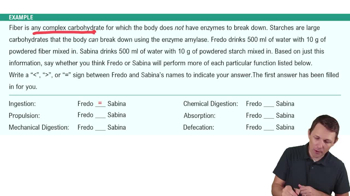
What is the function of amylase?
Amylase is an enzyme in saliva that breaks down starch into simple sugars.
What is the main function of the digestive system for the body?
The main function is to absorb nutrients and water from food into the blood or lymph.
What is the difference between voluntary and involuntary propulsion?
Swallowing is voluntary, while peristalsis is involuntary.
What is the function of buffers secreted by the pancreas?
Buffers neutralize stomach acid entering the small intestine.
What is the function of the GI tract's muscular walls?
The muscular walls of the GI tract help move and mix food through peristalsis and segmentation.
Where is bile produced and where is it stored?
Bile is produced in the liver and stored in the gallbladder.
What is the main function of the stomach in digestion?
The stomach mixes food with acid and enzymes to begin protein digestion and form chyme.
What is the fate of absorbed nutrients?
Absorbed nutrients enter the blood or lymph to be transported to body tissues.
What is the significance of the lumen in digestion?
The lumen is where food is processed and moved through the digestive tract until absorption or elimination.
What is the role of the digestive system in homeostasis?
The digestive system maintains homeostasis by providing nutrients and water to the body and eliminating waste.
What is the process by which food is moved from the mouth to the stomach?
Food is moved from the mouth to the stomach by swallowing and peristalsis.
What is chyme in the digestive system?
Chyme is the partially digested food mixed with gastric juices found in the stomach and small intestine during digestion.
What are the three main functions of the digestive system?
The three main functions of the digestive system are digestion (breaking down food), absorption (moving nutrients into the blood or lymph), and defecation (elimination of waste as feces).
What is the primary function of the digestive system?
The primary function of the digestive system is to convert food into nutrients that can be absorbed into the blood for use by the body.
What are the accessory organs of the digestive system?
Accessory organs of the digestive system include the teeth, tongue, salivary glands, liver, gallbladder, and pancreas.
Which organs make up the alimentary canal in the digestive system?
The alimentary canal consists of the mouth, pharynx, esophagus, stomach, small intestine, and large intestine.
What does the appendix do in the digestive system?
The provided materials do not specify a digestive function for the appendix.
What are the two types of digestion that occur in the digestive system?
The two types of digestion are mechanical digestion (physical breakdown of food) and chemical digestion (using acids and enzymes to break down food molecules).
What is the difference between the alimentary canal and accessory organs in the digestive system?
The alimentary canal is the continuous tube through which food travels, while accessory organs aid in digestion but are not part of the tube and do not directly contain food.
What are the stages food passes through as it moves along the digestive tract?
Food is called a bolus in the mouth and esophagus, chyme in the stomach and small intestine, and feces in the large intestine.
What is not a function of the digestive system?
Functions not performed by the digestive system include activities unrelated to food breakdown, nutrient absorption, or waste elimination, such as respiration or hormone production (except for digestive hormones produced by the pancreas).
 Back
Back
 4:06
4:06