Cortisol is a steroid hormone produced by the adrenal cortex that regulates metabolism and stress response.
What is the main difference between the endocrine and nervous system?
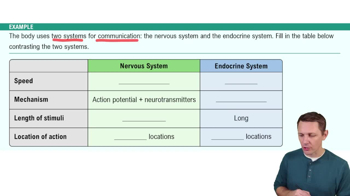
The main difference is that the endocrine system uses hormones for slower, long-lasting effects, while the nervous system uses electrical signals for rapid responses.
What education should the nurse provide to the patient taking long-term corticosteroids?
The nurse should educate the patient about potential side effects, such as weight gain and increased infection risk, and the importance of not abruptly stopping the medication.
What is the nurse’s priority action when administering phenytoin to a client intravenously?
The nurse's priority is to administer phenytoin slowly to prevent cardiovascular complications.
Which are embedded into the otolithic membrane?
Otoliths are embedded into the otolithic membrane.
What is the difference between an endocrine gland and an exocrine gland?
Endocrine glands secrete hormones into the bloodstream, while exocrine glands secrete substances through ducts to an epithelial surface.
Which hormone modulates FSH secretion and sperm production?
Inhibin modulates FSH secretion and sperm production.
Which organ produces testosterone?
The testes produce testosterone.
What are the nervous system and the endocrine system responsible for?
They are responsible for regulating body functions and maintaining homeostasis.
What is the difference between endocrine glands and exocrine glands?
Endocrine glands secrete hormones into the bloodstream, while exocrine glands secrete substances through ducts to an epithelial surface.
What is the primary function of the endocrine system?
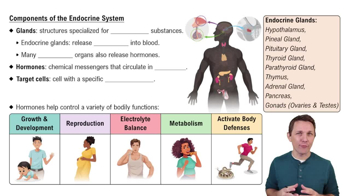
The endocrine system uses hormones as chemical messengers to regulate whole-body functions such as growth, metabolism, and stress response.
What is a hormone?
A hormone is a chemical messenger released by endocrine glands into the blood to regulate the activity of target cells with specific receptors.
What is autocrine signaling?
Autocrine signaling occurs when a cell releases a chemical messenger that binds to receptors on the same cell.
What is endocrine signaling?
Endocrine signaling involves hormones being released into the blood and traveling throughout the body to reach target cells with specific receptors.
What are endocrine glands?
Endocrine glands are specialized structures that secrete hormones directly into the bloodstream.
What is the role of the hypothalamus in the endocrine system?
The hypothalamus is a brain region that regulates homeostasis and connects the nervous and endocrine systems.
Where is the pituitary gland located and what is its function?
The pituitary gland is located below the hypothalamus and produces hormones that regulate other endocrine glands.
What do the parathyroid glands regulate?
The parathyroid glands regulate the body's calcium levels.
Where are the adrenal glands located and what is their main function?
The adrenal glands sit on top of the kidneys and are responsible for responding to stress.
What are the gonads and what hormones do they produce?
The gonads are the ovaries in females and testes in males; they produce sex hormones such as estrogen and testosterone.
What are target cells in the context of the endocrine system?
Target cells are cells that have specific receptors for a particular hormone and respond to its signal.
How do hormones help regulate growth and development?
Hormones coordinate anatomical and physiological changes from infancy through adolescence.
How does the endocrine system contribute to electrolyte balance?
The endocrine system signals the kidneys to adjust urine production, maintaining proper water and electrolyte levels in the blood.
How does the endocrine system activate body defenses?
Hormones like adrenaline trigger the fight or flight response and other stress-related defenses.
What are amino acid-based hormones?
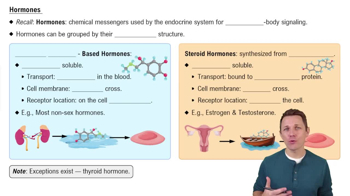
Amino acid-based hormones are water-soluble hormones derived from amino acids, peptides, or proteins.
How are amino acid-based hormones transported in the blood?
Amino acid-based hormones are water-soluble and dissolve directly in the blood.
Why can't most amino acid-based hormones cross the cell membrane?
They are hydrophilic and cannot pass through the hydrophobic lipid bilayer of the cell membrane.
How are steroid hormones transported in the blood?
Steroid hormones travel in the blood bound to transport proteins.
Why can steroid hormones cross the cell membrane?
Steroid hormones are hydrophobic and can pass through the lipid bilayer of the cell membrane.
What is a notable exception to the general rules of hormone classification?
Thyroid hormone is an amino acid-based hormone that is hydrophobic, requiring a transport protein and having intracellular receptors.
What is the main job of hormones released by endocrine glands?
Their main job is to send general messages about the body's state to target cells throughout the body.
What is the relationship between the hypothalamus and the pituitary gland?
The hypothalamus communicates with the pituitary gland to regulate the release of many hormones.
What is the role of estrogen and testosterone?
Estrogen and testosterone are steroid hormones that regulate reproductive functions.
What determines whether a cell is a target for a particular hormone?
A cell is a target if it has the specific receptor for that hormone.
What is the main difference in receptor location between amino acid-based and steroid hormones?
Amino acid-based hormone receptors are on the cell membrane, while steroid hormone receptors are inside the cell.
What is the significance of the lipid bilayer in hormone signaling?
The lipid bilayer prevents hydrophilic hormones from entering the cell, so their receptors must be on the cell surface.
What is the function of the pancreas in the endocrine system?
The pancreas releases hormones that regulate blood glucose levels.
What is the role of the thymus in childhood?
The thymus is active in childhood and helps develop the immune system.
What is the main function of the pineal gland?
The pineal gland regulates sleep and circadian rhythms.
What is the fight or flight response?
The fight or flight response is a rapid physiological reaction to stress, primarily triggered by adrenaline.
 Back
Back

 7:06
7:06