Skip to main content
Anatomy & Physiology
My Course
Learn
Exam Prep
AI Tutor
Study Guides
Textbook Solutions
Flashcards
Explore
Try the app
My Course
Learn
Exam Prep
AI Tutor
Study Guides
Textbook Solutions
Flashcards
Explore
Try the app
Back
Introduction to the Skeleton definitions
7 students found this helpful
You can tap to flip the card.
Axial Skeleton
You can tap to flip the card.
👆
Axial Skeleton
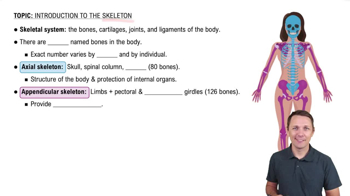
Comprises the skull, spinal column, and rib cage, providing structure and protection for internal organs.
Track progress
Control buttons has been changed to "navigation" mode.
1/15
Related flashcards
Related practice
Recommended videos
Introduction to the Skeleton quiz #1
Introduction to the Skeleton
38 Terms
Introduction to the Skeleton quiz #2
Introduction to the Skeleton
27 Terms
Introduction to the Skeleton quiz #3
Introduction to the Skeleton
16 Terms
Introduction to the Skeleton
7. The Skeletal System
3 problems
Topic
Bruce
The Skull
7. The Skeletal System
4 problems
Topic
Bruce
7. The Skeletal System - Part 1 of 2
7 topics
14 problems
Chapter
Bruce
7. The Skeletal System - Part 2 of 2
1 topic
2 problems
Chapter
Jason
4:50
Skeletal System
16271
views
557
rank
1
comments
Terms in this set (15)
Hide definitions
Axial Skeleton
Comprises the skull, spinal column, and rib cage, providing structure and protection for internal organs.
Appendicular Skeleton
Includes limbs and girdles, facilitating movement by attaching to the axial skeleton.
Sesamoid Bones
Small bones that develop in tendons, often found in hands and feet, varying among individuals.
Pectoral Girdle
Consists of shoulder blades and collarbones, attaching arms to the axial skeleton.
Pelvic Girdle
Composed of hip bones, connecting legs to the axial skeleton.
Rib Cage
Part of the axial skeleton, includes ribs and sternum, protecting thoracic organs.
Vertebrae
Bones forming the spinal column, part of the axial skeleton, providing support and protection.
Coxal Bones
Hip bones forming part of the pelvic girdle, supporting body weight in sitting and standing.
Skull
Bone structure in the axial skeleton, encasing and protecting the brain.
Ligaments
Connective tissues linking bones, contributing to joint stability and movement.
Cartilages
Flexible connective tissues in joints, aiding in smooth movement and cushioning.
Joints
Structures where two or more bones meet, allowing for movement and flexibility.
Sternum
Central bone in the rib cage, connecting ribs and providing chest structure.
Anatomical Model
A representation of the human skeleton used for educational purposes.
Human Variation
Differences in bone number and structure among individuals, influenced by genetics and development.
 BackBack

 4:50
4:50