Avoid alcohol and antacids containing magnesium trisilicate while taking nitrofurantoin, as they can interfere with the medication's effectiveness.
What is not a function of the urinary system?
Production of insulin
How do most nitrogenous wastes originate?
Most nitrogenous wastes originate from the breakdown of proteins and nucleic acids in the body.
Which of the choices below is not a function of the urinary system? a) Regulation of electrolyte balance b) Production of erythropoietin c) Digestion of food d) Excretion of metabolic wastes
c) Digestion of food
Which client will the nurse monitor closely for signs and symptoms of constipation?
The nurse will monitor clients taking medications that can cause constipation, such as opioids, or those with limited mobility or dietary fiber intake.
To which client should the nurse anticipate administering mannitol?
The nurse should anticipate administering mannitol to clients with increased intracranial pressure or acute kidney injury to promote diuresis.
In a client with nephrotic syndrome, what is a common symptom?
A common symptom in a client with nephrotic syndrome is edema due to significant proteinuria and hypoalbuminemia.
Which organ system carries waste to different parts of the horse's excretory system?
The circulatory system carries waste to different parts of the horse's excretory system.
Which renal tubule segments are influenced by aldosterone?
The distal convoluted tubule and the collecting duct are influenced by aldosterone.
Which diuretic medication conserves potassium?
Potassium-sparing diuretics, such as spironolactone, conserve potassium.
What is the process of separating wastes from body fluids and eliminating them from the body called?
The process is called excretion.
Which organ removes metabolic waste products from the blood?
Kidneys
Which type of dialysis occurs outside of the patient's body?
Hemodialysis occurs outside of the patient's body.
What substances does the excretory system create to get rid of waste?
The excretory system creates urine to get rid of waste.
What is formed as wastes and excess water are removed from the blood and excreted by the kidneys?
Urine is formed as wastes and excess water are removed from the blood and excreted by the kidneys.
What is the process of removing wastes from the body?
The process is called excretion.
Which form of dialysis filters waste products directly from the patient's blood?
Hemodialysis filters waste products directly from the patient's blood.
Which organ is most affected by hyponatremia?
The brain is most affected by hyponatremia.
Which of these conditions refers to a lack of voluntary control over urination?
Incontinence refers to a lack of voluntary control over urination.
What organ is primarily responsible for water absorption?
The kidneys are primarily responsible for water absorption.
How does an artificial kidney machine carry out dialysis?
An artificial kidney machine carries out dialysis by filtering waste products from the blood through a semipermeable membrane.
What structures merge to form a papillary duct?
Collecting ducts merge to form a papillary duct.
What collects in a renal papilla?
Urine collects in a renal papilla before entering the minor calyx.
What is the process by which excess water and waste products are removed from the blood?
The process is called filtration.
What is the value of transitional epithelium in the urinary system?
Transitional epithelium allows the urinary bladder to stretch and accommodate varying volumes of urine.
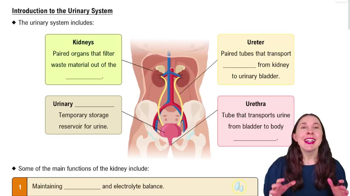
What are the major roles of the urinary system?
The major roles of the urinary system include filtering blood, excreting waste, regulating fluid and electrolyte balance, and maintaining blood pressure.
Which part of the brain controls the micturition (urination) reflex?
The pons in the brainstem controls the micturition reflex.
What initiates the micturition reflex?
The micturition reflex is initiated by the stretching of the bladder wall.
What would happen if the kidneys could not produce erythropoietin (EPO)?
If the kidneys could not produce EPO, it would lead to anemia due to reduced red blood cell production.
Which is not a function of the urinary system? a) Regulation of blood pressure b) Production of insulin c) Excretion of metabolic wastes d) Maintenance of acid-base balance
b) Production of insulin
A client is recovering from an attack of gout. What will the nurse include in the client teaching?
The nurse will teach the client to avoid foods high in purines, stay hydrated, and possibly take medications to lower uric acid levels.
In which critical role does the urinary system play a part?
Blood pressure regulation
Which body system filters wastes from the blood and helps to regulate fluid balance?
The urinary system filters wastes from the blood and helps to regulate fluid balance.
Which intervention is the priority for a patient with renal calculi?
Pain management and hydration are priorities for a patient with renal calculi.
Which system in the human body functions primarily to remove wastes from the body?
The urinary system functions primarily to remove wastes from the body.
What functions do you think a dialysis machine has to perform to act as an artificial kidney?
A dialysis machine must filter waste, balance electrolytes, and remove excess fluid from the blood to act as an artificial kidney.
 Back
Back


 0:54
0:54