Skip to main content
Anatomy & Physiology
My Course
Learn
Exam Prep
AI Tutor
Study Guides
Textbook Solutions
Flashcards
Explore
Try the app
My Course
Learn
Exam Prep
AI Tutor
Study Guides
Textbook Solutions
Flashcards
Explore
Try the app
Back
Introduction to Tissues & Histology definitions
20 students found this helpful
You can tap to flip the card.
Epithelial Tissue
You can tap to flip the card.
👆
Epithelial Tissue
Covers surfaces, lines cavities, and forms glands, with subtypes like covering, lining, and glandular epithelia.
Track progress
Control buttons has been changed to "navigation" mode.
1/15
Related flashcards
Related practice
Recommended videos
Introduction to Tissues & Histology quiz #1
Introduction to Tissues & Histology
39 Terms
Introduction to Tissues & Histology quiz #2
Introduction to Tissues & Histology
26 Terms
Introduction to Tissues & Histology quiz #3
Introduction to Tissues & Histology
10 Terms
Introduction to Tissues & Histology
4. Tissues & Histology
4 problems
Topic
Bruce
Introduction to Epithelial Tissue
4. Tissues & Histology
3 problems
Topic
4. Tissues & Histology - Part 1 of 2
9 topics
14 problems
Chapter
Bruce
4. Tissues & Histology - Part 2 of 2
12 topics
16 problems
Chapter
Bruce
03:32
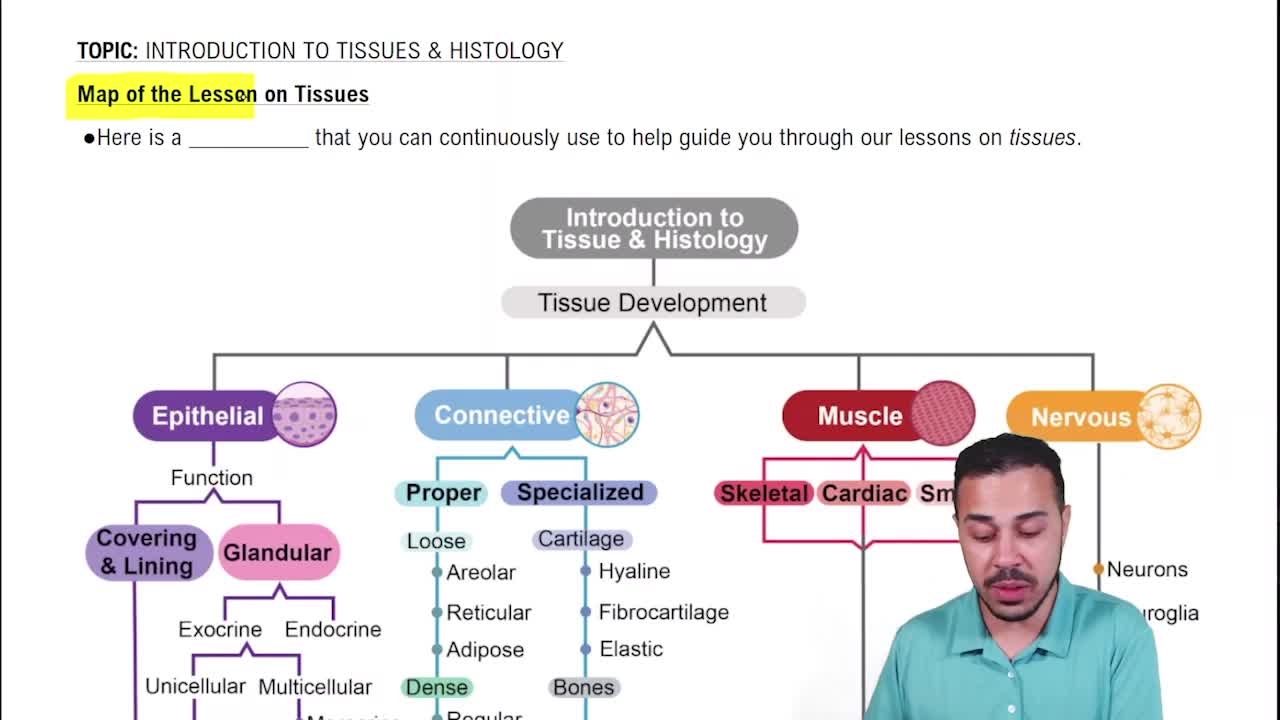
Map of the Lesson on Tissues
14843
views
678
rank
2
comments
02:52
What is Histology?
14924
views
339
rank
04:14
Intro to Human Tissues
24277
views
880
rank
Terms in this set (15)
Hide definitions
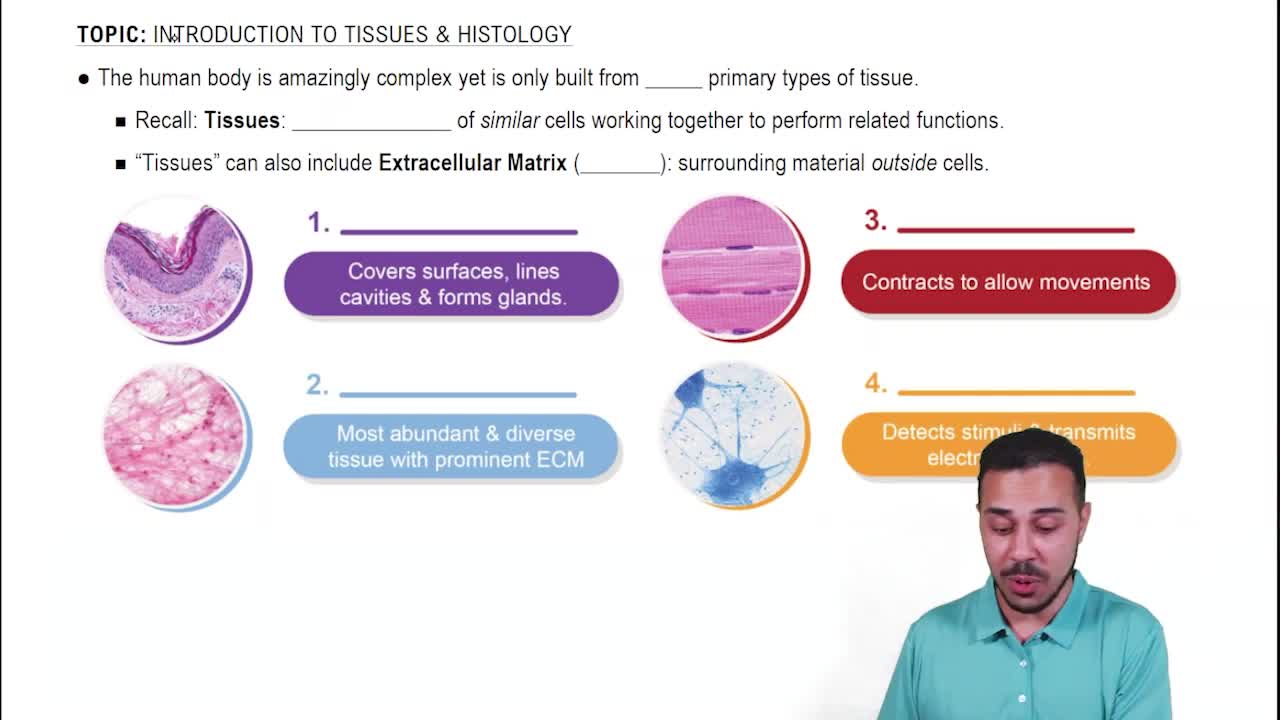
Epithelial Tissue
Covers surfaces, lines cavities, and forms glands, with subtypes like covering, lining, and glandular epithelia.
Connective Tissue
Most abundant and diverse tissue, with a prominent extracellular matrix, includes cartilage, bones, and blood.
Muscle Tissue
Responsible for contraction and body movements, includes skeletal, cardiac, and smooth muscle types.
Nervous Tissue
Detects stimuli and transmits electrical signals, composed of neurons and neuroglia.
Extracellular Matrix
Surrounding material outside cells, crucial for tissue structure and function, varies in prominence among tissues.
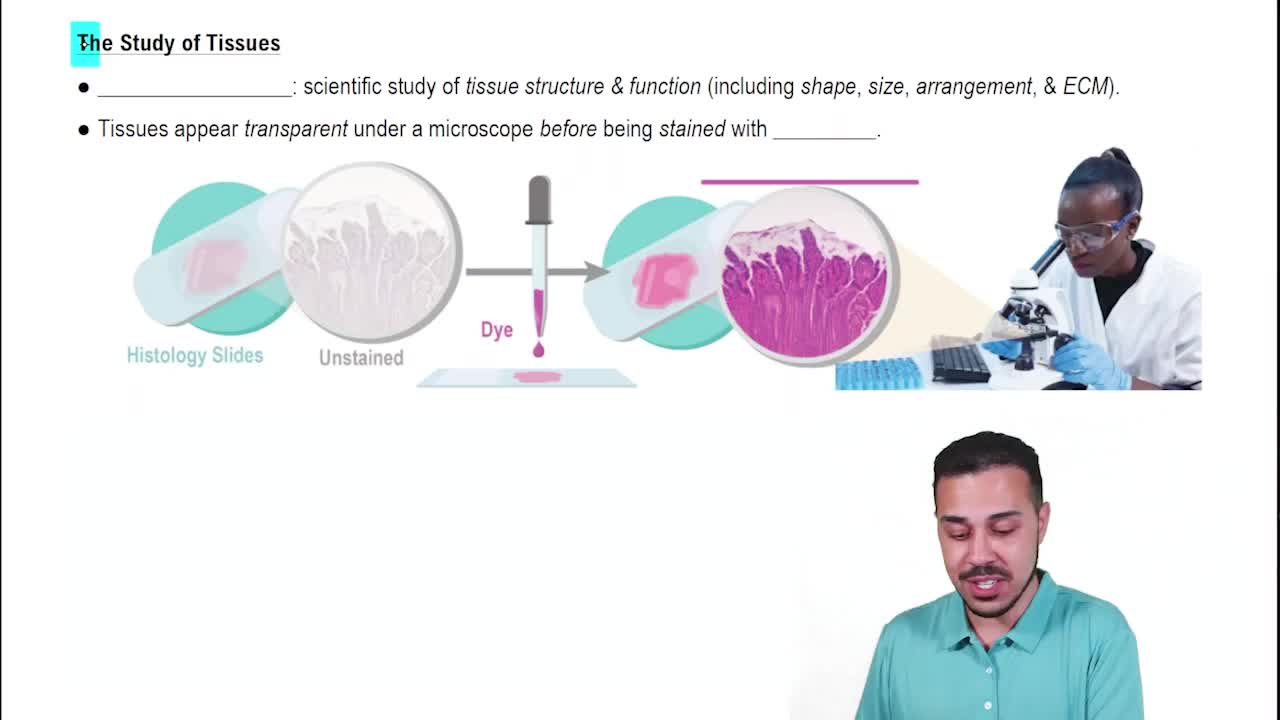
Histology
Scientific study of tissue structure and function, involves microscopy and staining techniques.
Staining
Technique to enhance tissue visibility under a microscope by adding dyes for better contrast.
Micrograph
Image of tissue viewed under a microscope, often stained to improve visualization.
Glandular Epithelia
Type of epithelial tissue involved in secretion, includes exocrine and endocrine glands.
Connective Tissue Proper
Includes loose and dense connective tissues, with subtypes like areolar, reticular, and adipose.
Cartilage
Specialized connective tissue, includes hyaline, fibrocartilage, and elastic types.
Neurons
Cells in nervous tissue responsible for transmitting electrical signals.
Neuroglia
Supportive cells in nervous tissue that assist neurons.
Membranes
Structures that support and separate body tissues, involved in tissue repair processes.
Tissue Repair
Process of restoring tissue structure and function after damage.
 BackBack
 03:32
03:32