Introduction to Translation definitions Flashcards

Introduction to Translation definitions
Control buttons has been changed to "navigation" mode.
1/15
  • Translation
    The process of protein synthesis using mRNA's encoded messages, involving ribosomes and tRNAs.
  • Ribosome
    Complex structures made of proteins and rRNA, essential for protein synthesis during translation.
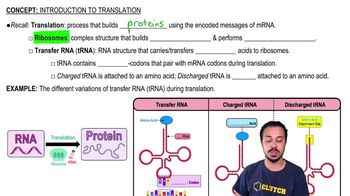
  • tRNA
    RNA molecules that transfer amino acids to ribosomes, containing anticodons for mRNA pairing.
  • Anticodon
    A sequence of three nucleotides in tRNA that pairs with a complementary mRNA codon.
  • mRNA
    Messenger RNA that carries genetic information from DNA to ribosomes for protein synthesis.
  • Charged tRNA
    A tRNA molecule attached to an amino acid, ready to participate in protein synthesis.
  • Discharged tRNA
    A tRNA molecule that is not attached to an amino acid after transferring it to the ribosome.
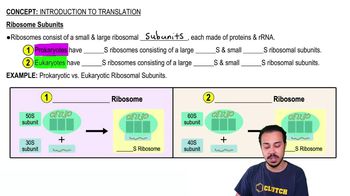
  • 70S Ribosome
    The complete ribosome in prokaryotes, composed of 50S and 30S subunits.
  • 80S Ribosome
    The complete ribosome in eukaryotes, composed of 60S and 40S subunits.
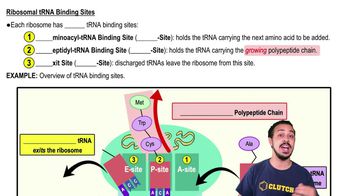
  • A Site
    The ribosomal site where charged tRNAs enter, carrying the next amino acid to be added.
  • P Site
    The ribosomal site holding tRNA with the growing polypeptide chain during translation.
  • E Site
    The ribosomal exit site for discharged tRNAs after amino acid transfer.
  • Svedberg Unit
    A unit measuring sedimentation rate, used to describe ribosomal subunit sizes.
  • rRNA
    Ribosomal RNA, a structural component of ribosomes, crucial for protein synthesis.
  • Polypeptide Chain
    A sequence of amino acids linked by peptide bonds, forming a protein during translation.