Isotopes definitions Flashcards
You can tap to flip the card.
Control buttons has been changed to "navigation" mode.
1/14
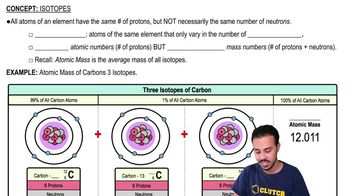
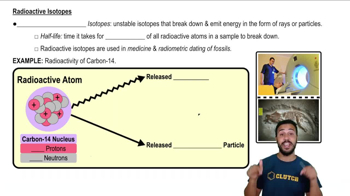
IsotopesAtoms of the same element with identical proton numbers but differing neutron counts, resulting in different mass numbers.ProtonsPositively charged particles in an atom's nucleus, determining the element's identity and atomic number.NeutronsNeutral particles in an atom's nucleus, varying in number among isotopes of the same element.Atomic NumberThe number of protons in an atom's nucleus, defining the element and its position in the periodic table.Mass NumberThe sum of protons and neutrons in an atom's nucleus, differing among isotopes of the same element.Atomic MassThe weighted average mass of an element's isotopes, considering their relative abundances.Carbon-12The most abundant carbon isotope, with 6 protons and 6 neutrons, making up 99% of carbon atoms.Carbon-13A carbon isotope with 6 protons and 7 neutrons, contributing to the atomic mass of carbon.Carbon-14A radioactive carbon isotope with 6 protons and 8 neutrons, used in radiometric dating.Radioactive IsotopesUnstable isotopes that decay over time, emitting energy and particles, used in medicine and dating.Half-lifeThe time required for half of a radioactive isotope sample to decay, used in dating and medical applications.Radiometric DatingA technique using radioactive isotopes to determine the age of fossils by measuring isotope decay.ElectronsNegatively charged particles orbiting an atom's nucleus, not varying among isotopes of the same element.NucleusThe central part of an atom containing protons and neutrons, determining the atom's mass and stability.