Anatomy & Physiology
My Course
Learn
Exam Prep
AI Tutor
Study Guides
Textbook Solutions
Flashcards
Explore
My Course
Learn
Exam Prep
AI Tutor
Study Guides
Textbook Solutions
Flashcards
Explore
Back
Lipid Vitamins quiz
You can tap to flip the card.
Define:
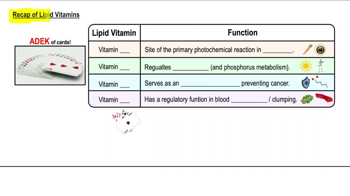
What are the four fat-soluble vitamins?
You can tap to flip the card.
👆
What are the four fat-soluble vitamins?
The four fat-soluble vitamins are vitamins A, D, E, and K.
Track progress
Control buttons has been changed to "navigation" mode.
1/10
Related flashcards
Recommended videos
Lipid Vitamins definitions
Lipid Vitamins
15 Terms
Lipid Vitamins quiz #1
Lipid Vitamins
10 Terms
Guided course
02:27
Lipid Vitamins
Bruce Bryan
1839
views
35
rank
Guided course
02:33
Vitamin A
Bruce Bryan
1556
views
25
rank
Guided course
01:50
Vitamin D
Bruce Bryan
1344
views
28
rank
Terms in this set (10)
Hide definitions
What are the four fat-soluble vitamins?
The four fat-soluble vitamins are vitamins A, D, E, and K.
Which organ can store the four fat-soluble vitamins?
The liver can store the four fat-soluble vitamins.
What is the mnemonic to remember the lipid vitamins?
The mnemonic to remember the lipid vitamins is 'A Deck' (A, D, E, K).
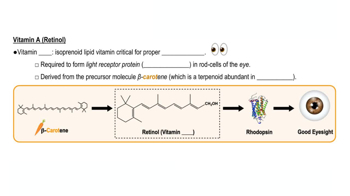
What is the primary function of vitamin A?
Vitamin A is crucial for eyesight and is required to form the light receptor protein rhodopsin in the eyes.
How is vitamin D formed in the body?
Vitamin D is formed in the body through the conversion of cholesterol with the help of ultraviolet light from the sun.
What role does vitamin E play in the body?
Vitamin E acts as an antioxidant, protecting cells from free radicals and helping to prevent cancer.
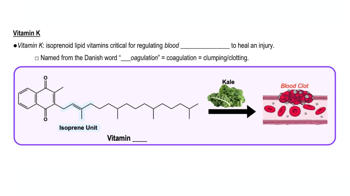
Why is vitamin K important for the body?
Vitamin K is essential for blood clotting, which helps heal injuries.
From which precursor is vitamin A derived?
Vitamin A is derived from the precursor molecule beta carotene, which is abundant in carrots.
What is the relationship between vitamin D and bone health?
Vitamin D increases calcium absorption, leading to strong and healthy bones.
Which vitamin is associated with the regulation of calcium and phosphorus metabolism?
Vitamin D is associated with the regulation of calcium and phosphorus metabolism.