Lipids definitions Flashcards

Lipids definitions
Control buttons has been changed to "navigation" mode.
1/15
  • Lipids
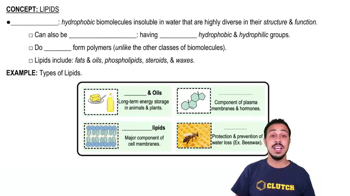
    Diverse hydrophobic biomolecules that do not form polymers, including fats, oils, phospholipids, steroids, and waxes.
  • Fatty acids
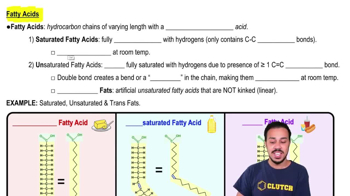
    Hydrocarbon chains with a carboxylic acid group; can be saturated or unsaturated.
  • Saturated fatty acids
    Fatty acids fully saturated with hydrogens, containing only single bonds, solid at room temperature.
  • Unsaturated fatty acids
    Fatty acids with one or more double bonds, causing kinks, liquid at room temperature.
  • Trans fatty acids
    Artificial unsaturated fatty acids with a double bond but no kink, often found in processed foods.
  • Triglycerides
    Lipids formed by three fatty acids linked to a glycerol molecule, primary fat storage in animals.
  • Glycerol
    A three-carbon molecule that forms the backbone of triglycerides and phospholipids.
  • Phospholipids
    Amphipathic lipids with a phosphate group, major component of cell membranes.
  • Amphipathic
    Molecules containing both hydrophilic and hydrophobic groups.
  • Steroids
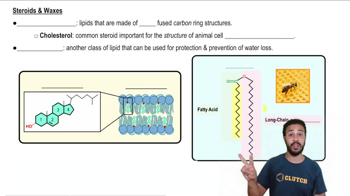
    Lipids with four fused carbon rings, important for cell membrane structure and as hormones.
  • Cholesterol
    A steroid crucial for animal cell membrane structure, composed of four fused carbon rings.
  • Waxes
    Lipids composed of long-chain alcohols and fatty acids, used for protection and water loss prevention.
  • Hydrophobic
    Describes molecules that are water-fearing and do not mix well with water.
  • Hydrophilic
    Describes molecules that are water-loving and interact well with water.
  • Dehydration synthesis
    A chemical reaction that builds molecules by removing water, used in forming triglycerides.