Skip to main content
Anatomy & Physiology
My Course
Learn
Exam Prep
AI Tutor
Study Guides
Textbook Solutions
Flashcards
Explore
Try the app
My Course
Learn
Exam Prep
AI Tutor
Study Guides
Textbook Solutions
Flashcards
Explore
Try the app
Back
Lung Volumes and Capacities definitions
You can tap to flip the card.
Tidal Volume
You can tap to flip the card.
👆
Tidal Volume
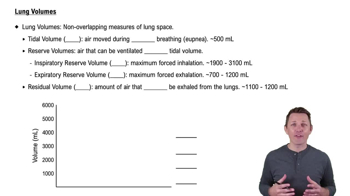
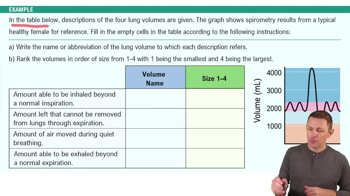
The amount of air moved during quiet breathing, approximately 500 milliliters for both males and females.
Track progress
Control buttons has been changed to "navigation" mode.
1/15
Related flashcards
Related practice
Recommended videos
Lung Volumes and Capacities quiz
Lung Volumes and Capacities
11 Terms
Lung Volumes and Capacities quiz #1
Lung Volumes and Capacities
11 Terms
Lung Volumes and Capacities
22. The Respiratory System
2 problems
Topic
Bruce
Law of Partial Pressure
22. The Respiratory System
3 problems
Topic
Jason
22. The Respiratory System - Part 1 of 2
5 topics
9 problems
Chapter
Bruce
22. The Respiratory System - Part 2 of 2
1 topic
2 problems
Chapter
6:38
Lung Capacities
4428
views
84
rank
6:28
Lung Volumes
5370
views
116
rank
1
comments
4:45
Lung Volumes and Capacities Example 1
4250
views
74
rank
Terms in this set (15)
Hide definitions
Tidal Volume
The amount of air moved during quiet breathing, approximately 500 milliliters for both males and females.
Inspiratory Reserve Volume
Additional air that can be inhaled after a normal breath, ranging from 1900 to 3100 milliliters.
Expiratory Reserve Volume
Additional air that can be exhaled after a normal breath, ranging from 700 to 1200 milliliters.
Residual Volume
Air remaining in the lungs after maximum exhalation, typically between 1100 to 1200 milliliters.
Inspiratory Capacity
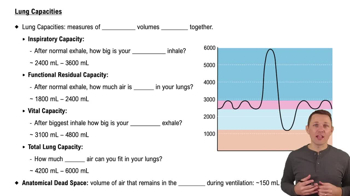
Maximum air that can be inhaled after a normal exhale, about 2400 to 3600 milliliters.
Functional Residual Capacity
Amount of air left in the lungs after a normal exhale, around 1800 to 2400 milliliters.
Vital Capacity
Total air that can be exhaled after a maximum inhalation, approximately 3100 to 4800 milliliters.
Total Lung Capacity
Sum of all lung volumes, about 4200 to 6000 milliliters, including anatomical dead space.
Anatomical Dead Space
Volume of air remaining in the airway during ventilation, approximately 150 milliliters.
Ventilation
The movement of air in and out of the lungs, crucial for gas exchange.
Alveoli
Tiny air sacs in the lungs where gas exchange occurs, essential for oxygen and carbon dioxide transfer.
Bronchi
Major air passages of the lungs that diverge from the windpipe, conducting air to the alveoli.
Trachea
The windpipe, a tube that connects the larynx to the bronchi, allowing air passage to the lungs.
Upper Respiratory Tract
Part of the respiratory system including the nose, nasal passages, and throat.
Eupnea
Normal, unlabored breathing, typically involving tidal volume.
 BackBack

 6:38
6:38