Which muscles are primarily responsible for plantar flexion?
The gastrocnemius and soleus muscles are primarily responsible for plantar flexion.
Which muscle relaxes when the arm flexes?
The triceps brachii relaxes when the arm flexes.
What type of stretching features contracting a muscle prior to stretching?
Proprioceptive Neuromuscular Facilitation (PNF) stretching features contracting a muscle prior to stretching.
What is the action of the trapezius?
The trapezius is responsible for moving, rotating, and stabilizing the scapula and extending the neck.
Which two characteristics describe adduction?
Adduction is characterized by movement toward the midline of the body and decreasing the angle between body parts.
Which muscle motion is used for shrugging the shoulders?
The trapezius muscle is used for shrugging the shoulders.
Which muscles flex the forearm?
The biceps brachii and brachialis muscles flex the forearm.
Which three of the following are actions of the teres major? Options: a) Adduction of the arm, b) Abduction of the arm, c) Medial rotation of the arm, d) Lateral rotation of the arm, e) Extension of the arm
The actions of the teres major are: a) Adduction of the arm, c) Medial rotation of the arm, e) Extension of the arm.
Which muscle relaxes to allow the elbow to flex?
The triceps brachii relaxes to allow the elbow to flex.
Which muscles insert to the posterior calcaneus via the calcaneal tendon?
Gastrocnemius and Soleus insert to the posterior calcaneus via the calcaneal tendon.
Which muscle relaxes to allow the elbow to extend?
The biceps brachii relaxes to allow the elbow to extend.
Which muscle extends the knee?
Quadriceps femoris extends the knee.
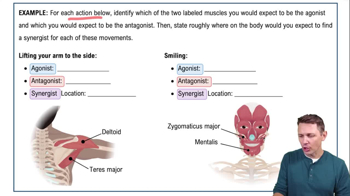
Which muscle elevates the shoulders?
The trapezius muscle elevates the shoulders.
Which muscle contracts to extend the elbow?
The triceps brachii contracts to extend the elbow.
What structure attaches a muscle to a bone?
A tendon attaches a muscle to a bone.
Which muscle is responsible for rotation of the scapula and depression of the shoulder?
The trapezius muscle is responsible for rotation of the scapula and depression of the shoulder.
Which muscle does not flex the forearm?
Triceps brachii does not flex the forearm.
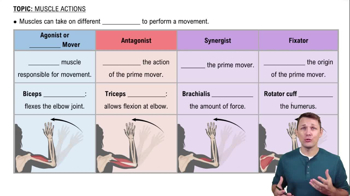
In the example of bending the arms at the elbow, which muscle acts as the agonist?
In bending the arms at the elbow, the biceps brachii acts as the agonist.
What structure attaches muscle to bone?
A tendon attaches muscle to bone.
What structures attach muscles to bones?
Tendons attach muscles to bones.
Which muscle is responsible for flexion of the thigh at the hip?
Iliopsoas is responsible for flexion of the thigh at the hip.
Which movement is antagonistic to extension?
Flexion is antagonistic to extension.
Muscles can act in different ways during a particular movement. What is the role of the antagonist?
The role of the antagonist is to oppose the action of the agonist, allowing controlled movement.
Which muscle closes the lips?
The orbicularis oris muscle closes the lips.
Which two muscle groups work as antagonistic pairs in the leg?
The quadriceps and hamstrings work as antagonistic pairs in the leg.
What is one example of an antagonist pair of muscles?
An example of an antagonist pair of muscles is the biceps brachii and triceps brachii.
Which muscle contracts to flex the elbow?
The biceps brachii contracts to flex the elbow.
Which action is not performed concentrically by the trapezius muscle?
Flexion of the neck is not performed concentrically by the trapezius muscle.
What muscle is responsible for plantar flexion and inversion of the foot?
The tibialis posterior is responsible for plantar flexion and inversion of the foot.
The latissimus dorsi has several actions. What are the three actions of the latissimus dorsi?
The three actions of the latissimus dorsi are extension, adduction, and medial rotation of the arm.
Does a muscle perform an action when it is contracting or relaxing?
A muscle performs an action when it is contracting.
Which muscle does not act in plantar flexion?
Tibialis anterior does not act in plantar flexion.
Which muscle is not involved in plantar flexing the foot?
The tibialis anterior is not involved in plantar flexing the foot.
Which muscle is primarily responsible for flexion of the elbow?
The biceps brachii is primarily responsible for flexion of the elbow.
 Back
Back
 3:55
3:55