What is the benefit of having both agonist and antagonist muscles at a joint?
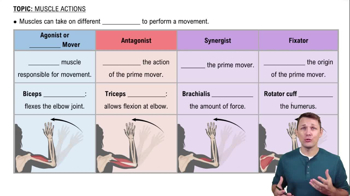
Having both allows for controlled movement in both directions and joint stability.
How do muscles act as levers in the body?
Muscles attach to bones and contract to move them around joints, acting as levers to produce movement.
What is the role of muscle tone in stabilizing joints?
Muscle tone provides a constant, low-level contraction that helps stabilize joints even at rest.
How do synergists and fixators work together during complex movements?
Synergists assist the prime mover, while fixators stabilize the origin, ensuring efficient and controlled movement.
Why is it important to understand the different roles muscles play during movement?
Understanding these roles helps explain how movements are coordinated and how injuries can be prevented.
What would happen if the antagonist muscle contracted at the same time as the agonist?
If both contracted simultaneously, movement would be restricted or prevented, and joint strain could occur.
How does the nervous system coordinate the actions of agonist and antagonist muscles?
The nervous system sends signals to contract the agonist while inhibiting the antagonist, allowing smooth movement.
What is the significance of muscle roles in rehabilitation and physical therapy?
Understanding muscle roles helps target specific muscles for strengthening or relaxation during rehabilitation.
What is the main function of a fixator muscle during movement?
A fixator stabilizes the origin of the prime mover, allowing effective and controlled movement by holding certain body parts steady.
How do agonist and antagonist muscles work together to produce movement at a joint?
The agonist contracts to create movement while the antagonist relaxes to allow that movement, working in opposition to control and stabilize the joint.
What is the function of a synergist muscle?
A synergist muscle aids the prime mover by working together to enhance a movement.
Which muscle group extends the thigh and flexes the knee?
The hamstring muscle group extends the thigh and flexes the knee.
Which muscle group is responsible for extending the knee?
The quadriceps femoris muscle group is responsible for extending the knee.
Which muscle causes wrinkles across the forehead?
The frontalis muscle causes wrinkles across the forehead.
Which muscle is responsible for extending the elbow?
The triceps brachii muscle is responsible for extending the elbow.
What is the action of the biceps brachii muscle?
The biceps brachii muscle flexes the elbow joint.
What is the function of the sternocleidomastoid muscle?
The sternocleidomastoid muscle flexes and rotates the head.
What is the action of the pectoralis major muscle?
The pectoralis major muscle adducts and flexes the arm at the shoulder.
What is the action of the rectus abdominis muscle?
The rectus abdominis muscle flexes the vertebral column.
Which muscle is used to grin?
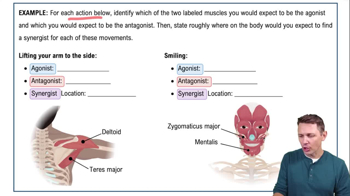
The zygomaticus major muscle is used to grin.
Which muscle relaxes when the arm flexes at the elbow?
The triceps brachii muscle relaxes when the arm flexes at the elbow.
Which muscle extends the elbow?
The triceps brachii muscle extends the elbow.
What is the function of the masseter muscle?
The masseter muscle elevates the mandible to close the jaw.
What is the action of the gastrocnemius muscle?
The gastrocnemius muscle plantar flexes the foot.
What is the action of the biceps brachii muscle?
The biceps brachii muscle flexes the elbow joint.
What is the action of the adductor magnus muscle?
The adductor magnus muscle adducts the thigh.
What is the action of the brachioradialis muscle?
The brachioradialis muscle flexes the forearm at the elbow.
What is the function of the masseter muscle?
The masseter muscle elevates the mandible to close the jaw.
What is the action of the adductor magnus muscle?
The adductor magnus muscle adducts the thigh.
Which muscle plantar flexes the foot?
The gastrocnemius muscle plantar flexes the foot.
Which muscle motion is used for frowning?
The depressor anguli oris muscle is used for frowning.
What is a prime mover muscle?
A prime mover muscle, or agonist, is the main muscle responsible for a movement.
Which muscle flexes the vertebral column?
The rectus abdominis muscle flexes the vertebral column.
Which muscle extends the knee?
The quadriceps femoris muscle extends the knee.
Which describes a muscle that opposes a movement?
A muscle that opposes a movement is called an antagonist.
Which muscle group extends the knee?
The quadriceps femoris muscle group extends the knee.
Which leg muscle extends the thigh?
The gluteus maximus muscle extends the thigh.
Which muscle extends the elbow?
The triceps brachii muscle extends the elbow.
Which muscle elevates the eyebrows?
The frontalis muscle elevates the eyebrows.
Which describes a muscle that opposes a movement?
A muscle that opposes a movement is called an antagonist.
 Back
Back
 3:55
3:55