Back

Noncovalent Bonds quiz

Control buttons has been changed to "navigation" mode.
1/15
  • What defines a noncovalent bond?

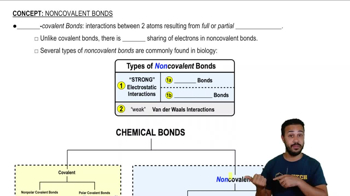
    A noncovalent bond is an interaction between two atoms resulting from full or partial charges, without any sharing of electrons.
  • How do noncovalent bonds differ from covalent bonds?

    Noncovalent bonds do not involve sharing of electrons, while covalent bonds do.
  • What does the prefix 'non-' in noncovalent indicate?

    The prefix 'non-' indicates that there is no sharing of electrons in the bond.
  • Into what two major groups can noncovalent bonds be categorized?

    Noncovalent bonds can be categorized into strong electrostatic interactions and weak Van der Waals interactions.
  • Which type of noncovalent interactions will the biology course focus on?

    The biology course will focus on strong electrostatic interactions.
  • What are the two main types of strong electrostatic interactions discussed in the course?

    The two main types are ionic bonds and hydrogen bonds.
  • Will weak Van der Waals interactions be covered in detail in this biology course?

    No, weak Van der Waals interactions will not be covered in detail; they are discussed more in chemistry courses.
  • What is the first type of strong electrostatic interaction to be discussed in the course?

    The first type to be discussed is the ionic bond.
  • What is the second type of strong electrostatic interaction to be discussed after ionic bonds?

    The second type is the hydrogen bond.
  • What is the main characteristic of interactions in noncovalent bonds?

    The main characteristic is that they result from full or partial charges, not electron sharing.
  • Where can you learn more about weak Van der Waals interactions?

    You can learn more about weak Van der Waals interactions in chemistry courses.
  • What visual aids are used in the lesson to illustrate noncovalent bonds?

    A table and a map are used to illustrate the types and categorization of noncovalent bonds.
  • What does the lesson map show about the sequence of topics?

    The map shows that after covalent bonds, the course moves to noncovalent bonds, starting with ionic and then hydrogen bonds.
  • What is the focus of the upcoming lessons after this introduction?

    The upcoming lessons will focus first on ionic bonds, then on hydrogen bonds.
  • Why is it important to distinguish between covalent and noncovalent bonds?

    It's important because covalent bonds involve electron sharing, while noncovalent bonds do not, affecting how atoms interact.