Skip to main content
Anatomy & Physiology
My Course
Learn
Exam Prep
AI Tutor
Study Guides
Textbook Solutions
Flashcards
Explore
Try the app
My Course
Learn
Exam Prep
AI Tutor
Study Guides
Textbook Solutions
Flashcards
Explore
Try the app
Back
Optic Components of the Eyeball definitions
You can tap to flip the card.
Iris
You can tap to flip the card.
👆
Iris
Controls the amount of light entering the eye by adjusting the size of the pupil.
Track progress
Control buttons has been changed to "navigation" mode.
1/15
Related flashcards
Related practice
Recommended videos
Optic Components of the Eyeball quiz
Optic Components of the Eyeball
15 Terms
Optic Components of the Eyeball
15. The Special Senses
1 problem
Topic
Bruce
Inner Layer of the Eyeball
15. The Special Senses
2 problems
Topic
15. The Special Senses
8 topics
13 problems
Chapter
Bruce
3:07
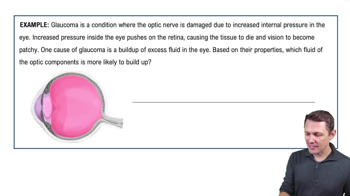
Optic Components of the Eyeball Example 1
3307
views
67
rank
5:04
Optic Components
4090
views
75
rank
Terms in this set (15)
Hide definitions
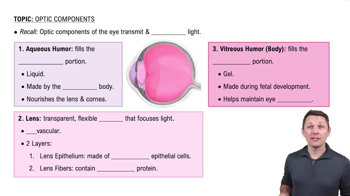
Iris
Controls the amount of light entering the eye by adjusting the size of the pupil.
Aqueous Humor
A liquid produced by the ciliary body, nourishing the avascular lens and cornea.
Lens
A transparent, flexible disk that focuses light onto the retina, composed of lens epithelium and lens fibers.
Vitreous Humor
A gel filling the posterior eye, maintaining its shape, produced during fetal development.
Ciliary Body
Produces aqueous humor and contains ciliary processes involved in eye function.
Lens Epithelium
The outer layer of the lens made of cuboidal cells, contributing to lens structure.
Lens Fibers
Inner part of the lens composed of crystalline protein, aiding in light focusing.
Crystalline Protein
Forms the lens fibers, creating a structure that allows light to pass and focus.
Retina
The light-sensitive layer at the back of the eye where images are formed.
Cornea
The transparent front part of the eye that helps focus incoming light.
Pupil
The opening in the iris through which light enters the eye.
Vitreous Body
Another term for vitreous humor, the gel that fills the back of the eye.
Anterior
Refers to the front portion of the eye, where the aqueous humor is located.
Posterior
Refers to the back portion of the eye, filled with vitreous humor.
Avascular
Describes tissues like the lens and cornea that lack blood vessels.
 BackBack
 3:07
3:07