Organization of Sensory Pathways definitions Flashcards

Organization of Sensory Pathways definitions
Control buttons has been changed to "navigation" mode.
1/15
  • Somatosensory System
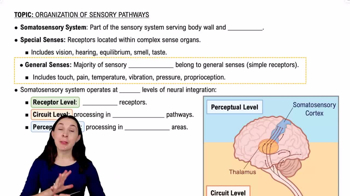
    Part of the sensory system serving the body wall and limbs, involving general senses like touch and proprioception.
  • Special Senses
    Senses with receptors in complex organs, including vision, hearing, taste, smell, and equilibrium.
  • General Senses
    Senses with simple receptors, including touch, pain, temperature, vibration, pressure, and proprioception.
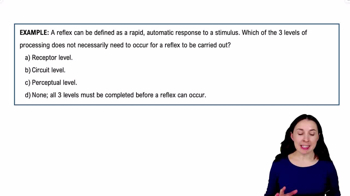
  • Receptor Level
    The initial stage of sensory processing where stimuli activate sensory receptors.
  • Circuit Level
    Stage involving ascending pathways that transmit impulses to the brain.
  • Perceptual Level
    Stage where the brain processes and interprets sensory information, leading to conscious awareness.
  • Receptive Field
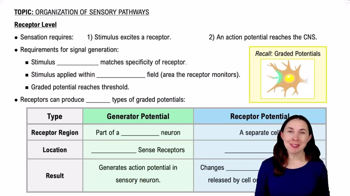
    The area monitored by a sensory receptor, where stimuli must be applied to be detected.
  • Graded Potential
    A change in membrane potential that must reach threshold to trigger an action potential.
  • Generator Potential
    A graded potential occurring directly in sensory neurons, common in general sense receptors.
  • Receptor Potential
    A graded potential involving a separate receptor cell affecting a sensory neuron, common in special senses.
  • Ascending Pathways
    Neural pathways that carry sensory information from receptors to the brain.
  • Afferent Nerves
    Nerves that carry sensory signals from receptors toward the central nervous system.
  • Somatosensory Cortex
    Brain region where sensory information is processed and interpreted.
  • Neurotransmitter
    Chemical released by neurons to transmit signals across a synapse to another neuron.
  • Cerebral Cortex
    The outer layer of the brain involved in processing sensory input and conscious perception.