Skip to main content
Anatomy & Physiology
My Course
Learn
Exam Prep
AI Tutor
Study Guides
Textbook Solutions
Flashcards
Explore
Try the app
My Course
Learn
Exam Prep
AI Tutor
Study Guides
Textbook Solutions
Flashcards
Explore
Try the app
Back
Placentation quiz
You can tap to flip the card.
Which function is not performed by the placenta?
You can tap to flip the card.
👆
Which function is not performed by the placenta?
Blood cell production
Track progress
Control buttons has been changed to "navigation" mode.
1/9
Related flashcards
Related practice
Recommended videos
Placentation definitions
Placentation
15 Terms
Placentation
28. Human Development
4 problems
Topic
Bruce
Embryonic Development (Weeks 3-8)
28. Human Development
4 problems
Topic
28. Human Development - Part 1 of 2
4 topics
10 problems
Chapter
28. Human Development - Part 2 of 2
2 topics
4 problems
Chapter
0:38
Placentation Example 3
1448
views
18
rank
4:29
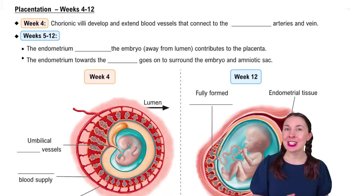
Placentation – Weeks 4-12
1650
views
17
rank
0:55
Placentation Example 2
1603
views
12
rank
Terms in this set (9)
Hide definitions
Which function is not performed by the placenta?
Blood cell production
What hormones does the placenta produce?
It produces hormones like HCG and estrogen
What is the function of the placenta? Check all that apply. a) Nutrient exchange b) Hormone production c) Blood cell production d) Waste removal
a) Nutrient exchange, b) Hormone production, d) Waste removal
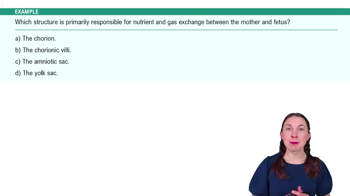
What is the role of chorionic villi in the placenta?
Chorionic villi are projections that facilitate nutrient, gas, and waste exchange between the mother and the conceptus.
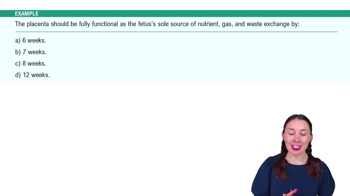
At what stage of pregnancy is the placenta fully formed?
The placenta is fully formed by week 12 of pregnancy.
What is the maternal portion of the placenta derived from?
The maternal portion of the placenta is derived from the endometrium beneath the embryo.
What hormone does the placenta begin producing almost immediately after conception?
The placenta begins producing HCG almost immediately after conception.
What is the significance of lacunae in placentation?
Lacunae are pools of maternal blood within the endometrium that facilitate exchange between the mother and the conceptus.
What is the function of the extraembryonic mesoderm in placentation?
The extraembryonic mesoderm contributes to the formation of the chorion, which supports the development of the placenta.
 BackBack
 0:38
0:38