Back

Prokaryotic & Eukaryotic Cells quiz

Control buttons has been changed to "navigation" mode.
1/10
  • What three basic parts are found in most human cells?

    Most human cells contain a nucleus, cytoplasm, and a cell membrane.
  • What components are found in the cell wall of gram-negative bacteria?

    The cell wall of gram-negative bacteria contains lipopolysaccharides and a thin layer of peptidoglycan.
  • Which cellular structure is found in animal cells but not in plant cells?

    Centrioles are found in animal cells but not in plant cells.
  • Which cellular structure is located outside of the nucleus?

    Ribosomes are located outside of the nucleus.
  • In animal cells, what is the primary function of mitochondria?

    In animal cells, mitochondria are responsible for producing energy through the process of cellular respiration.
  • What is the main difference between prokaryotic and eukaryotic cells regarding their DNA structure?

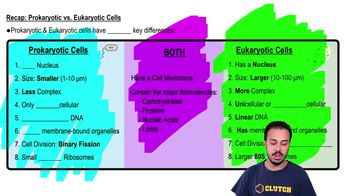
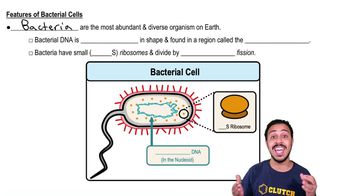
    Prokaryotic cells have circular DNA, while eukaryotic cells have linear DNA.
  • How do prokaryotic cells divide?

    Prokaryotic cells divide through a process called binary fission.
  • What is the size difference between prokaryotic and eukaryotic ribosomes?

    Prokaryotic ribosomes are smaller (70S) compared to eukaryotic ribosomes (80S).
  • What type of cell can be either unicellular or multicellular?

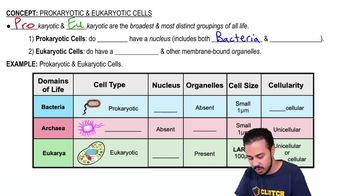
    Eukaryotic cells can be either unicellular or multicellular.
  • What is the primary function of ribosomes in cells?

    Ribosomes are responsible for building proteins in cells.