Properties of Water- The Universal Solvent definitions Flashcards

Properties of Water- The Universal Solvent definitions
Control buttons has been changed to "navigation" mode.
1/15
  • Universal Solvent
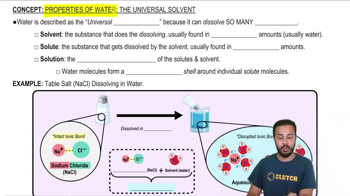
    A substance capable of dissolving many different solutes, typically water in biological contexts.
  • Solvent
    The substance that dissolves a solute, usually present in larger amounts.
  • Solute
    The substance that is dissolved by the solvent, typically present in smaller amounts.
  • Ionic Bonds
    Electrostatic attractions between oppositely charged ions, such as sodium and chloride.
  • Aqueous Solution
    A solution where water acts as the solvent, dissolving various solutes.
  • Hydration Shell
    A layer of water molecules surrounding a solute, facilitating its dissolution.
  • Homogeneous Solution
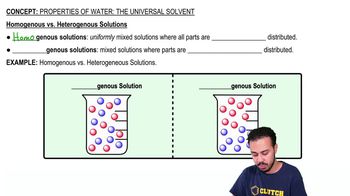
    A solution with uniformly distributed components, appearing the same throughout.
  • Heterogeneous Solution
    A solution with unevenly distributed components, appearing different throughout.
  • Hydrophilic
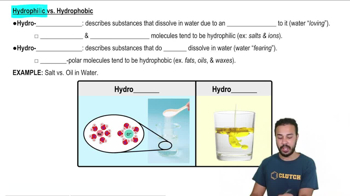
    Describes substances that dissolve easily in water due to their affinity for it.
  • Hydrophobic
    Describes substances that do not dissolve in water, often nonpolar molecules.
  • Polar Molecules
    Molecules with uneven distribution of charges, often hydrophilic.
  • Nonpolar Molecules
    Molecules with even charge distribution, often hydrophobic.
  • Sodium Chloride
    A common salt composed of sodium and chloride ions, dissolves in water.
  • Cation
    A positively charged ion, such as sodium in sodium chloride.
  • Anion
    A negatively charged ion, such as chloride in sodium chloride.