Reflex Arcs definitions Flashcards

Reflex Arcs definitions
Control buttons has been changed to "navigation" mode.
1/15
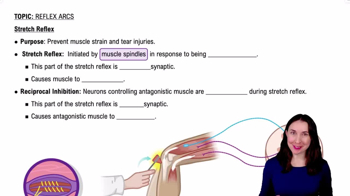
  • Stretch Reflex
    A monosynaptic reflex initiated by muscle spindles in response to unexpected stretching, causing muscle contraction.
  • Muscle Spindles
    Sensory receptors within muscles that detect changes in muscle length and trigger the stretch reflex.
  • Reciprocal Inhibition
    A polysynaptic process that relaxes the antagonistic muscle during a stretch reflex to ensure smooth movement.
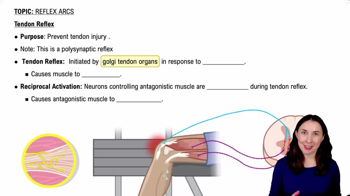
  • Tendon Reflex
    A polysynaptic reflex triggered by Golgi tendon organs in response to excessive tension, leading to muscle relaxation.
  • Golgi Tendon Organs
    Sensory receptors located in tendons that detect tension and initiate the tendon reflex.
  • Reciprocal Activation
    A process where the antagonistic muscle contracts during the tendon reflex to maintain balance and prevent overextension.
  • Flexor Reflex
    An ipsilateral reflex causing rapid contraction of flexor muscles in response to a painful stimulus, leading to withdrawal.
  • Crossed Extensor Reflex
    A contralateral reflex that extends the opposite limb to maintain balance during a flexor reflex.
  • Ipsilateral
    Referring to reflex actions occurring on the same side of the body as the stimulus.
  • Contralateral
    Referring to reflex actions occurring on the opposite side of the body as the stimulus.
  • Monosynaptic
    A reflex arc involving a single synapse between a sensory and a motor neuron.
  • Polysynaptic
    A reflex arc involving multiple synapses, typically including interneurons.
  • Antagonistic Muscle
    A muscle that opposes the action of another muscle, often relaxed during reflex actions.
  • Interneuron
    A neuron that transmits impulses between other neurons, especially in reflex arcs.
  • Sensory Neuron
    A neuron that transmits sensory information from receptors to the central nervous system.