Review of Aerobic Cellular Respiration quiz Flashcards

Review of Aerobic Cellular Respiration quiz
Control buttons has been changed to "navigation" mode.
1/10
  • What are the four stages of aerobic cellular respiration?
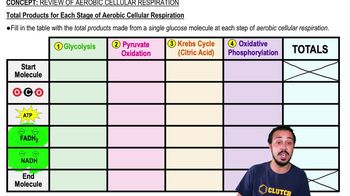
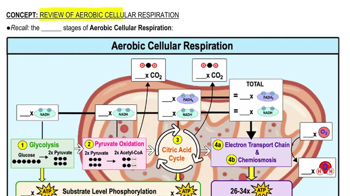
    The four stages are Glycolysis, Pyruvate Oxidation, Krebs Cycle (Citric Acid Cycle), and Oxidative Phosphorylation.
  • Where does glycolysis occur in the cell?
    Glycolysis occurs in the cytoplasm of the cell.
  • What is the net ATP gain from glycolysis?
    The net ATP gain from glycolysis is 2 ATP molecules.
  • What molecule is pyruvate converted into during pyruvate oxidation?
    Pyruvate is converted into acetyl CoA during pyruvate oxidation.
  • How many carbon dioxide molecules are released during the Krebs Cycle?
    A total of 4 carbon dioxide molecules are released during the Krebs Cycle.
  • What is the primary function of the Electron Transport Chain in aerobic respiration?
    The primary function of the Electron Transport Chain is to transfer electrons and build a hydrogen ion gradient for ATP production.
  • How many ATP molecules are produced during oxidative phosphorylation?
    Oxidative phosphorylation produces between 26 to 34 ATP molecules.
  • What is the final electron acceptor in the Electron Transport Chain?
    Oxygen gas is the final electron acceptor in the Electron Transport Chain.
  • What is the total ATP yield from one glucose molecule in aerobic respiration?
    The total ATP yield from one glucose molecule ranges from 30 to 38 ATPs.
  • How many NADH molecules are produced in total during aerobic respiration?
    A total of 10 NADH molecules are produced during aerobic respiration.