Skip to main content
Anatomy & Physiology
My Course
Learn
Exam Prep
AI Tutor
Study Guides
Textbook Solutions
Flashcards
Explore
Try the app
My Course
Learn
Exam Prep
AI Tutor
Study Guides
Textbook Solutions
Flashcards
Explore
Try the app
Back
Secondary Lymphoid Organs: Lymph Nodes definitions
You can tap to flip the card.
Lymph nodes
You can tap to flip the card.
👆
Lymph nodes
Small, bean-shaped structures that filter lymph and trap pathogens, crucial for immune response.
Track progress
Control buttons has been changed to "navigation" mode.
1/15
Related flashcards
Related practice
Recommended videos
Secondary Lymphoid Organs: Lymph Nodes quiz
Secondary Lymphoid Organs: Lymph Nodes
10 Terms
Secondary Lymphoid Organs: Lymph Nodes
20. The Lymphatic System
4 problems
Topic
Secondary Lymphoid Organs: The Spleen
20. The Lymphatic System
4 problems
Topic
Bruce
20. The Lymphatic System - Part 1 of 2
4 topics
9 problems
Chapter
Jason
20. The Lymphatic System - Part 2 of 2
4 topics
9 problems
Chapter
Bruce
Guided course
1:48
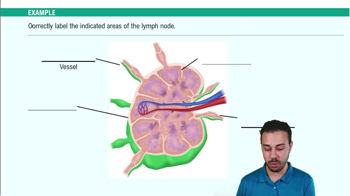
Secondary Lymphoid Organs: Lymph Nodes Example 3
2799
views
47
rank
Guided course
10:32
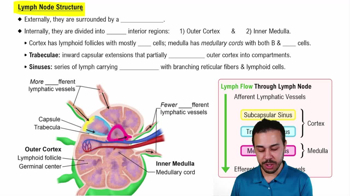
Lymph Node Structure
3820
views
66
rank
Guided course
5:05
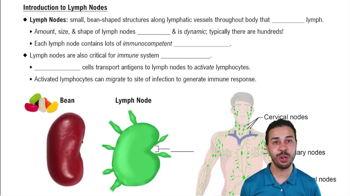
Introduction to Lymph Nodes
4059
views
70
rank
Terms in this set (15)
Hide definitions
Lymph nodes
Small, bean-shaped structures that filter lymph and trap pathogens, crucial for immune response.
Hilum
Indentation in a lymph node where efferent lymphatic vessels exit.
Cortex
Outer region of a lymph node, rich in B lymphocytes and lymphoid follicles.
Medulla
Inner region of a lymph node containing both B and T lymphocytes.
Afferent vessels
Lymphatic vessels through which lymph enters a lymph node.
Efferent vessels
Lymphatic vessels through which lymph exits a lymph node.
Lymphoid follicles
Densely packed spheres of lymphoid tissue in the cortex, containing dividing B cells.
Medullary cords
Lymphoid tissues in the medulla containing populations of B and T cells.
Trabeculae
Inward extensions of the capsule that partially divide the cortex into compartments.
Sinuses
Lymph-carrying channels within lymph nodes that filter pathogens.
Subcapsular sinus
Sinus located immediately beneath the capsule of a lymph node.
Trabecular sinus
Sinus parallel to the trabeculae, found in the outer cortex of a lymph node.
Medullary sinus
Sinus located in the medulla of a lymph node, part of lymph flow.
Capsule
Dense irregular connective tissue surrounding a lymph node, providing structural integrity.
Lymphatic trunks
Large lymphatic vessels formed by merging lymphatic vessels, leading to lymph nodes.
 BackBack

 1:48
1:48