Skip to main content
Anatomy & Physiology
My Course
Learn
Exam Prep
AI Tutor
Study Guides
Textbook Solutions
Flashcards
Explore
Try the app
My Course
Learn
Exam Prep
AI Tutor
Study Guides
Textbook Solutions
Flashcards
Explore
Try the app
Back
Structural Class: Fibrous Joints definitions
You can tap to flip the card.
Fibrous Joints
You can tap to flip the card.
👆
Fibrous Joints
Joints bound by collagen fibers of dense connective tissue, providing stability with limited movement.
Track progress
Control buttons has been changed to "navigation" mode.
1/15
Related flashcards
Related practice
Recommended videos
Structural Class: Fibrous Joints quiz
Structural Class: Fibrous Joints
10 Terms
Structural Class: Fibrous Joints quiz #1
Structural Class: Fibrous Joints
10 Terms
Structural Class: Fibrous Joints
8. Joints
4 problems
Topic
Bruce
Structural Class: Cartilaginous Joints
8. Joints
3 problems
Topic
Bruce
8. Joints
6 topics
14 problems
Chapter
Bruce
Guided course
07:31
Sutures
10029
views
176
rank
Guided course
02:23
Structural Class: Fibrous Joints Example 2
6853
views
119
rank
Guided course
04:28
Syndesmosis (Pleural: Syndesmoses)
8506
views
143
rank
Terms in this set (15)
Hide definitions
Fibrous Joints
Joints bound by collagen fibers of dense connective tissue, providing stability with limited movement.
Collagen Fibers
Protein fibers providing strength and stability to fibrous joints, limiting their movement.
Dense Irregular Connective Tissue
Tissue with densely packed fibers in random arrangement, resisting forces in multiple directions.
Synarthroses
Immovable joints allowing no movement, providing structural stability.
Amphiarthroses
Joints allowing slight movement, providing a balance between stability and mobility.
Sutures
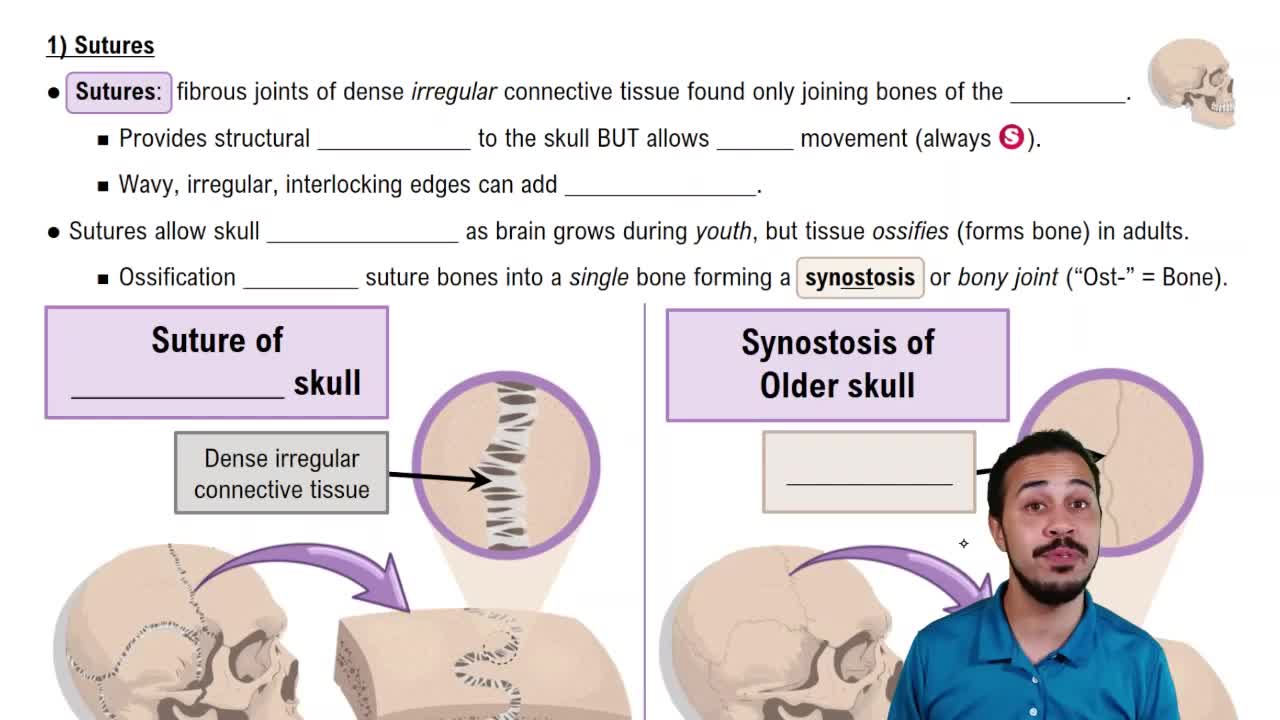
Fibrous joints in the skull, providing stability with no movement, may ossify into synostosis.
Synostosis
Fusion of bones into a single bone, resulting in a bony joint with no movement.
Gomphoses
Fibrous joints anchoring teeth to bony sockets, allowing subtle movement under chewing forces.
Periodontal Ligament
Dense connective tissue gluing teeth to their sockets, allowing resistance to multidirectional forces.
Syndesmoses
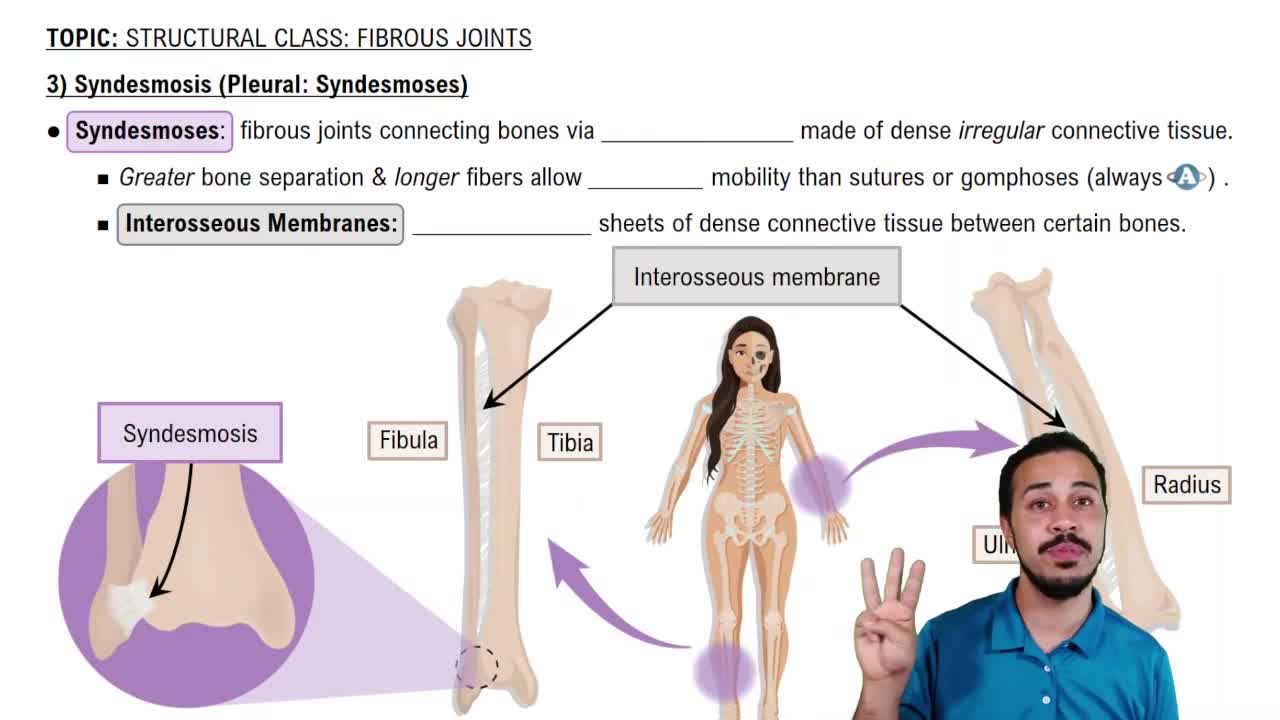
Fibrous joints connecting bones via ligaments, allowing more mobility than sutures and gomphoses.
Interosseous Membranes
Broad sheets of dense connective tissue between bones, allowing varying degrees of movement.
Tibia
The larger and stronger of the two bones in the lower leg, connected to the fibula by syndesmoses.
Fibula
The smaller bone in the lower leg, connected to the tibia by syndesmoses.
Radius
One of the two bones in the forearm, connected to the ulna by interosseous membranes.
Ulna
One of the two bones in the forearm, connected to the radius by interosseous membranes.
 BackBack
 07:31
07:31