Skip to main content
Anatomy & Physiology
My Course
Learn
Exam Prep
AI Tutor
Study Guides
Textbook Solutions
Flashcards
Explore
Try the app
My Course
Learn
Exam Prep
AI Tutor
Study Guides
Textbook Solutions
Flashcards
Explore
Try the app
Back
Structural Class: Synovial Joints definitions
3 students found this helpful
You can tap to flip the card.
Synovial Joints
You can tap to flip the card.
👆
Synovial Joints
Most common joint type in the human body, allowing free movement and classified as diarthroses.
Track progress
Control buttons has been changed to "navigation" mode.
1/15
Related flashcards
Related practice
Recommended videos
Structural Class: Synovial Joints quiz
Structural Class: Synovial Joints
10 Terms
Structural Class: Synovial Joints
8. Joints
2 problems
Topic
Joint Movements
8. Joints
7 problems
Topic
Jason
8. Joints
6 topics
14 problems
Chapter
Bruce
Guided course
2:15
Structural Class: Synovial Joints Example 1
5714
views
84
rank
Guided course
2:42
Weeping Lubrication
6184
views
95
rank
Guided course
4:08
Additional Features
6121
views
94
rank
Terms in this set (15)
Hide definitions
Synovial Joints
Most common joint type in the human body, allowing free movement and classified as diarthroses.
Diarthroses
Functional classification of joints that allow for dynamic and free movement.
Synovial Cavity
Space between bones in a synovial joint, storing synovial fluid for lubrication and shock absorption.
Synovial Fluid
Viscous liquid in synovial joints, acting as a lubricant and shock absorber.
Articular Cartilage
Hyaline cartilage covering bone ends in synovial joints, reducing friction and absorbing shock.
Articular Capsule
Structure surrounding synovial joints, consisting of an inner synovial membrane and an outer fibrous layer.
Synovial Membrane
Inner layer of the articular capsule, producing synovial fluid.
Fibrous Layer
Outer layer of the articular capsule, made of dense irregular connective tissue for stability.
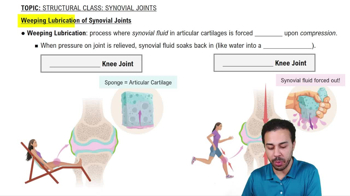
Weeping Lubrication
Process where synovial fluid is expelled and reabsorbed by articular cartilage during joint movement.
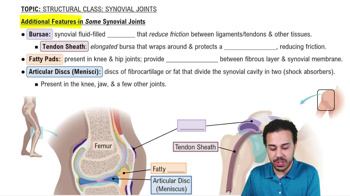
Bursae
Fluid-filled sacs in some synovial joints, reducing friction between tissues.
Tendon Sheaths
Elongated bursae wrapping around tendons to reduce friction.
Fatty Pads
Adipose tissue in joints like the knee, providing extra cushioning.
Articular Discs
Fibrocartilage structures dividing synovial cavities, acting as shock absorbers.
Menisci
Fibrocartilage discs in joints like the knee, providing stability and shock absorption.
Ligaments
Structures reinforcing synovial joints, enhancing stability.
 BackBack

 2:15
2:15