Skip to main content
Anatomy & Physiology
My Course
Learn
Exam Prep
AI Tutor
Study Guides
Textbook Solutions
Flashcards
Explore
Try the app
My Course
Learn
Exam Prep
AI Tutor
Study Guides
Textbook Solutions
Flashcards
Explore
Try the app
Back
Sympathetic Nervous System definitions
You can tap to flip the card.
Sympathetic Nervous System
You can tap to flip the card.
👆
Sympathetic Nervous System
Activates during stress, increasing heart rate, blood pressure, and airflow, while decreasing gastrointestinal activity.
Track progress
Control buttons has been changed to "navigation" mode.
1/15
Related flashcards
Related practice
Recommended videos
Sympathetic Nervous System quiz
Sympathetic Nervous System
18 Terms
Sympathetic Nervous System quiz #1
Sympathetic Nervous System
16 Terms
Sympathetic Nervous System
14. The Autonomic Nervous System
7 problems
Topic
Jason
Parasympathetic Nervous System
14. The Autonomic Nervous System
7 problems
Topic
Jason
14. The Autonomic Nervous System
6 topics
13 problems
Chapter
Jason
5:03
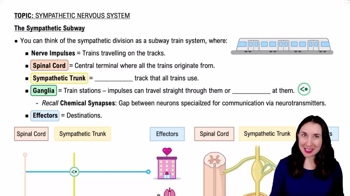
The Sympathetic Subway
6776
views
98
rank
1:21
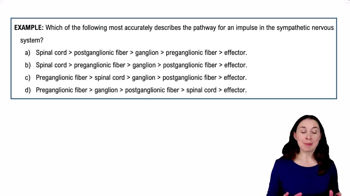
Sympathetic Nervous System Example 3
5186
views
78
rank
4:04
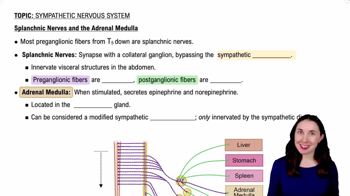
Splanchnic Nerves and the Adrenal Medulla
5412
views
82
rank
Terms in this set (15)
Hide definitions
Sympathetic Nervous System
Activates during stress, increasing heart rate, blood pressure, and airflow, while decreasing gastrointestinal activity.
Fight or Flight Response
A physiological reaction that occurs in response to a perceived harmful event, attack, or threat to survival.
Preganglionic Fiber
The short nerve fiber that originates in the spinal cord and synapses in a ganglion.
Postganglionic Fiber
The long nerve fiber that extends from a ganglion to the target organ.
Sympathetic Trunk
A bundle of nerve fibers running parallel to the spinal cord, involved in transmitting nerve impulses.
Ganglia
Structures acting as relay points where nerve impulses can synapse or pass through.
Splanchnic Nerves
Nerves that bypass the sympathetic trunk to synapse in collateral ganglia near abdominal organs.
Adrenal Medulla
Part of the sympathetic nervous system, secreting adrenaline and noradrenaline for the fight or flight response.
Vasoconstriction
The narrowing of blood vessels, reducing blood flow to certain areas like the stomach or intestines.
Vasodilation
The widening of blood vessels, increasing blood flow to skeletal muscles during stress.
Arrector Pili Muscles
Tiny muscles around hair follicles that contract to cause goosebumps.
Dual Innervation
Most organs receive nerve fibers from both sympathetic and parasympathetic divisions.
White Ramus Communicans
Carries preganglionic fibers from the spinal nerve to the sympathetic ganglia.
Gray Ramus Communicans
Carries postganglionic fibers from the ganglia back to the spinal nerve.
Collateral Ganglion
Ganglia located closer to effector organs where splanchnic nerves synapse.
 BackBack
 5:03
5:03