Skip to main content
Anatomy & Physiology
My Course
Learn
Exam Prep
AI Tutor
Study Guides
Textbook Solutions
Flashcards
Explore
Try the app
My Course
Learn
Exam Prep
AI Tutor
Study Guides
Textbook Solutions
Flashcards
Explore
Try the app
Back
The Gallbladder definitions
1 student found this helpful
You can tap to flip the card.
Gallbladder
You can tap to flip the card.
👆
Gallbladder
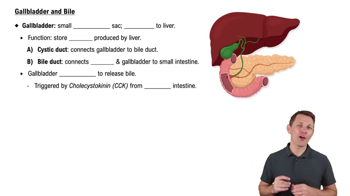
A small muscular sac located inferior to the liver, responsible for storing bile produced by the liver.
Track progress
Control buttons has been changed to "navigation" mode.
1/15
Related flashcards
Related practice
Recommended videos
The Gallbladder quiz
The Gallbladder
10 Terms
The Gallbladder quiz #1
The Gallbladder
10 Terms
The Gallbladder
23. The Digestive System
5 problems
Topic
Jason
Pancreas
23. The Digestive System
4 problems
Topic
23. The Digestive System - Part 1 of 2
4 topics
11 problems
Chapter
Jason
23. The Digestive System - Part 2 of 2
2 topics
5 problems
Chapter
2:53
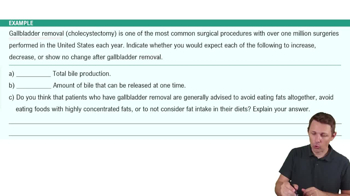
The Gallbladder Example 1
3976
views
62
rank
6:54
Gallbladder and Bile
5334
views
94
rank
1
comments
Terms in this set (15)
Hide definitions
Gallbladder
A small muscular sac located inferior to the liver, responsible for storing bile produced by the liver.
Bile
A digestive fluid produced by the liver, stored in the gallbladder, and released into the small intestine to aid in fat digestion.
Cystic duct
A duct connecting the gallbladder to the bile duct, allowing bile to flow in and out of the gallbladder.
Bile duct
A duct that connects the liver and gallbladder to the small intestine, facilitating bile transport.
Cholecystokinin
A hormone released by the small intestine that triggers the gallbladder to release bile.
Bile salts
Compounds derived from cholesterol that emulsify fats, increasing their surface area for enzyme action.
Bile pigment
Substances in bile, primarily bilirubin, that give bile its color and contribute to the color of feces.
Cholesterol
A lipid molecule that serves as a precursor for bile salts, aiding in fat digestion.
Triglycerides
A type of fat found in the blood, broken down by bile salts during digestion.
Phospholipids
A class of lipids that are a component of bile, aiding in the emulsification of fats.
Electrolytes
Minerals in bile that help maintain fluid balance and support digestion.
Emulsification
The process by which bile salts break down large fat globules into smaller droplets.
Ileum
The last section of the small intestine where bile salts are reabsorbed and recycled.
Portal vein
A blood vessel that carries reabsorbed bile salts from the intestine back to the liver for recycling.
Bilirubin
A waste product from the breakdown of red blood cells, giving bile and feces their color.
 BackBack
 2:53
2:53