Which muscle type is correctly matched to its location?
Cardiac muscle is correctly matched to the heart.
Which muscle type is striated?
Both skeletal and cardiac muscle types are striated.
Which muscle type is voluntary?
Skeletal muscle is voluntary.
Which type of muscle is voluntary muscle?
Skeletal muscle is voluntary muscle.
Which muscle fibers are resistant to fatigue because they rely on aerobic metabolism?
Slow-twitch muscle fibers are resistant to fatigue because they rely on aerobic metabolism.
What are the two types of myofilaments?
The two types of myofilaments are actin (thin) and myosin (thick).
What type of muscle do we control voluntarily?
We control skeletal muscle voluntarily.
Where might you find involuntary muscle?
Involuntary muscle is found in the heart (cardiac muscle) and in the walls of hollow organs (smooth muscle).
Which of the three muscle types is found only in the heart?
Cardiac muscle is found only in the heart.
Which type(s) of muscle tissue is/are striated?
Skeletal and cardiac muscle tissues are striated.
What muscle is both voluntary and involuntary?
No muscle is both voluntary and involuntary; skeletal is voluntary, while cardiac and smooth are involuntary.
Which describes slow-twitch fibers?
Slow-twitch fibers are fatigue-resistant, rely on aerobic metabolism, and are suited for endurance activities.
Voluntary muscles are what type of muscle?
Voluntary muscles are skeletal muscles.
Which is true about the three types of muscles?
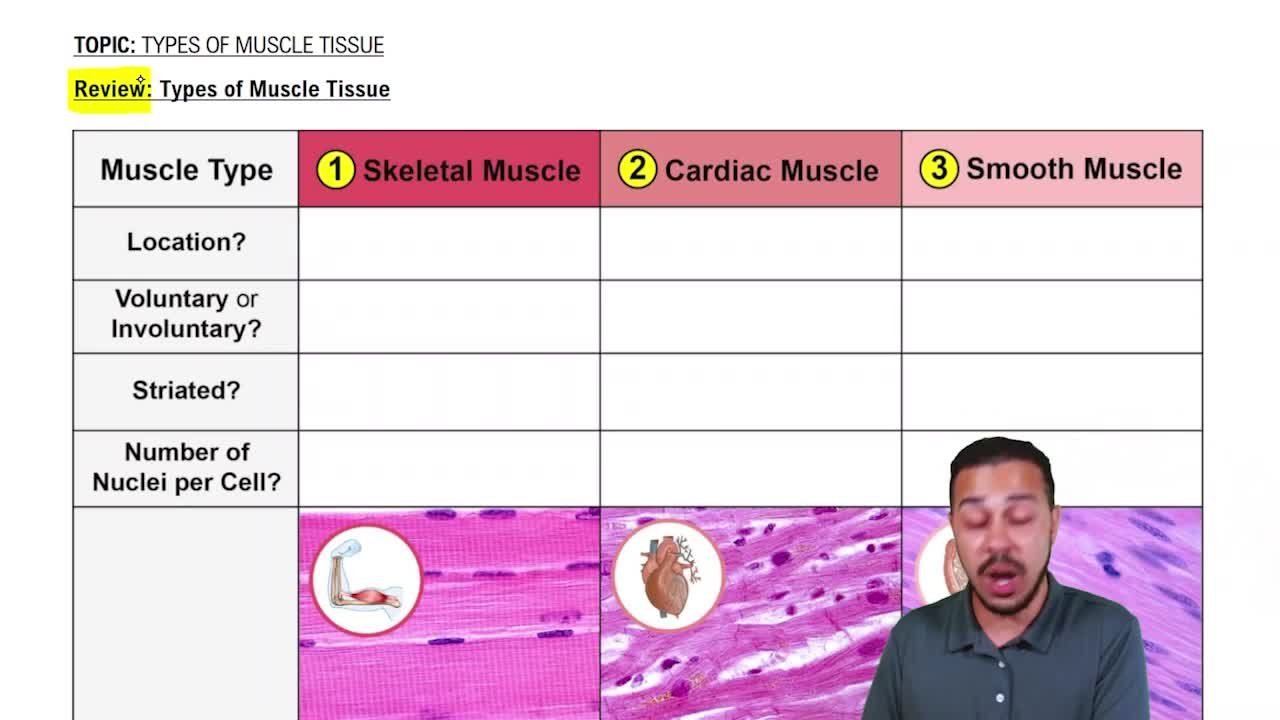
Skeletal muscle is voluntary and striated, cardiac muscle is involuntary and striated, and smooth muscle is involuntary and non-striated.
Which type of muscle is characterized by the presence of striations and intercalated discs?
Cardiac muscle is characterized by the presence of striations and intercalated discs.
Which type of muscle is involuntary and makes up many of your internal organs?
Smooth muscle is involuntary and makes up many of your internal organs.
Cardiac and skeletal muscles have which feature(s) in common?
Both cardiac and skeletal muscles are striated.
Where can you find voluntary muscles?
Voluntary muscles, or skeletal muscles, are found attached to bones throughout the body.
How do striated and smooth muscles differ?
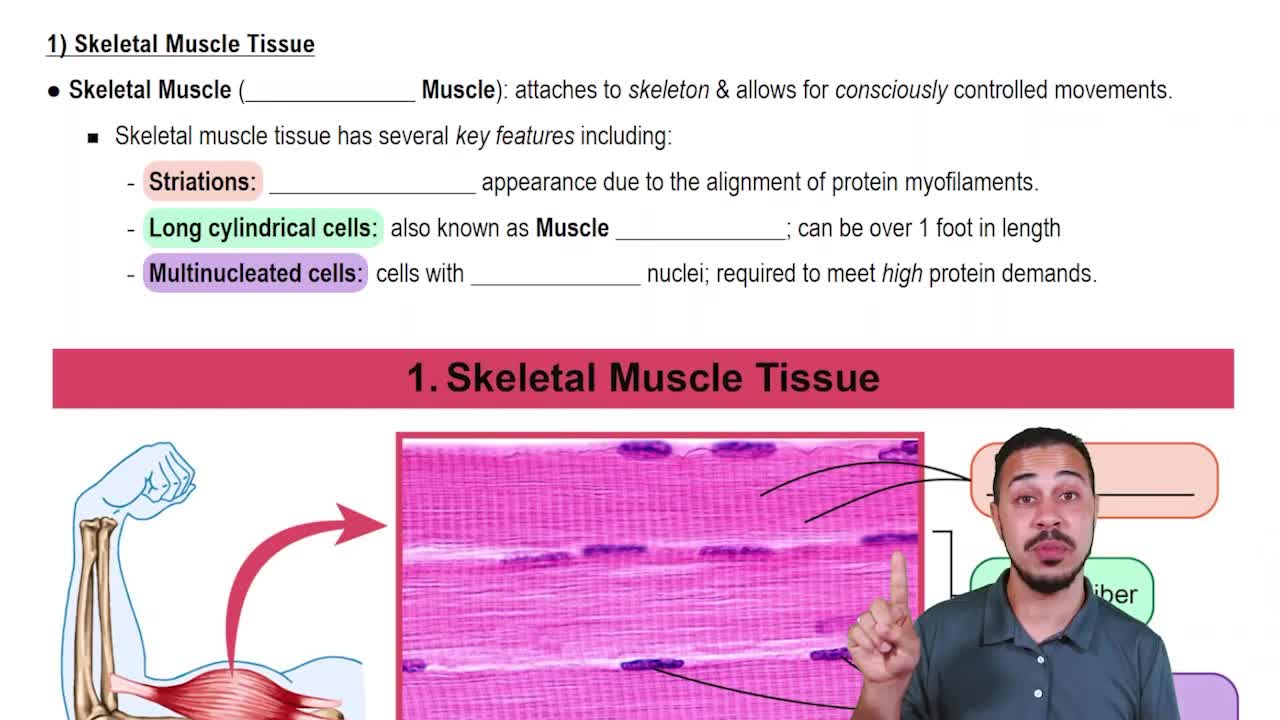
Striated muscles (skeletal and cardiac) have a banded appearance due to aligned myofilaments, while smooth muscles lack striations.
What is a similarity between cardiac and skeletal muscle?
Both cardiac and skeletal muscles are striated.
How are muscle cells different from most other body cells?
Muscle cells are specialized for contraction, often multinucleated (in skeletal muscle), and contain abundant myofilaments for movement.
What are the three types of muscle tissue in the human body, and how do they differ in terms of location, voluntary control, striations, and number of nuclei per cell?
The three types of muscle tissue are skeletal, cardiac, and smooth muscle tissue. Skeletal muscle is attached to the skeleton, is voluntary (consciously controlled), striated, and has multinucleated long cylindrical cells. Cardiac muscle is found in the heart, is involuntary, striated, has branching uninucleate cells, and contains intercalated discs. Smooth muscle is found in the walls of hollow organs (like blood vessels and intestines), is involuntary, lacks striations, and has short, spindle-shaped uninucleate cells.
Is skeletal muscle tissue voluntary or involuntary?
Skeletal muscle tissue is voluntary, meaning its contractions are under conscious control.
What are the three types of muscle tissue in the human body?
The three types of muscle tissue are skeletal muscle tissue, cardiac muscle tissue, and smooth muscle tissue.
Are cardiac muscles considered smooth muscles?
No, cardiac muscles are not considered smooth muscles; they are a distinct type of muscle tissue found in the heart.
Which type of muscle tissue is voluntary?
Skeletal muscle tissue is voluntary.
What type of muscle do we control voluntarily?
We control skeletal muscle tissue voluntarily.
Are cardiac muscles considered smooth muscles?
No, cardiac muscles are not considered smooth muscles; they are a separate type of muscle tissue.
Which muscle tissue is multinucleate?
Skeletal muscle tissue is multinucleate, meaning its cells have multiple nuclei.
Which muscle tissue moves bones?
Skeletal muscle tissue moves bones.
Which type of muscle is voluntary?
Skeletal muscle tissue is voluntary.
Voluntary muscles are what type of muscle?
Voluntary muscles are skeletal muscles.
Which type of muscle is voluntary and striated?
Skeletal muscle tissue is voluntary and striated.
What are the three types of muscle tissue?
The three types of muscle tissue are skeletal, cardiac, and smooth muscle tissue.
How many basic types of muscle tissue are there?
There are three basic types of muscle tissue.
What type of muscle has intercalated discs?
Cardiac muscle tissue has intercalated discs.
Which muscle has intercalated discs?
Cardiac muscle tissue has intercalated discs.
Which muscle tissue is under conscious control?
Skeletal muscle tissue is under conscious control.
What causes striation of the cardiac muscle?
Striations in cardiac muscle are caused by the alignment of protein myofilaments.
 Back
Back
 00:36
00:36