What are the two major divisions of the skeletal system?
The skeletal system is divided into the axial skeleton and the appendicular skeleton.
What bones make up the axial skeleton?
The axial skeleton consists of the skull, vertebral column, and thoracic cage.
What are the primary functions of the axial skeleton?
To form the longitudinal axis of the body, support the head, neck, and trunk, and protect the brain, spinal cord, and thoracic organs.
What are the two sets of bones that form the skull?
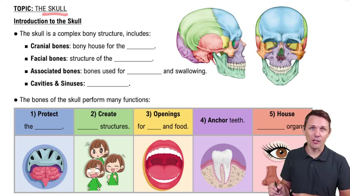
The skull is formed by cranial bones and facial bones.
What is the function of cranial bones?
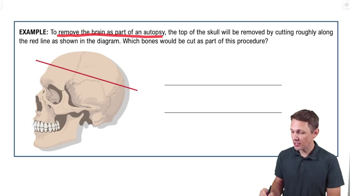
Cranial bones enclose the brain and provide attachment sites for head and neck muscles.
What is the function of facial bones?
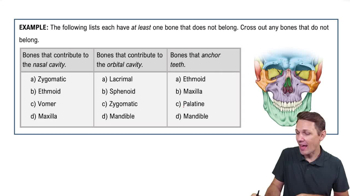
Facial bones form the framework of the face, contain cavities for special sense organs, provide openings for air and food passage, secure teeth, and anchor facial muscles.
Name the three cranial fossae and the brain parts they house.
Anterior cranial fossa houses the frontal lobes, middle cranial fossa houses the temporal lobes, and posterior cranial fossa houses the cerebellum.
List the eight cranial bones.
Frontal, parietal (left and right), occipital, temporal (left and right), sphenoid, and ethmoid bones.
What is the glabella and where is it located?
The glabella is the smooth area between the orbits on the frontal bone.
Name the four major sutures of the parietal bones.
Coronal suture (parietal to frontal), sagittal suture (between parietal bones), lambdoid suture (parietal to occipital), and squamous suture (parietal to temporal).
What is the foramen magnum and which bone contains it?
The foramen magnum is a large opening in the occipital bone through which the brain connects with the spinal cord.
What are the three regions of the temporal bones?
Squamous (forms zygomatic arch and mandibular fossa), tympanic (surrounds external acoustic meatus), and petrous (houses middle and internal ear cavities).
What is the sella turcica and which bone contains it?
The sella turcica is a depression in the sphenoid bone that houses the pituitary gland.
What are the key features of the ethmoid bone?
It forms the roof of the nasal cavity, floor of the anterior cranial fossa, contains the crista galli for dura mater attachment, and has lateral masses with ethmoidal air cells.
What are sutural bones?
Tiny, irregular bones that appear within sutures; their significance is unknown and not everyone has them.
They form the upper jaw, hold upper teeth, form the anterior nasal spine, and contribute to the hard palate.
What bones form the orbits?
Frontal, sphenoid, zygomatic, maxilla, palatine, lacrimal, and ethmoid bones.
What are paranasal sinuses and their functions?
Mucosa-lined, air-filled spaces in frontal, sphenoid, ethmoid, and maxillary bones that lighten the skull, warm and humidify air, and enhance voice resonance.
What is unique about the hyoid bone?
It does not articulate with any other bone and serves as a movable base for the tongue and attachment for muscles of swallowing and speech.
 Back
 2:12