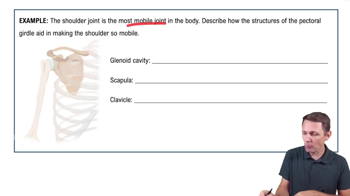
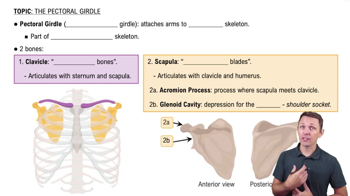
The pectoral girdle is composed of the clavicles (anteriorly) and scapulae (posteriorly).
What is the function of the pectoral girdle?
It attaches the upper limbs to the trunk, provides muscle attachment sites, and allows high mobility due to the shallow shoulder socket.
Describe the clavicle's role and articulation points.
The clavicle is an S-shaped bone that articulates medially with the sternum and laterally with the scapula, acting as a brace for the scapula and arms.
Name key features of the scapula.
The scapula is a thin, triangular bone with three borders (superior, medial, lateral) and three angles (superior, lateral, inferior). It includes the spine, acromion, coracoid process, and glenoid cavity.
What bones make up the upper limb?
The upper limb consists of the humerus (arm), radius and ulna (forearm), and the carpal, metacarpal, and phalangeal bones (hand).
What are the main features of the humerus?
The humerus has a head, anatomical neck, greater and lesser tubercles, surgical neck, deltoid tuberosity, and epicondyles.
How do the radius and ulna differ in function?
The ulna forms the major part of the elbow joint and is medial, while the radius is lateral and articulates with the wrist.
What bones form the pelvic girdle?
The pelvic girdle is formed by two hip bones (coxal bones) and the sacrum.
What three bones fuse to form the coxal bone?
The ilium, ischium, and pubis fuse to form the coxal bone.
What is the acetabulum?
The acetabulum is the deep socket in the hip bone that receives the head of the femur.
Describe the ilium's location and articulation.
The ilium is the superior region of the hip bone and articulates with the sacrum.
What are the key features of the ischium?
The ischium is the posteroinferior region of the hip bone, featuring the ischial spine and tuberosity.
What forms the pubic symphysis and pubic arch?
The pubis, the anterior region of the hip bone, forms the pubic symphysis and pubic arch.
How does the female pelvis differ from the male pelvis?
The female pelvis is wider, shallower, lighter, with a broader pubic arch (80–90°), wider pelvic inlet, and more movable coccyx, adapted for childbirth.
What bones make up the lower limb?
The lower limb consists of the femur (thigh), tibia and fibula (leg), and the tarsals, metatarsals, and phalanges (foot).
What are the main features of the femur?
The femur has a head, neck, trochanters, condyles, epicondyles, and patellar surface.
What is the function of the tibia and fibula?
The tibia is the medial, weight-bearing bone articulating with the femur and foot; the fibula is lateral, non-weight-bearing, and provides muscle attachment.
Name the three arches of the foot and their functions.
The foot has the lateral longitudinal arch (low curve), medial longitudinal arch (higher curve), and transverse arch, which bear weight and absorb shock.
What are fontanelles?
Fontanelles are soft spots in the infant skull where bones are not yet fused, allowing brain growth and ease of birth.
Describe the curvature of the infant spine.
The newborn spine is C-shaped with primary curvatures in the thorax and sacrum; secondary curvatures develop in the cervical and lumbar regions as the child grows.
 Back
 6:23