Skip to main content
Anatomy & Physiology
My Course
Learn
Exam Prep
AI Tutor
Study Guides
Textbook Solutions
Flashcards
Explore
Try the app
My Course
Learn
Exam Prep
AI Tutor
Study Guides
Textbook Solutions
Flashcards
Explore
Try the app
Back
8.3
You can tap to flip the card.
What defines a cartilaginous joint?
You can tap to flip the card.
👆
What defines a cartilaginous joint?
Bones are connected by
cartilage
, lack a joint cavity, and are not highly movable.
Track progress
Control buttons has been changed to "navigation" mode.
1/20
Recommended videos
Guided course
01:39
Structural Class: Cartilaginous Joints Example 2
6290
views
107
rank
Guided course
05:22
Synchondrosis (Plural: Synchondroses)
9091
views
161
rank
1
comments
Guided course
02:23
Structural Class: Cartilaginous Joints Example 1
6940
views
109
rank
Terms in this set (20)
Hide definitions
What defines a cartilaginous joint?
Bones are connected by
cartilage
, lack a joint cavity, and are not highly movable.
What are the two main types of cartilaginous joints?
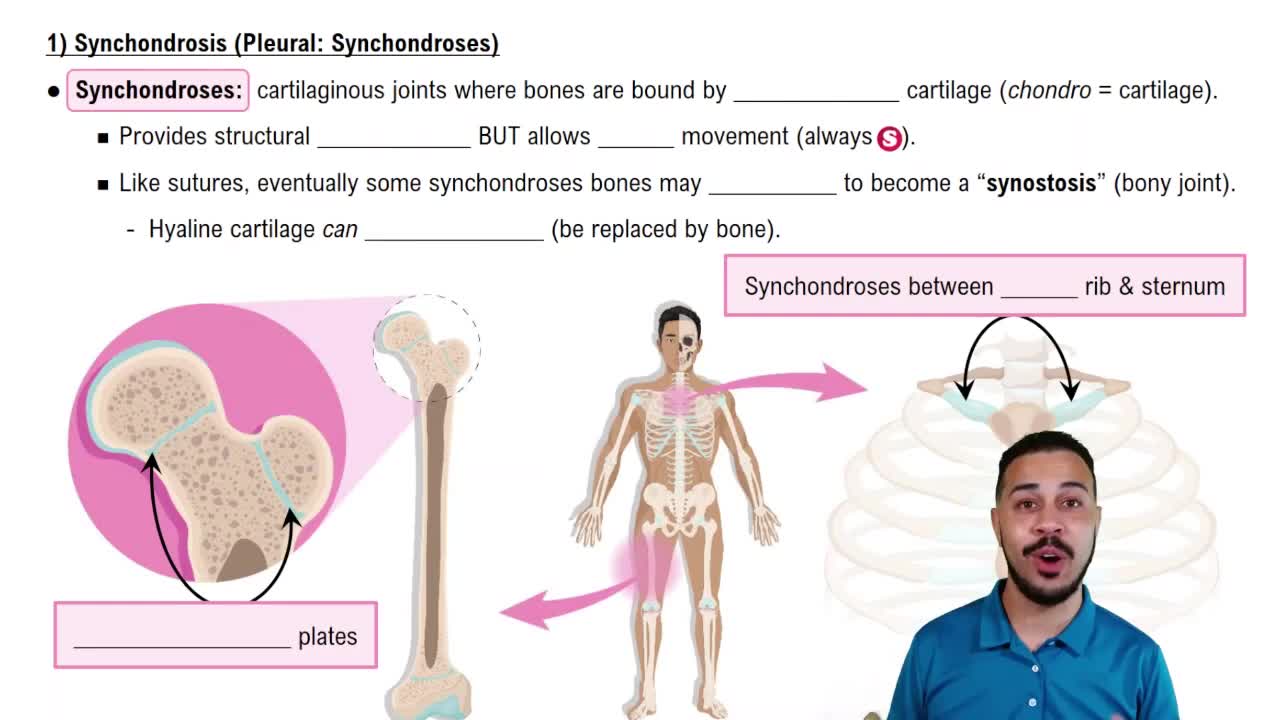
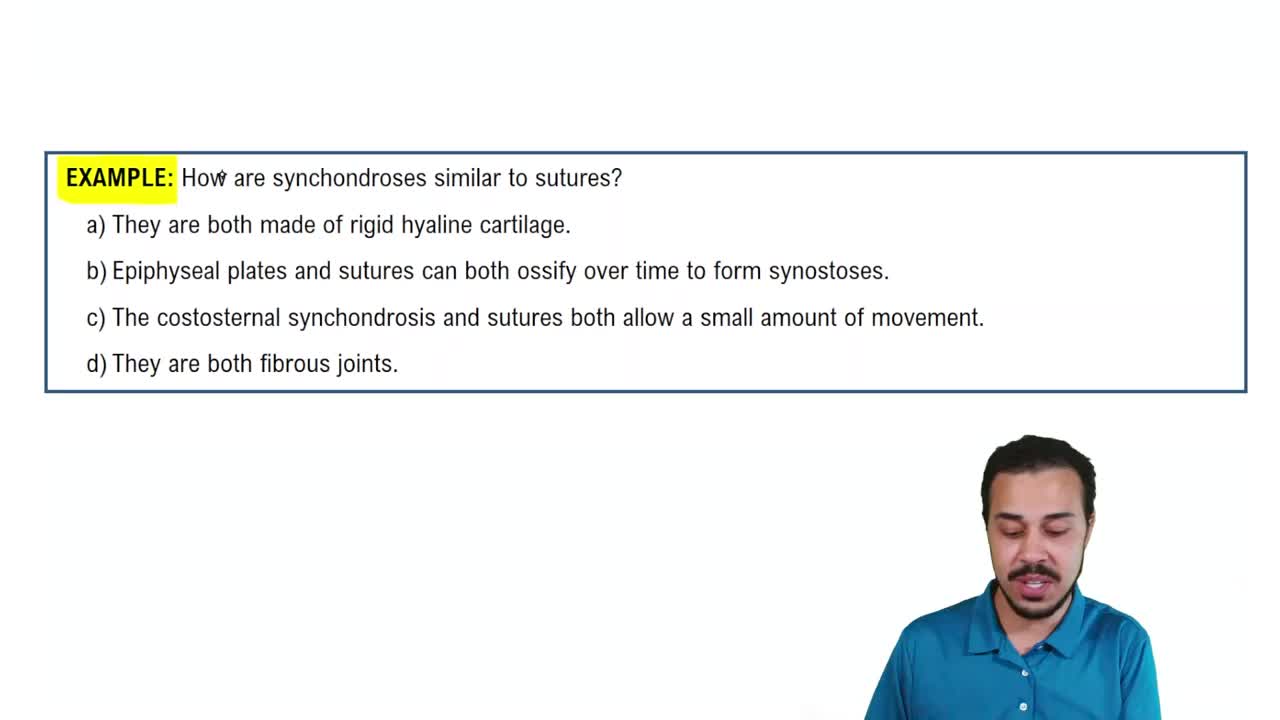
Synchondroses
(bones united by hyaline cartilage) and
symphyses
(bones united by fibrocartilage).
What type of cartilage unites bones in synchondroses?
Hyaline cartilage
unites bones in synchondroses.
Are synchondroses movable or immovable joints?
Virtually all synchondroses are
synarthrotic
, meaning they are immovable.
Give an example of a synchondrosis joint.
The
epiphyseal plates
in growing long bones and the joint between the first rib's costal cartilage and the manubrium of the sternum.
What type of cartilage unites bones in symphyses?
Fibrocartilage
unites bones in symphyses.
What is the function of fibrocartilage in symphyses?
Fibrocartilage is
compressible and resilient
, acting as a shock absorber and allowing limited movement.
What additional cartilage is present in symphyses besides fibrocartilage?
Hyaline cartilage
is present as articular cartilage on the bony surfaces.
Are symphyses movable or immovable joints?
Symphyses are
amphiarthrotic
, providing strength with limited flexibility.
Give two examples of symphyses joints.
The
intervertebral discs
between vertebrae and the
pubic symphysis
of the pelvis.
What type of joint is the epiphyseal plate in children?
A
synchondrosis
where hyaline cartilage unites the diaphysis and epiphysis.
What type of joint are intervertebral discs classified as?
Fibrocartilaginous joints, specifically
symphyses
, not synchondroses.
Is the distal articulation between the fibula and tibia a synchondrosis?
No, it is a
syndesmosis
, not formed by hyaline cartilage.
What type of joint is the pubic symphysis?
A
fibrocartilaginous symphysis
, not a synchondrosis.
What characteristic distinguishes synchondroses from symphyses?
Synchondroses use
hyaline cartilage
and are immovable; symphyses use
fibrocartilage
and allow limited movement.
Why are symphyses important for the spine?
They provide
shock absorption
and flexibility through fibrocartilaginous intervertebral discs.
What happens to the epiphyseal plate synchondrosis over time?
It eventually ossifies and becomes a
synostosis
(bony fusion).
What is the joint cavity status in cartilaginous joints?
Cartilaginous joints
lack a joint cavity
.
How does fibrocartilage contribute to joint function in symphyses?
It provides
strength and flexibility
by being compressible and resilient.
What type of movement do cartilaginous joints generally allow?
They allow
limited or no movement
, depending on the type (synchondroses immovable, symphyses slightly movable).
 BackBack

 01:39