 Back
Anatomical Terms, Regions, Planes, and Body Cavities
 04:19

Terms in this set (29)
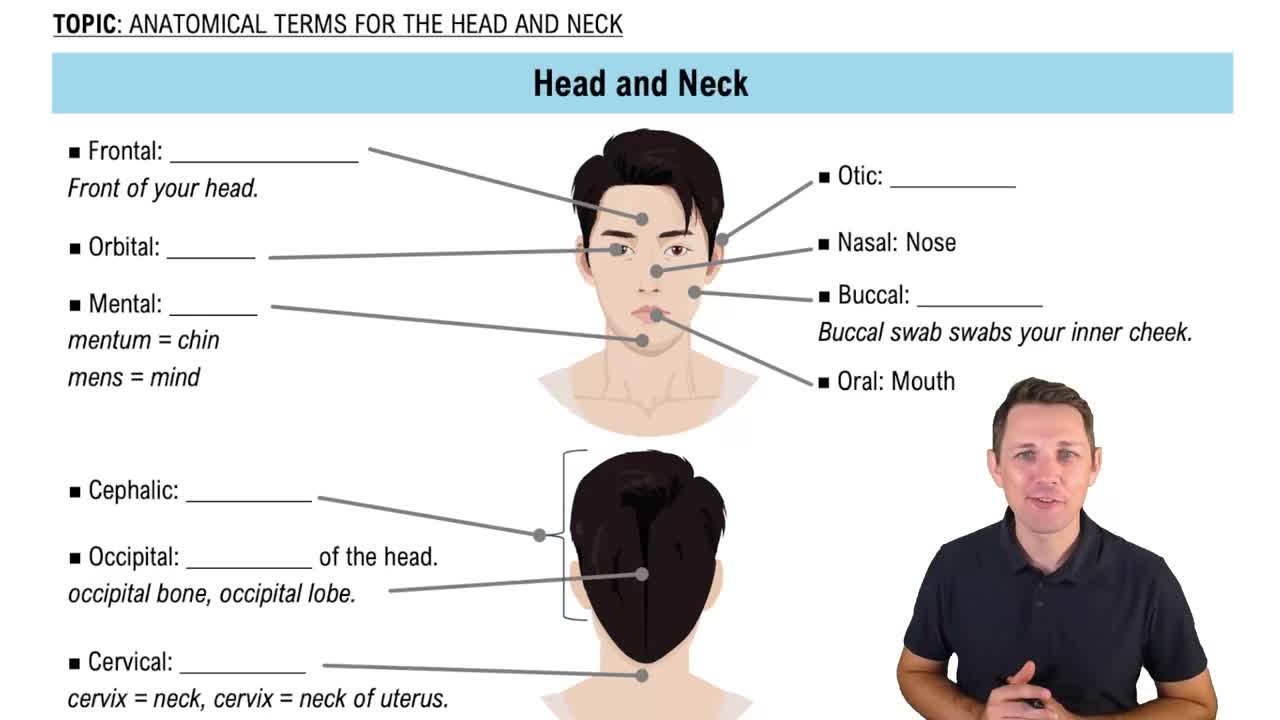
Cephalic refers to the head region.
Cranium is the skull that encloses the brain.
Facial pertains to the face.
Anterior means front or before.
Posterior means back or behind.
Medial means towards the midline of the body.
Lateral means away from the midline of the body.
Proximal means toward an attached base, usually of a limb.
Distal means away from an attached base, usually of a limb.
Sagittal Plane divides the body into left and right parts.
Midsagittal Plane divides the body into equal left and right halves.
Frontal Plane divides the body into front (anterior) and back (posterior) parts.
Transverse Plane divides the body into upper (superior) and lower (inferior) parts.
Dorsal Body Cavity includes the cranial cavity and spinal cavity.
Ventral Body Cavity includes the thoracic cavity and abdominopelvic cavity.
Thoracic Cavity contains the pleural cavities, mediastinum, and pericardial cavity.
Abdominopelvic Cavity is subdivided into the abdominal and pelvic cavities.
Right Upper Quadrant is one of four abdominopelvic quadrants used to locate organs.
Epigastric Region is the central upper region of the abdominopelvic area.
Umbilical Region is the central middle region around the navel.
Hypogastric Region is the central lower region of the abdominopelvic area.
Acromial refers to the shoulder area.
Axilla is the armpit region.
Brachium refers to the arm between shoulder and elbow.
Antebrachium is the forearm, between elbow and wrist.
Carpus refers to the wrist.
Femur is the thigh bone.
Patella is the kneecap.
Tarsus refers to the ankle region.