 Back
BackAnatomy & Physiology 2 final
 7:06
7:06
Terms in this set (662)
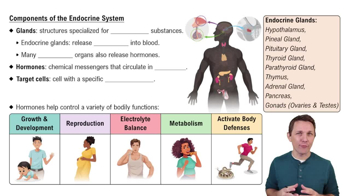
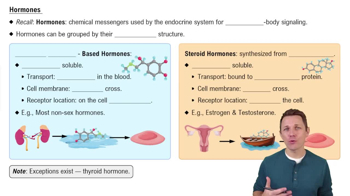
Cholesterol derivatives, hydrophobic, require protein carriers, bind intracellular nuclear receptors, affect gene transcription, lipid soluble, stored in fat.
Amino acid-based, hydrophilic, bind extracellular receptors, use cAMP second messenger system.
Thyroid hormone is an exception: hydrophobic due to tyrosine.
Hormone binds ec membrane receptor. G-protein activates. Adenylate cyclase enzyme activates + catylazes ATP to become cAMP(second messenger). cAMP activates protein kinase A. Proteins are phosphorylated. Cell response occurs.
single amino acids (amine hormones) to several amino acids (peptide hormones) to complete proteins (protein hormones)
Hypothalamus function + what does it control?
Stimulates another endocrine gland to secrete hormones;
controls hormone secretion from other organs.
Not trophic hormones, which induce target cell growth.
Small bean-sized organ in sella turcica of sphenoid bone;
anterior lobe -(adenohypophysis, glandular),
posterior lobe (neurohypophysis, nervous).
Anterior pituitary (adenohypophysis) + posterior pituitary (neurohypophysis).
Large blood vessels formed by merging capillaries; travel through infundibulum;
specialized blood supply between hypothalamus and pituitary gland.
Hypothalamic neurons in paraventricular and supraoptic nuclei produce hormones that travel down infundibulum and stay stored in axon terminals until Action potential fired allowing release into posterior pituitary capillaries.
pathway that tranpsorts adh +oxytocin from hypothalamus to pos pi.
Posterior pituitary function? store + release?
ADH
ADH antidiuretic hormone/vasopresin
Source: Hypothalamus produced Posterior released /stored
Target: Kidney
Effects: Increase kidneys water retention (water reabsorption)
(decrease urine production)
Insertion of aquaporins in tubules cells
Decreases blood solute concentration
Increases blood volume
Oxytocin
Source: Hypothalamus produced Posterior pituitary released/stored
Target: mammary glands + uterus
Effect: Milk let down reflex
infant suckling triggers contraction of glands resulting in milk ejection
positive feedback
Uterus contractions triggered by stretch
Anterior pituitary function? make + release?
FSH
Follicle stimulating hormone
Source: Ant. Pituitary
Target: Gonads
Effects:
secrete chemical to bind + concentrate testosteron
triggers estrogen production + maturation of ovarian follicles
TSH
Thyroid stimulating hormone
Source: Anterior pit.thyrotrophs
Target: Thyroid
Effect: Development/growth of thyroid gland + hormone secretion t3, t4, stimulated by TRH
ACTH
adrenocorticotropic hormone
Source: ant. pit
target: adrenal cortex
Effects: growth of adrenal cortex + production of steroid hormones
LH
Luteinizing hormone (gonadotropin)
Source: Ant.pit
Target: gonads
Effect:
stimulates testosteron production in testes
release of oocyte 4 ovulation and production of estrogen + progesterone
PRL
Prolactin - Non tropic
Source: ant. pit
target: mammary glands
Effect: growth of mammary glands, initiation of milk production + maintenance
GH
Growth hormone - Non tropic
Source: Ant. pit
Target: liver, muscle, fat, cartilage
Effect:
Short - lipolysis(fat breakdown) + gluceonegenesis (new glucose)
decreases muscle uptake of glucose (^ blood glucose)
So cell can use glucose + FA for cell growth.
Long: IGF stimulation
IGF
Insulin like growth factor
Source: liver
target: nearly all cell
Effect: prolong + mediat GH effects - LONG TERM
increases protein synthesis + cell division. + growth
Increases cell uptake of glucose (opposing GH effect)
T3 and T4
Thyroid hormones
Source: Thyroid follicular cells
Target: all body cell
Effect:
regulation of the metabolic rate and thermoregulation,
promotion of growth and development
synergism with the sympathetic nervous system.
Calcitonin
Source: parafollicular cells of thyroid gland
Target: bone osteoclast
effect: decrease in blood calcium from inhibition, short term
PTH
Parathyroid hormone
Source: chief cells of parathyroid glands
Target: bone, kidneys are small intestines
Effect: increased blood calcium
bone breakdown, increase calcium reabsorption from tubule
indirectly enhances dietary calcium in small intestine by stimulating kidney to convert vit D
Aldosterone
mineralocorticoid
Source: adrenal cortex, zona glomerulosa
Target: kidney tubules
Effect: sodium reabsorption + water follows from distal tubule. and H+ and K+ secretion
Increases blood pressure/volume
Cortisol
Source: adrenal cortex glucocorticoid
Target: liver, muscle, adipose tissue, white blood cells
Effect:
Increases gluconeogenesis in liver
Increases protein breakdown in muscle
Increases lipolysis in adipose tissue
^ blood glucose
Inhibits inflammatory response/Helps body respond to stress
Main: insulin and glucagon;
others: thyroid hormone, growth hormone, cortisol.
Islet of Langerhans;
alpha cells secrete glucagon (raises blood glucose),
beta cells secrete insulin (lowers blood glucose).
Glucagon
Source: Produced by alpha cells of pancreatic islets;
Target: liver, muscle, fat
Effect: increases blood glucose by stimulating glycogenolysis(breakdown), gluconeogenesis(new), protein and fat breakdown, and ketone body formationfuel source from FA in liver).
Hypophysis
Pituitary gland
TRH
Thyrotropin Releasing Hormone
Source: Hypothalamus
Target: Ant. pit
Effect: stimulates release of TSH
GnRH
Gonadotropins Releasign Hormone
Source: Hypothalamus
Target: Ant. pit
Effect: stimulates release of gonadotropins FSH,
GHRH
Source: Hypothalamus
Target: Ant. pit
Effect: stimulates release of GH
Thyroid hormone does what?
Thyroid hormones T3 and T4 increase the basal metabolic rate of most body cells. This increases ATP use and heat production, supports normal growth and nervous system development, and increases sensitivity to the sympathetic nervous system.
Target of pth
increased blood calcium
Bone: Stimulates osteoclast releasing calcium ion into blood
Kidney: increases calcium reabsorption from kidney tubules
Small intestine: indirectly enhances dietary calcium/intestine absorption through kidney activation
kidney converts vitamin D to active form (Calcitriol)
What is the modified sympathetic ganglion part of the endocrine system? what hormones does is secrete.
Adrenal medulla: neuroendocrine organ
epinephrine & norepinephrine (effects are similar to the sympathetic nervous system – fight or flight)
portal system
when (hypothalamic ) capillaries drained by (portal) veins then transports to second group of capillaries (in anterior pitituary).
Insulin
Source: beta cells of pancreatic islets
Target: liver, skeletal muscle, cardiac muscle, adipose tissue, some brain areas
Effects:
Decreases blood glucose
Increases glucose, amino, lipid uptake by cells
Increases glycogen + fat synthesis
satiety
Diabetes mellitus – type 1
Destruction of beta cells by immune system, causing low insulin and hyperglycemia. Cells starve because no way to go from blood to cells w/o insulin.
signs
Glucos/ketonuria glucose/ketone in urine
Polyuria: frequent urination
Polydipsia: thirst
Hunger
treatment: insulin injection + monitiring diet
Diabetes mellitus – type 2
Insulin resistance, impaired beta-cell response, body cells do not respond properly to insulin
Cause: heredity + obesity
Similair signs.
treatment: lifestyle changes, insulin
Thymus anatomy
Irregularly shaped organ found in the mediastinum, larger in infants, replaced with adipose in adults
Thymus Function
- Hormones (thymosins) lead to development of T cells – important for immune system
Site of T-lymphocytes(white blood cell) maturation involved in immune response
Thymus secretes hormones thymosin and thymopoietin that target T-lymphocytes for maturation
The gonad organs
ovaries + testes.
the gonads produce the sex steroid hormones that are responsible for gamete production and have multiple other function
Ovaries produce what hormones
Estradiol
Progesterone
Inhibin
Testes produce what hormones
Testosterone - steroid
Inhibin
Pineal gland anatomy
epithalamus, posterior diencephalon
Pineal gland function
Secrete melatonin when ambient light decreases in the evening, and it reaches its peak secretion over the nighttime hours.
Melatonin
Source:pineal gland
Target:brain stem/reticular formation (sleep regulating center)
effect: regulates sleep wake cycle in response to light.
Progesterone
Source: ovaries (corpus luteum)
target: uterus/reproductive tissues
effect: prepares body pregnancy/fetus
peaks after ovulation
mammary gland development
smooth muscle, temp regulation, blood clotting, bone tissue, + metabolism
Estradiol
Source: ovaries, type of estrogen
Target: reproductive organs, bone, blood
Effect
Development of secondary sex characteristics
regulation of menstrual cycle
reduced bone breakdown
increases HDL and decreases LDL cholesterol
blood clot risk
Inhibin
Source: ovaries/testes
Target: anterior pituitary
Primary effect: inhibits FSH secretion through negative feedback
Testosterone
Source: testes
Target: reproductive organs, bone, skeletal muscle, and other tissues
Effect: Development of secondary sex characteristics
increase bone + muscle
Supports sperm production
Stimulates development of male reproductive organs
Calcitriol
Active vitamin D
Source; kidney, stimulated by PTH from para glands
Target: small intestine
Effect: increases intestinal absorption of calcium ions, by conversion to active form
EPO
Erythropoietin
Source: kidney
target: red bone marrow
Effect: stimulates erythrocytes/RBC production, to increase oxygen in blood
Skin hormones
produces a vitamin D precursor in response to UV light.
Liver role in calcitriol production
involved in the vitamin D precursor pathway before vitamin D is activated by the kidneys into calcitriol.
ANP
Atrial natriuretic peptide
Source: cardiac muscle cells of heart
Target: Blood vessel smooth mucle + kidney tubules:
Effect: Causes vasodilation
Increases sodium excretion: natriuresis
Water follows sodium into urine
Decreases blood volume
Decreases blood pressure
Where is the heart located?
Slightly left in the thoracic cavity’s mediastinum, within the pericardial cavity.
pulmonary circuit vs systemic circuit
The right side of the heart pumps deoxygenated blood to the lungs through the pulmonary trunk/arteries.
The left side of the heart receives oxygenated blood and pumps it to the body through the systemic circuit.
What happens in the pulmonary circuit?
Gas exchange occurs between alveoli and pulmonary capillaries: O₂ diffuses from alveoli into blood, and CO₂ diffuses from blood into alveoli to be expired.
What returns oxygenated blood to the left side of the heart?
Pulmonary veins.
What happens in systemic capillaries?
O₂ diffuses from blood into tissues, and CO₂ diffuses from tissues into blood, making the blood deoxygenated and returns by systemic veins to SVC/IVC.
Pulmonary circuit vs systemic circuit pressure
Pulmonary circuit = low pressure, short distance to lungs. Systemic circuit = high pressure, greater distance to body.
What is the mediastinum?
Part of the thoracic cavity that contains the heart, pericardium, and pericardial cavity.
What is the pericardium?
A membranous sac surrounding the heart that helps reduce friction and protect/anchor the heart.
consists of fibrous + serous pericardium
Fibrous pericardium vs Serous pericardium
Tough outer layer of the pericardium that anchors the heart and prevents overfilling.
Thin membrane of the pericardium made of
parietal + visceral layers.
Parietal pericardium
Layer of serous pericardium fused to the inside of the fibrous pericardium.
Visceral pericardium
Layer of serous pericardium that covers the heart surface; also called the epicardium.
Pericardial cavity + fluid
Space between the parietal and visceral pericardium that contains pericardial fluid.
fluid acts as a lubricant and prevents friction as the heart beats.
What are the three layers of the heart wall?
peri/Epicardium, myocardium, endocardium.
Epicardium
Outermost layer of the heart wall; same as the visceral pericardium.
Myocardium
Middle and thickest heart wall layer; composed of cardiac muscle and fibrous skeleton.
Which heart wall layer does the pumping? Myocardium.
Endocardium
Deepest layer that lines the heart lumen/chambers; composed of simple squamous endothelium and continuous with blood vessel lining.
Which heart wall layer lines the chambers?Endocardium.
What does the right/Left atrium receive blood from?
Superior vena cava, inferior vena cava, and coronary sinus.
Pulmonary veins.
Atria vs ventricle function
Receive blood from veins.
Pump blood into arteries.
Right vs Left ventricle function
Pumps blood into the pulmonary trunk/pulmonary circuit.
Pumps blood into the aorta/systemic circuit.
Right vs left ventricle wall thickness
Right ventricle is thinner; cresent
left ventricle is thicker because it pumps against higher systemic pressure.
Atrioventricular/coronary sulcus
External groove separating atria from ventricles; holds right and left coronary arteries.
Interventricular sulcus
External groove marking the separation between the right and left ventricles.
Interatrial septum + what does it contain
Thin internal wall separating the right and left atria.
fossa ovalis indent in the interatrial septum; remnant of fetal foramen ovale.
Interventricular septum
Thick muscular wall separating the ventricles; contracts to help expel blood. AV bundle location
Pectinate muscles
Muscular ridges on the internal anterior surface of the right atrium.
Trabeculae carneae
Ridges - Irregular protrustions of cardiac muscle on the internal ventricular surface.
Papillary muscles
Cord-like structures that attach papillary muscles to AV valve cusps.
What do chordae tendineae and papillary muscles do?
Prevent AV valves from flipping backward into the atria during ventricular contraction.
Main function of heart valves + how do they open/close
Keep blood flowing in one direction and prevent backflow.
In response to pressure changes.
Atrioventricular valves, right + left
AV - Valves between atria and ventricles that prevent backflow into atria during ventricular contraction.
Right AV valve Tricuspid valve; between right atrium and right ventricle. 3 cusps
Left AV valve Bicuspid/mitral valve; between left atrium and left ventricle. 2 cusps
2 Semilunar valves +function
Valves between ventricles and arteries that prevent blood from flowing back into ventricles. 3 cusps
Pulmonary valve SL valve bt right ventricle and pulmonary trunk;
Aortic valve SL valve bt left ventricle and aorta;
Do semilunar valves have chordae tendineae/papillary muscles? No.
What causes heart sounds?
Valve closure and vibrations in the heart/blood vessel walls.
S1 heart sound + when
“Lub”; caused by closing of AV valves.
-Start of ventricular systole/isovolumetric contraction.
-longer and louder
S2 heart sound + when
“Dub”; caused by closing of semilunar valves.
Start of ventricular diastole/isovolumetric relaxation.
Full blood flow pathway through the heart
Systemic capillaries→ systemic veins → SVC → RA → tricuspid valve →RV → pulmonary valve → pulmonary trunk → right/left pulmonary arteries → pulmonary capillaries → pulmonary veins → LA → mitral/bicuspid valve → LV → aortic valve → aorta → systemic arteries → systemic capillaries 2 tissues.
What comes after the pulmonary trunk?
What comes after pulmonary veins?
Right and left pulmonary arteries.
Left atrium.
Pulmonary arteries carry what type of blood?
Pulmonary veins carry what type of blood?
Deoxygenated blood.
Oxygenated blood.
Cardiocytes
Cardiac muscle cells; short, branched, usually one nucleus, many mitochondria, striations; Due to alternating contractile proteins used for tension generation.
Intercalated discs + function/structures
Structures that join adjacent cardiocytes, including pacemaker and contractile cells.
Allow heart muscle cells to contract as a coordinated unit.
Desmosomes - Hold cardiac muscle cells together.
Gap junctions - allow ions to pass between cells for electrical signal communication. AP spread quickly
Autorhythmicity
Ability of pacemaker cells to spontaneously and rhythmically generate action potentials, setting the heart’s rhythm without nervous system input.
Cardiac conduction system + pathway
Three populations of pacemaker cells responsible for action potentials that pace the heart: SA node, AV node, and Purkinje fiber system.
SA node → AV node → AV bundle → bundle branches → Purkinje fibers.
SA node function + location
Sinoatrial
Right atrium, inferolateral to the superior vena cava.
Fastest rate of depolarization; sets sinus rhythm/pace for the heart.
AV node function + location
Atrioventricular
Posteromedial to the tricuspid valve
Delays the signal so atria contract first and ventricles have time to fill before contraction.
AV node delay
Delay in conduction that allows atria to contract before ventricles.
Delays the signal so atria contract first and ventricles have time to fill before contraction.
Purkinje fiber system type
Slowest pacemaker group but conducts signals quickly through the ventricles.
AV bundle, right/left bundle branches, and Purkinje fibers.
Purkinje fiber system structures function
AV bundle : Conducts action potentials between atria and ventricles through the fibrous skeleton.
Bundle branches : Carry the signal down the interventricular septum.
Purkinje fibers : Spread the signal through the ventricles to contact contractile cells.
SA Node/Pacemaker Action Potential
HCN/Na⁺ leak in → threshold → Ca²⁺ in → K⁺ out → repeat.
slow initial deloparization to -40mv threshold
Full depolarization - VG open Ca+ influx
Repolarization: time gate Ca+, VG K+ channels open, K efflux
Hyperpolarization/minimum potential : K+ open until minumum -> close, HCN open, repeats
Contractile Cardiocyte Action Potentials
Depolarization:VG Na⁺ channels open, rapid Na⁺ influx
Initial repolarization : Na⁺ channels inactivate + a small amount K⁺ leaves
Plateau phase: Slow Ca²⁺ influx and K⁺ efflux keep membrane 0 mV.
Repolarization : K⁺ leaves, returning membrane potential to about -85 mV.
Contractile cells
99% of cardiac muscle cells and are triggered by action potentials from pacemaker cells.
have a stable resting membrane potential unlike SA node cells
Why is the plateau phase important?
It prolongs the action potential, allows Ca²⁺ entry, strengthens contraction, lengthens the refractory period, and prevents tetanus.
Electrocardiogram/ECG
Tool for heart examination that records electrical activity of the heart’s contractile cells AP.
Net changes in electrical activity;
P wave
Atrial depolarization + Atrial contraction.
1st wave
contraction of all cells except SA node
SA node contracetion = flat segment after p wave
QRS complex
Ventricular depolarization/Ventricular contraction.
Q = first downward deflection, R = large upward deflection, S = second downward deflection.
Large complex hides atrial repolarization
T wave
Ventricular repolarization.
Occurs After the S wave and before ventricular relaxation.
Cardiac cycle
Sequence of events from one heartbeat to the next.
Atrial systole
Atria contract at the end of filling to eject remaining blood into ventricles. due to pressure build up
Why do atrial and ventricular systole occur at different times?
Because of the AV node delay, which allows atria to contract and ventricles to fill before ventricular contraction.
What controls valve opening/closing during the cardiac cycle?
Pressure gradients, not contraction force directly.
What are the four phases of the cardiac cycle?
Ventricular filling
isovolumetric contraction
ventricular ejection
isovolumetric relaxation.
Ventricular filling
Blood flows from atria into ventricles; AV valves open, semilunar valves closed; ends with EDV.
Isovolumetric contraction
Ventricles start contracting; AV valves close causing S1 Lub; all valves closed, so volume stays the same. EDV
Ventricular ejection
3.Ventricular systole continues; semilunar valves open; blood is ejected.
volume ejected = Stroke volume, SV 70ml
ESV 50 mL
Isovolumetric relaxation
4.Ventricles relax; semilunar valves close causing S2 dub; AV valves are closed; all valves closed, so volume stays the same.
ESV
Starts again when
Ventricular pressure drops, AV valves open, and ventricular filling begins.
EDV vs ESV
End-diastolic volume; blood in ventricles after filling. 120ml
End-systolic volume; leftover blood in ventricles after contraction/ejection. 50mL
Stroke volume
Amount of blood pumped in one heartbeat/cycle.
SV = EDV - ESV.
What happens if EDV increases?
Preload increases, stretch increases, contraction is stronger, and SV increases.
What happens if ESV increases? Less blood was ejected, so SV decreases.
Cardiac output
Amount of blood pumped by each ventricle into the circuits in 1 minute.
CO = SV × HR.
mL/beat × beats/min = mL/min.
What factors affect stroke volume?
Preload, contractility, and afterload.
Preload
Blood/stretch imposed on the heart before contraction; stretch of ventricular cells.
EDV
Frank-Starling law of the heart
EDV is proportional to SV; more blood in the heart before contraction causes more blood to be ejected.
More filling → more stretch → stronger contraction → higher stroke volume.
Contractility? increase/decrease
Strength of contraction for a given preload; tension-generating ability.
increase: More blood is ejected, SV increases, and ESV decreases.
De: Less blood is ejected, SV decreases, and ESV increases.
Afterload? increase/decrease
Resistance to blood being ejected from the ventricles; force the ventricles must overcome.
increase:SV decreases and ESV increases.
Decrease: SV increases and ESV decreases.
Preload, Contractility and afterload affect which volume?
- EDV - pre
- ESV
-ESV
Heart rate + Pulse
Number of heartbeats/cardiac cycles per minute.
The rate at which the SA node generates action potentials.
Pulse: Pressure wave/recoil felt in arteries as blood is ejected from the heart.
pulse reflect HR
Arteries function
Carry blood away from the heart.
They are the distribution system of the vasculature.
branch into smaller
Capillaries function
Very numerous, tiny vessels where exchange happens in beds.
They are the exchange system.
Vein function
Veins
-They are the collection system and also act as blood reservoirs because they hold a lot of blood at low pressure.
merge into larger
Tunica intima
Innermost layer.
Contains endothelium, which is simple squamous epithelium lining the lumen.
Tunica media
Middle layer. Contains smooth muscle, allowing vasomotion.
Vasomotion = changing vessel diameter.
Tunica externa
AKA adventivia
Outermost layer.
Connective tissue that supports/protects the vessel. prevents overstretch
Elastic arteries
largest w estatic tissue to stretch + recoil w heartbeat
internal and external elastic lamina on either side of tunica media helps w recoil
under high pressure
Muscular arteries
named for organs/regions
deliver blood to specific organs.
thick tunica media
Arterioles
Small arteries that control blood flow into tissues.
They are major resistance vessels.
Metarterioles
Smallest arteriole that connect arterioles to capillary beds.
directly feed capillary beds into most tissues
Precapillary sphincter
Ring of smooth muscle that controls whether blood enters a capillary bed.
Open or close to control blood flow into true capillaries.
Continuous capillaries
Least leaky.
Have tight junctions. transcytosis
Found in places like muscle, skin, nervous tissue, and connective tissue.
Fenestrated capillaries
Have pores/fenestrations.
More leaky than continuous capillaries. allow water = small solutes thru osmosis
ound where rapid exchange is needed, like kidneys, endocrine glands, and small intestine.
Sinusoid capillaries
Leakiest.
Large gaps/irregular structure.
Allow large substances or cells to pass.
Found in liver, spleen, bone marrow, and lymphoid organs.
Vein features
large lumens
thinner walls than arteries
valves to prevent backflow
blood reservoir
Venous valves
Prevent blood from flowing backward, especially in limbs where blood has to move against gravity.
Anastomosis
Connection between vessels bt alternative path of blood flow.
Collateral circulation
Alternate pathway for blood flow if one vessel is blocked.
Arterial anastomosis
Connection between arteries to meet tissue demands. common for heart + brain
Venous anastomosis
Connection between veins via small calaterals creating weblike networks that can be seen under skin
Arteriovenous anastomosis
Direct connection between an artery and a vein without going through a capillary bed.
This acts like a shunt.
-can regulate temp through blowflow to the skin or redirect blood away from non functioning organs in fetus
Hemodynamics
Study of blood flow.
Blood flow speed
fastest in arteries → slowest in capillaries → increases again in veins
but still slower than artery
Perfusion
Blood flow to an area of tissue through capillary bed.
Blood pressure
Blood pressure = force blood exerts on vessel walls.
Blood flow is _ proportional to resistance
Blood flow is inversely proportional to resistance; that is, as resistance increases, blood flow decreases.
Systolic pressure vs Diastolic pressure
Pressure during ventricular contraction.
Pressure during ventricular relaxation.
pulse pressure
Difference between systolic and diastolic pressure.
120/80 → pulse pressure = 40 mm Hg.
MAP
Mean arterial pressure.Average arterial pressure during one cardiac cycle.
MAP = diastolic pressure + 1/3 pulse pressure
pulse pressure (systolic - diastolic)
95mmHG
Pressure through vessels
highest + pulsatile in arteries
↓dampens in arterioles
↓lower and smoother in capillaries
↓very low and smooth in veins
Arterioles are where pressure drops a lot because they create major resistance.
What determines blood pressure?
1. Cardiac output
-If CO increases, BP usually increases.
2. Blood volume
-If blood volume increases, BP increases.
3. Peripheral resistance
-If resistance increases, BP increases.
Peripheral resistance affected by?
blood vessel radius, blood viscosity, and blood vessel length
Longer vessels = higher resistance.
Thicker blood = higher resistance.
Small changes in radius cause big changes in resistance.
Local control of Blood Pressure and Flow
Vasomotion
Local vessels can constrict/dilate to direct blood to specific organs or tissues.
Example: active skeletal muscle gets more blood during exercise.
Neural control of Blood Pressure and Flow
Sympathetic
norepinephrine and epinephrine
Increase BP, HR, contractility, cardiac out, PR, vasoconstriction
Parasympathetic
acetylcholine
Decrease BP, HR, CO, contractility (mild)
_ and _are the two factors that determine the pressure gradient driving circulation.
Cardiac output and peripheral resistance are the two factors that determine the pressure gradient driving circulation.
CO*PR=
Venous Return
Venous return = blood returning to the heart.
Because veins have low pressure, they need help.
Skeletal muscle pump
Skeletal muscles squeeze veins during movement.
Valves prevent backflow, so blood moves toward the heart.
Respiratory pump + exercise + inactivity
Pressure changes during breathing help move venous blood back to the heart.
Increases venous return because skeletal muscle pump is more active.
Can cause venous pooling because blood is not being pushed back efficiently.
Most important physiological factor contributing to perheal resistance
vessel radius = most important physiologically
Hormonal control of Blood pressure (long term + Raises)
Renin
Released by kidneys when BP is low.
Angiotensin II
Powerful vasoconstrictor
Raises peripheral resistance + BP
+ stimulates aldosterone
Aldosterone
Increases Na⁺ kidneys reabsorption
Water follows Na⁺, so blood volume increases
raises BP
ADH
Inc kidney water retention
Raises blood volume + BP
Hormonal control of Blood pressure (long term + lowers)
ANP
Released by the heart when blood volume is high.
Promotes sodium and water loss.
Lowers blood volume and BP.
RAAS + ADH = raise BP
ANP = lowers BP
Hypertension
High blood pressure.
20%, associated w heart, kidney disease, etc. 1 modifiable risk factor = silent killer
Hypotension
Low blood pressure.
hypovolemia - reduced blood volume, from fluid loss,
Capillary exchange
Diffusion through endothelial cells
Used for lipid-soluble substances to enter/exit cell to blood or fluid
Examples: travel of nutrients, ions, wastes,
oxygen
carbon dioxide
Filtration
Movement of fluid by force out of the capillary due to pressure.
HP -hydrostatic pressure
The force that a fluid exerts on the wall of its container. Drives water out
Blood hydrostatic pressure drives fluid out of capillary
Reabsorption
Movement of fluid back into the capillary.
Blood colloid osmotic pressure/COP
Pulls fluid into the capillary.
due to plasma proteins, especially albumin.
Sum of forces
The direction of fluid movement depends on the balance between:
hydrostatic pressure pushing fluid out
colloid osmotic pressure pulling fluid in
Net filtration vs Net reabsorption
More fluid moves out.
More fluid moves in.
Edema
Excess fluid in the interstitial space.
Can happen if:
hydrostatic pressure is too high
colloid osmotic pressure is too low
capillaries become too leaky
Major Systemic Arteries - aorta
Ascending aorta - 3 branches
Brachiocephalic trunk - 2 branches
right subclavian artery
right common carotid artery
Left common carotid artery
Left subclavian artery
Thoracic, abdominal = descending
Common iliac arteries - Terminal branches of abdominal
internal iliac artery
external iliac artery
Head arteries
Vertebral artery
Helps supply brain. branch of right subclavian
External carotid artery - branch from common anteriorly
Supplies superficial head, face, and neck.
Internal carotid artery - Branch from common superiorly
Supplies brain and eyes.
3 Aorta branches
Brachiocephalic trunk - 2 branches
Left common carotid
Left subclavian
2 Brachiocephalic trunk - 2 branches
Right common carotid
Right subclavian
Abdomen arteries
Celiac trunk
Supplies upper abdominal organs like stomach, liver, spleen, pancreas.
Superior mesenteric artery
Supplies small intestine and much of large intestine.
Renal artery
Supplies kidneys.
Inferior mesenteric artery
Supplies remaining large intestine.
Upper limb arteries
Subclavian → axillary → brachial → radial + ulnar
Subclavian → Armpit. axillary → media upper arm .brachial → . thumb radial + ulnar. pinky
Lower limb arteries
External iliac → femoral → popliteal → anterior tibial + posterior tibial
bigger. External iliac → straight branch. femoral → kneee. popliteal → anterior tibial + posterior tibial
Left and right brachiocephalic veins
Merge to form the superior vena cava.
left side = 3rd aorta branch
Superior/Inferior vena cava
Drains blood from structures superior/inferior to the diaphragm into the right atrium.
Veins that drain the head
External jugular vein
Drains superficial face/head/neck.
Internal jugular vein
Drains brain, deep head, and neck.
Vertebral vein
Drains posterior neck.
all from right brachiocephalic vein
Draining the upper limb
Superficial/deep pathway includes:
ulnar vein
radial vein
median cubital vein - arm fold
basilic vein - Basic Boob
cephalic vein - outer
brachial vein
axillary vein
subclavian vein
Median cubital vein is commonly used for drawing blood.
Draining the lower limb
Great saphenous vein
Superficial medial lower limb.
Femoral vein
Major deep vein of thigh. middle unlike artery
Hepatic portal vein
Carries nutrient-rich blood from digestive organs/spleen to the liver for processing.
Hepatic veins
Drain processed blood from the liver into the inferior vena cava.
Higher up and 2
Hepatic portal vein vs Hepatic veins
Hepatic portal vein = goes TO liverHepatic veins = leave liver TO IVC
Blood composition
Blood is a fluid connective tissue made of: Plasma, Serum, formed elements, Hemocrit
Plasma
matrix of blood; contains plasma proteins (albumins, globulins, fibrinogen), nutrients, dissolved gasses and electrolytes
plasma proteins
Albumins: help maintain colloid osmotic pressure, which keeps water in the blood
Globulins: include transport proteins and immune proteins/antibodies
Fibrinogen: clotting protein that gets converted into fibrin during coagulation
Serum
plasma without clotting proteins/fibrinogen, fluid left after clotting happens
plasma = liquid part of blood before clotting
Formed elements
Cells/cell fragments in blood:
Erythrocytes/RBCs
Leukocytes/WBCs
Platelets - cell fragments
Hematocrit
Hematocrit = percentage of whole blood that is RBCs.
Erythrocytes / red blood cells
Biconcave disc + surface area good 4 gas exchange
Lack organelles, nucleus, DNA
Contain hemoglobin
Contain carbonic anhydrase, which helps with carbon dioxide transport
Their main job is gas transport, especially oxygen.
Hemoglobin
Large protein that consists of four polypeptide subunits: two alpha (α) chains and two beta (β) chains.
4 globin proteins
4 heme groups
Each heme group contains iron, + the iron binds oxygen.
Heme = holds oxygen because it has iron.
RBC lifespan and breakdown
RBCs last about 4 months, or about 100–120 days.
RBC graveyard
The spleen is called the RBC graveyard because old/damaged RBCs are trapped and broken down there.
hemoglobin is broken down
Globin proteins → amino acids, Iron → recycled
Heme → converted to bilirubin
Bilirubin is secreted in bile
Heme is converted to what?
Heme → converted to bilirubin
Bilirubin is secreted in bile
where is bilirubin secreted
bile
Erythropoiesis
RBC production in bone marrow,
What stimulates Erythropoiesis
EPO stimulated from kidney or liver when o2 leves low in blood = hypoxemia
reticulocyte
immature RBC precursor.
It still has some leftover organelles/ribosomes but no nucleus. It matures into an erythrocyte.
Mature blood structure is that way bc?
Adaptation maximizes internal space for hemoglobin (for oxygen transport) and carbonic anhydrase (for CO2 transport/pH balance), allowing for efficient gas exchange and high deformability in capillaries.
Blood types based on
Blood type is based on antigens found on RBCs.
ABO blood type
Type A, A antigen, anti-B antibodies
Type B, B antigen, anti-A antibodies
Type AB, A+B antigen, No anti-A/B antibodies
Type O, no A or B antigens, Anti-A + anti-B
Rh blood type
Positive
D/Rh antigen is present on RBCs
Negative
No D/Rh antigen on RBCs
Antibodies D only form only when an Rh-negative person is exposed to Rh-positive blood + antigen.
Hemolytic disease of the newborn
Mother is Rh-negative
Fetus is Rh-positive
Mother becomes exposed to fetal Rh+ RBCs
Mother makes anti-Rh antibodies
In a later pregnancy, those antibodies can cross the placenta and attack fetal RBCs
Agglutination
antibodies attach to antigens on different RBCs and make them clump.
potentially leading to hemolysis
Transfusion compatilbility;
Recipient antibodies cannot attack donor RBC antigens.
Leukocytes / white blood cells
WBCs are involved in immune defense. Use blood to reach tissues (buffy coat).
Large w nucleus
Leukocytes categories
Granulocytes: contain cytoplasmic granules that the cells release when activated
neutrophils, eosniphil, basophil
AGranulocytes: lack visible cytoplasmic granules.
lympocytes (B+T)
monocyte
Never Let Monkeys Eat Bananas
Leukopoiesis
production of WBCs, in bone marrow, all leukocytes arise from hematopoietic stem cells (HSCs). split into two cell lines.
Neutrophils
Function:
Phagocytosis of bacteria
3-5
High-yield memory: Neutrophils = bacteria eaters.
Eosinophils
Function:
Increased in allergies
2 bilobed, RED
Also involved with parasitic worm infections
Basophils
Function:
Release inflammatory mediators
S shaped, purple
Bae stop dont flame media
Lymphocytes
B lymphocytes + T lymphocytes - Agranulocyte
Involved in immune response
B cells make antibodies
large nuclues, blue
T cells attack infected/cancerous cells and help coordinate immune response
Monocytes
Agranulocyte
Leave blood and become macrophages
u- shaped, purple
Macrophages phagocytize pathogens, dead cells, and debris
Platelets
cell fragments, important in hemostasis =stopping blood loss.
Not true full cells, lack nucleus but have mitochondria
Made from megakaryocyte fragments
Platelets made from?
megakaryocyte fragments and help in hemostasis
Thrombopoiesis
platelet production.
megakaryoblasts/megakaryocyte
megakaryoblasts turn into megakaryocyte, undergo uncomplete division.
large + mature megakaryocytes extend ribbon-like “arms,” or extensions, filled with cytosol, granules, and several organelles.
force of blood cuts arm into small piece = platelet
Each arm can give rise to thousands of platelets
Hemopoiesis / Hematopoiesis
Hemopoiesis = production of blood formed elements/cells
Red bone marrow
Produces:
RBCs
WBCs
Platelets
Hemostasis
Hemostasis = stoppage of blood flow/loss from a damaged vessel.
Vascular spasm
Platelet plug formation
Coagulation
clot retractionn
clot retraction, brings the edges of the wounded vessel closer together + secretes serum
thrombolysis
dissolving clot
1. Vascular spasm
The damaged vessel constricts.
Purpose:
Decreases blood vessel diameter
Reduces blood flow
Limits blood loss = tissue. repair
2. Platelet plug formation
Platelets stick/aggregate to the damaged area and to each other.
Purpose:
Creates a temporary plug over the injury to exposed elastic fibers + release granule content to attract +
3. Coagulation
Coagulation makes the platelet plug stronger.
Key reaction: Thrombin(platelet) converts fibrinogen into fibrin.
Fibrinogen = inactive soluble clotting protein
Fibrin = sticky threadlike protein that glues the clot together
what is fibrogen/fibrine and what activates/converts it?
Thrombin(platelet) converts fibrinogen into fibrin.
Fibrinogen = inactive soluble clotting protein in platelet
Fibrin = sticky threadlike protein that glues the clot together
Heparin
Heparin is an anticoagulant.
It prevents or slows clotting.
Thrombus vs. embolus
Thrombus
A clot that forms and stays in one place in a vessel
Embolus
A clot or piece of material that breaks loose and travels through the bloodstream
Functions of the lymphatic system - FIL
FIL
Fluid recovery
return excess interstitial fluid back 2 bloodstream so blood volume + Bp dont drop
Immunity
lymphatic organs+tissues help trap pathogens+house immune cells
Lipid absorption
lymphatic capillaries in small intestine absorb dietary fats too large to enter blood capillaries directly
Lymph
interstitial fluid once it enters lymphatic vessels
Plasma leaks out of blood capillaries → becomes interstitial fluid → enters lymphatic capillaries → now called lymph.
Can contain: water solutes proteins immune cells pathogens dietary fats from the small intestine
Lymphatic collecting vessels
move lymph back toward the blood.
merge to form trunks
capillaries – closed at one end
collecting vessels, lymphatic trunks, two lymphatic ducts (right lymphatic duct + thoracic duct) drain into subclavian veins
Lymphatic capillaries
Smallest lymphatic vessels around BV
Key features: away from tissues
closed at one end, very leaky
collect extra interstitial fluid, allow immune cells/pathogens to enter
special lymphatic capillaries in small intestine are called lacteals, which absorb fats
lacteals
special lymphatic capillaries in small intestine are called lacteals, which absorb fats
Lymph flow pathway
Interstitial fluid → lymphatic capillaries → lymph-collecting vessels → lymphatic trunks → lymphatic ducts → subclavian veins → blood
The vessels get larger as lymph moves closer to the bloodstream.
Lymphatic trunks
merged collecting vessels
Lymphatic trunks drain lymph from body regions.
lumbar trunks: lower limbs and pelvis
intestinal trunk: fats from small intestine
jugular trunks: head and neck
subclavian trunks: upper limbs
Two lymphatic ducts
Right lymphatic duct
Drains R upper body
R side of head/neck, upper limb +thorax
drains into junction of right internal jugular+subclavian veins
Thoracic duct
Drains remaining
lower body
L side of head/neck, upper body, thorax, upper limb
drains into Left internal jugular+subclavian veins junction
Lymphatic cells
immune cells found in lymphatic tissues/organs.
Natural killer cells
T lymphocytes / T cells
B lymphocytes / B cells
Plasma cells
Macrophages
Natural killer cells
Kill abnormal cells, like virus-infected cells and cancer cells, without needing a super-specific antigen match.
T lymphocytes / T cells lymphatic
help activate immune responses
kill infected or abnormal body cells
They mature in the thymus.
B lymphocytes / B cells lymphatic
Important for antibody-mediated immunity.
B cells can differentiate into plasma cells.
Plasma cells
Plasma cells produce antibodies.
B cell → plasma cell → antibodies
Macrophages lymphatic
Macrophages are phagocytes.
engulf pathogens
clean up dead cells/debris
help activate other immune cells by presenting antigens
Lymphatic tissue
reticular connective tissue filled with immune cells. makes up organ tissue
fibers form little “nets” that trap pathogens so immune cells can attack them.
MALT
MALT = mucosa-associated lymphatic tissue
clusters of b/t cells
It protects mucous membranes, which are areas exposed to pathogens.
respiratory tract
digestive tract
genitourinary tract
Specialized MALT
specialized lymphoid follicles conisting primary of b cells
tonsils (pharyngeal, palatine, lingual)
Peyer’s patches (small intestine ileum)
appendix (off large intesitne)
Lymphatic organs
Red bone marrow, thymus, lymph nodes, tonsils, spleen
Red bone marrow lymphatic
site of blood cell production
B cells mature here
Thymus - lymphatic
T cells mature here
secretes thymosins that help T cell development
The thymus is most active in children and shrinks with age.
no follicles so no b cells
Lymph nodes
bean shaped organs
filter lymph
trap pathogens
house B cells, T cells, macrophages, and dendritic cells
Lymph nodes swell when immune cells are activated and multiplying.
cervical nodes: neck axillary nodes: armpit
inguinal nodes: groin mesenteric nodes: abdomen
Tonsils
Specialized MALT near oral/nasal cavities.
trap pathogens entering through mouth/nose
Types:
pharyngeal tonsil/adenoid
palatine tonsils
lingual tonsil
Spleen
Largest lymphoid organ.
filters blood, not lymph
removes pathogens from blood
destroys old RBCs
white pulp = immune function, filters pathogens
red pulp = destroys old erythrocytes/RBCs
red dead
Lymphatic system composed of
Lymphatic vessels - blinded ended tubes
Lymphatic tissue/organ w clusters of lymphoid follicles(tonsils, lymph nodes, spleen)
Metabolism
all chemical reactions in the body.
Catabolism = breaks molecules down Purpose: releases energy / makes ATP Example: glycolysis, glycogenolysis, lipolysis
Anabolism = builds molecules up Purpose: stores energy / builds body structures Example: glycogenesis, gluconeogenesis, lipogenesis
Glycolysis
Breakdown of glucose.Glucose is split into smaller molecules to help make ATP.
Glycogenesis
Production of glycogen from glucose.
This happens when blood glucose is high and the body wants to store extra glucose.
Glycogenolysis
Breakdown of glycogen into glucose.
This happens when blood glucose is low and the body needs more glucose
Gluconeogenesis
Production of new glucose from non-carbohydrate sources.
Sources can include amino acids, glycerol, lactate, or other compounds.
Lipogenesis
Production of lipids/fats.
This happens when the body has extra nutrients/energy and stores them as fat.
Lipolysis
Breakdown of lipids/fats.
This happens when the body needs energy from stored fat.
Proteins. building block
Amino acids are the building blocks of proteins.
Proteins are broken down into amino acids, and amino acids can be used to build new proteins.
Essential vs. nonessential amino acids
Essential amino acids = the body cannot make them, so they must come from the diet.
Nonessential amino acids = the body can make them.
Complete vs. incomplete proteins
Complete protein = contains all essential amino acids.
animal
Incomplete protein = missing one or more essential amino acids.
Many plant proteins are incomplete by themselves, but they can be combined.
are proteins stored
Proteins are not stored
The body does not store extra amino acids the way it stores glucose as glycogen or fat as triglycerides.
body will convert them into glucose or fat, or use parts of them for energy.
Cholesterol
Cholesterol is a lipid/steroid molecule.
cell membranes
steroid hormone production
vitamin D production
bile salt production
Cholesterol is not mainly used for fuel like triglycerides are.
Lipoprotein complexes
Because lipids are hydrophobic, they do not travel well in watery blood/plasma by themselves.
So the body packages lipids into lipoprotein complexes.
HDL and LDL are not cholesterol. They are lipoprotein carriers that transport cholesterol.
Chylomicrons
Chylomicrons carry dietary lipids from the small intestine into lymph/blood.
VLDL
VLDL = very low-density lipoprotein
Source: produced by the liver
Function: transports triglycerides from the liver to adipose tissue.
Once triglycerides are removed from VLDL, it becomes LDL.
LDL
LDL = low-density lipoprotein
Function: delivers cholesterol to body cells.
Cells need cholesterol for:
cell membranes + steroid hormone production
LDL = “bad cholesterol” = misleading.
too much LDL means more cholesterol is being delivered to tissues
can contribute to plaque buildup in arteries.
HDL
HDL = high-density lipoprotein
Source: produced by the liver as an “empty shell.”
Function: picks up excess cholesterol from tissues and takes it back to the liver.
The liver can eliminate cholesterol in bile.
"good cholesterol" misleading
lipoprotein that removes excess cholesterol.
Respiratory system functions
gas exchange of O2 + co2
helps w speech
regulate blood ph
assist w venous blood/lymph flow pressure (pump)
hormone related - angiotensin II production
Conducting zone
conducting zone moves air in and out of the body but does not do gas exchange. It includes structures like the nose, pharynx, larynx, trachea, bronchi, and most bronchioles.
Air is filtered, warmed, and moistened as it travels in/out
respiratory system upper/lower
he upper respiratory tract includes the passageways from the nasal cavity to the larynx.
The lower respiratory tract includes the passageways from the trachea to the respiratory tract’s terminal structures, the alveoli.
respiratory zone
where gas exchange happens. It includes the respiratory bronchioles, alveolar ducts, alveolar sacs, and alveoli.
Respiration
provides the body’s cells with oxygen and removes the waste product carbon dioxide.
Respiratory epithelium
pseudostratified ciliated columnar epithelium with goblet cells.
Goblet cells secrete mucus, which traps debris and particles.
cilia move the mucus toward the pharynx so it can be swallowed or expelled.
Nose/Nasal cavity function
1st part of respiratory tract
warm and humidify the inhaled air;
filter out debris from inhaled air and secrete antibacterial substances;
house olfactory receptors; for smell
enhance the resonance of the voice (
Nose anatomy
Paired nasal bones
Lateral/alar cartilages
anterior nares - paired nostril openings
nasal septum - divides in to l/r sections
nasal concha (superior, middle, inferior)
nasal meatus (superior, middle, inferior)
nasal concha (superior, middle, inferior)
nasal meatus (superior, middle, inferior)
Meatuses are the air lanes. the lines
The conchae increase surface area + help create turbulenceo air can be warmed, moistened, and filtered more effectively.
Pharynx
Throat portion after posterior nares
passageway posterior to the nasal and oral cavities
nasopharynx, oropharynx, and laryngopharynx.
Nasopharynx
Behind the nasal cavity. It extends from the posterior nares to the uvula.
lined with pseudostratified ciliated columnar epithelium
so it continues warming, humidifying, and filtering air.
Oropharynx
behind the oral cavity.
Both air and food pass through it
lined with nonkeratinized stratified squamous epithelium, which protects against abrasion.
Laryngopharynx
extends from the hyoid bone to the esophagus.
Both air and food pass through it
lined with nonkeratinized stratified squamous epithelium, which protects against abrasion.
Larynx
voice box
connects the pharynx to the trachea
keep food and liquid out of the airway and is involved in sound production.
epiglottis
helps prevent food and liquid from entering the airway during swallowing
thyroid cartilage
Large cartilage of the larynx, often called the Adam’s apple.
cricoid cartilage
sits inferior to the thyroid cartilage
Vestibular folds, vocal cords, glottis
false vocal cords, They help protect the airway
true vocal folds, produce sound when air passes through and causes them to vibrate.
glottis is the opening between the vocal cords.
Trachea
windpipe
carries air from the larynx into the bronchial tree
open posteriorly so the esophagus can expand during swallowing.
posterior part of the trachea has smooth muscle and elastic connective tissue.
carina = last trachea ring w sensory recptors that trigger cough
Bronchial tree + flow
trachea branches at carina to form L/R primary bronchi
branching airway system inside the lungs
bronchioles continue branching until they reach the respiratory zone.
Trachea → primary bronchi → secondary bronchi → tertiary bronchi → bronchioles → respiratory bronchioles → alveolar sacs
respiratory bronchioles
1,2,3, bronchioles then respiratory
beginning of the respiratory zone
2/3 from terminal surrounded w thing smooth muscle bands
lead to alveolar sacs(clusters of alveoli)
start of gas exchange
Alveoli
Alveoli are tiny air sacs where oxygen and carbon dioxide are exchanged between air and blood.
alveolar sacs = clusters
alveolar cells
Type I alveolar cells
Type I alveolar cells are thin squamous cells. Their thinness allows rapid gas diffusion.
Type II alveolar cells
produce surfactant to reduce surface tension + keep them open + not collapse, cuboidal
Alveolar macrophages
phagocytize particles, debris,+ pathogens in alveoli
Respiratory membrane
thin barrier that gases must cross to move between the alveoli and pulmonary capillary blood.
Type I squamos alveolar cells
shared basal lamina
Capillary endothelial cell
Pleurae
lungs serous membrane
Visceral pleura
The visceral pleura is attached directly to the lung surface.
Parietal pleura
The parietal pleura lines the inner wall of the thoracic cavity.
Pleural cavity
The potential space between the visceral and parietal pleurae
contains pleural fluid, which reduces friction as the lungs move during breathing.
Pulmonary ventilation + why does air move
breathing = inspiration/expiration
pressure gradients
Gas moves from an area of higher pressure to lower pressure.
what do respiratory bronchioles end in
2-3 alveolar sacs
what is structures between air in alveolus and blood in capillary (must be crossed for gas exchange)
respiratory membrane
Diaphragm is the _ and its does what when it contracts
prime mover 4 inpsiration
When the diaphragm contracts, it moves downward, increasing thoracic cavity volume.
This lowers intrapulmonary pressure and pulls air into the lungs.
When volume increases, pressure decreases.
When volume decreases, pressure increases.
boyle ^
Other muscles involved in respiration
external intercostals assist with inspiration by helping expand the thoracic cage.
internal intercostals are important during forced expiration.
Airway resistance
If the airway diameter decreases, resistance increases and airflow decreases.
Intrapleural pressure
pressure inside the pleural cavity
slight vacuum between visceral and parietal pleurae
normally lower than atmospheric pressure, creating a slight vacuum.
helps keep the lungs expanded against the thoracic wall
if disrupted, the lung may collapse.
Inspiration
Diaphragm contracts → thoracic volume increases
causes intrapulmonary pressure to decrease below atmospheric pressure.
air flows into lungs increasing lung volume
→ lung volume increases → intrapulmonary pressure decreases → air flows in
Exhalation
Normal quiet exhalation is passive
inspiratory muscles relax and the lungs recoil due to elastic tissue.
Muscles relax → lung volume decreases → intra pressure increases above Atm → air flows out
Forced exhalation uses muscles, like abdominal muscles and internal intercostals.
Pneumothorax
-air enters the pleural cavity.
-disrupts the normal intrapleural pressure/vacuum that holds the lung open.
-lungs collaspe risk
-bc it is no longer being pulled outward against the thoracic wall.
Factors influencing pulmonary ventilation
airway resistance, alveolar surface tension, and pulmonary compliance.
Airway resistance
A smaller airway diameter causes more resistance and less airflow.
A larger airway diameter causes less resistance and more airflow.
Diameter of airway has major influence on _ ? Broncho?
airflow - controlled by the contraction or relaxation of the smooth muscles of the bronchioles
Bronchodilation means the airways widen. This decreases resistance and increases airflow.
Bronchoconstriction means the airways narrow. This increases resistance and decreases airflow.
Alveolar surface tension
tension is caused by water molecules lining the alveoli
tension tends to pull the alveoli inward and could promote collapse.
Surfactant from Type II alveolar cells reduces surface tension, making it easier for alveoli to stay open and for the lungs to expand.
pumonary compliance
ability of the lungs and the chest wall to stretch, a property known as distensibility ( not elasticity)
Pulmonary compliance is how easily the lungs expand
High compliance means the lungs expand easily.
Low compliance means the lungs are stiff and harder to inflate
Restrictive lung diseases
Pulmonary volumes and capacities are measured with
These are measured with a spirometer.
TV = normal breath. IRV = extra in. ERV = extra out. RV = stuck air. VC = max usable exhale after max inhale. TLC = everything.
Tidal volume
TV- 500mL
amount of air inhaled or exhaled during a quiet breat
Inspiratory reserve volume
IRV
extra air that can be inhaled after a normal tidal inhalation
during forced inhalation.
Expiratory reserve volume
ERV
-extra air that can be exhaled after a normal tidal exhalation
during forced exhalation
Residual volume
RV
-air remaining in the lungs after maximum exhalation
-This air cannot be voluntarily exhaled.
Vital capacity
VC - 4700mL
-maximum amount of air that can be exhaled after a forced inspiration.
-the total amount of exchangeable air, or the total amount of air that can move in and out of the lungs. It is equal to the sum of the TV, IRV, and the ERV
TV + IRV + ERV
Inspiratory capacity
IC
the total amount of air that can be inhaled after a normal exhalation
IRV +TV
Functional residual capacity
amount of air remaining in the lungs after a normal tidal exhalation.
Total lung capacity
the total amount of air the lungs can hold. 6000 mL.
exchangable + non
IRV, TV, ERV, and RV.
volume / capacity
volume - green
capacity - blue+ longer
Gas exchange
Pulmonary gas exchange involves the exchange of gases between the alveoli and the blood
Tissue gas exchange involves the exchange of gases between the blood in systemic capillaries and the body’s cells.
Pulmonary ventilation brings new air into alveoli + removes oxygen-poor air from alveoli.
Oxygen and carbon dioxide move
along their partial pressure gradients.
what in/decrease gas exchange
A bigger pressure gradient increases the rate of exchange.
A thicker respiratory membrane decreases gas exchange because gases must diffuse farther.
A decreased surface area decreases gas exchange because there is less membrane available for diffusion.
Pulmonary edema
fluid accumulation along the alveolar walls. This increases the distance gases must diffuse, so it -
decreases the rate of gas exchange.
Emphysema
alveolar walls break down.
This decreases surface area available decreasing gas exchange,
so oxygen and carbon dioxide exchange becomes less efficient.
Ventilation-perfusion matching
Ventilation = airflow to alveoli. Perfusion = blood flow to alveoli.
body match airflow + blood flow so gas exchange is efficient.
No air? Move blood away. No blood? Move air away.
Poor ventilation , Ventilation-perfusion matching
pulmonary arterioles constrict. This redirects blood away from poorly ventilated alveoli.
so rates matched
Poor perfusion , Ventilation-perfusion matching
In areas with poor perfusion, bronchioles constrict. This redirects air away from areas that do not have good blood flow.
Pulmonary/Alveolar gas exchange
between the alveoli and pulmonary capillary blood.
In lungs, blood loads oxygen and unloads carbon dioxide.
Oxygen moves from alveoli into blood bc alveolar PO₂ is higher than blood PO₂.
Carbon dioxide moves from blood into alveoli because blood PCO₂ is higher than alveolar PCO₂.
Systemic/tissue gas exchange
between systemic capillary blood and tissue cells.
In the tissues, blood unloads oxygen and loads carbon dioxide to return
Oxygen moves from blood into tissues because blood PO₂ is higher than tissue PO₂.
Carbon dioxide moves from tissues into blood because tissue PCO₂ is higher than blood PCO₂.
Gas transport of O2
Gas transport is the movement of oxygen and carbon dioxide through the blood.
Most oxygen is transported bound to the 4 heme groups on hemoglobin inside erythrocytes.
four oxygen molecules can bind to one hemoglobin.
A small amount of oxygen is dissolved in plasma (gas+solutes)
Carbon dioxide transport
Most carbon dioxide is transported as bicarbonate ion after carbonate ion dissolves
CO₂ + H₂O → H₂CO₃ → HCO₃⁻ + H⁺
This reaction is catalyzed by carbonic anhydrase, an enzyme found in red blood cells.
Some carbon dioxide is dissolved in plasma or binds to the globin = carbaminohemoglobin
Loading + unloading
During loading, oxygen from alveoli binds to hemoglobin in the pulmonary capillaries.
This loading reaction converts hemoglobin from deoxyhemoglobin (HHb) to oxyhemoglobin (HbO2).
During unloading, Hb in the systemic capillaries releases oxygen to the tissue cells.
Neural ventilation controlled by
Ventilation is controlled largely by groups of neurons in the brainstem.
respiratory pattern generator helps generate the basic rhythm of breathing. RPG
Ventral respiratory group
dorsal respiratory group
Medulla oblongata controls breathing rate
what structure controls breathing rate
Medulla oblongata
Control of rate + depth of ventilation by chemoreceptors
RBG/ medulla oblongata set basic rhythym
Central chemoreceptors monitor the pH of cerebrospinal fluid, or CSF.
Blood CO₂ levels affect CSF pH bc CO₂ can combine w water to form carbonic acid, which dissociates into bicarbonate and hydrogen ions.
More CO₂ leads to more H⁺, which lowers pH.
How would breathing rate change with low PCO₂ or low H⁺?
Decrease in rate/ depth of ventilation
breathing rate decreases.
to retain more co2 so when reacts w water forms carbonic acid that dissociates into H+ + bicarbonate ion
Central vs Peripheral chemoreceptors
neurons in the medullary reticular formation that detect ph changes in CSF
located in the aortic bodies and carotid bodies + monitor blood ph, Partial p of O2 + CO2
Central chemoreceptors check CSF pH. Peripheral chemoreceptors check blood gases and pH.
How would breathing rate change with high PCO₂ or high H⁺?
If PCO₂ is high or H⁺ is high, breathing rate increases.
This helps remove more CO₂ from the body. Removing CO₂ reduces carbonic acid formation and helps raise pH back toward normal.
High CO₂/high H⁺ = breathe faster.
peripheral chemorecptors
They are especially important for detecting changes in oxygen levels in the blood.
Peripheral chemoreceptors detect low O₂, high CO₂, or high H⁺ → signal medulla → breathing rate and depth increase.
Restrictive lung diseases
Decrease pulmonary compliance
-reduce inspiration effectiveness + IC, TLC, VC
-lungs are harder to expand
cause: increased surface tension + destroyed eleastic fibers
idiopathic pulmonary fibrosis - smoking , pneumoconiosis -toxins, neuromuscular disease, and chest wall deformities.
Obstructive lung diseases
make it harder to move air through the airways,
due to airflow blockage or increased airway resistance
decrease the efficiency of expiration
Obstructive = airways blocked/narrowed. Problem getting air out.
Asthma, chronic bronchitis, and emphysema
urinary system
cleans the blood of metabolic wastes
-organs of excretion; that is, they remove wastes and water from the body
-essential for removing toxins, maintaining homeostasis of many variables (including blood pH and blood pressure), and producing erythrocytes.
Urinary system functions
Waste elimination
Regulates blood pressure, blood volume, osmolarity, and pH
Secretes renin and erythropoietin
Waste elimination of urinary system
removes metabolic wastes from the blood and eliminates them in urine. body cant use
urea: nitrogenous waste product made from protein/amino acid metabolism. The kidneys filter urea from the blood so it can leave the body in urine.
urinary system is composed
kidneys and the urinary tract (bladder + urethra)
- transport, store, and eventually eliminate urine from the body.
Kidneys function
filter the blood to remove metabolic wastes and then modify the resulting fluid producing urine.
Regulates blood pressure, blood volume, osmolarity, and pH
Kidneys
BP by controlling blood volume + releasing renin.
Blood volume by deciding # water reabsorbed vs versus lost 2 urine.
Osmolarity by controlling water + electrolyte balance, especially sodium and water.
pH by controlling hydrogen ion secretion + bicarbonate ion reabsorption/excretion
Secretes renin and erythropoietin
The kidneys secrete renin, which starts the RAAS pathway to raise blood pressure.
The kidneys also secrete erythropoietin/EPO, which stimulates red blood cell production in red bone marrow when blood oxygen is low.
Kidney Anatomy
kidney bean, in both shape and color
Against the posterior abdominal wall and are retroperitoneal = behind organs
right lower due to liver
External Kidney Anatomy
Renal fascia, Adipose capsule, Renal capsule
-outer CT that anchors the kidney to surrounding structures/ abdominal wall
-middle fat that cushions the kidney + helps hold it in place.
-thin, deep connective tissue layer directly covering the kidney. It protects the kidney from trauma and infection.
Internal kidney structures main
cortex, medulla (pyramid )
-outer region contains renal corpuscles + < renal tubules. has a rich blood supply
-deeper/middle contains renal pyramids and nephron loops/collecting ducts.
which portion of the kidney has a rich blood supply
renal cortex
lot of the tubules also present in this region
Renal sinus
central cavity inside the kidney that contains urine-draining structures, blood vessels, nerves, and fat.
Renal column
extensions of the renal cortex that project between renal pyramids. They contain blood vessels.
Renal pyramid
Renal pyramids are cone-shaped structures in the renal medulla. They contain many parallel tubules and collecting ducts.
Papilla is? urine drains from here to _
The papilla is the tip of a renal pyramid. Urine drains from the papilla into a minor calyx.
Urine flows:
papillary duct → minor calyx → major calyx → renal pelvis → ureter
Afferent arteriole +Efferent arteriole
In the kidney’s renal cortex, the interlobular arteries branch into tiny afferent arterioles
The afferent arteriole brings blood to the glomerulus.
The efferent arteriole carries/drains blood away from the glomerulus.
to peritubular capillaries
Glomerulus
ball of fenestrated g capillaries where blood filtration occurs.
-part of nephrons corpuscle
-allow water + solutes to leave blood easily
Peritubular capillaries
surround the renal tubules. They receive reabsorbed water and solutes from the tubule and can also deliver substances for secretion into the tubule.
fed by efferent arteriole
Vasa recta
capillaries associated with juxtamedullary nephrons.
They help maintain the medullary osmotic gradient without washing away solutes.
As blood flows down into the medulla, it gains solutes and loses water.
As blood flows back up toward the cortex, it loses solutes and gains water.
Collecting duct
receives filtrate from multiple distal tubules. It helps determine final urine concentration, especially under the influence of ADH.
Papillary duct
The papillary duct is the final portion of the collecting system. It drains urine into the minor calyx.
Nephron is the _? function?
functional unit of the kidney. It filters blood, modifies filtrate, and helps produce urine.
Made of Renal corpuscle, tubule + can be cortical or juxtamedullar
Renal corpuscle
The renal corpuscle is where filtration happens. It includes the glomerulus(capillaries) and the glomerular/Bowman capsule.
Glomerulus vs Glomerular/Bowman capsule
The glomerulus is the fenestrated capillary bed that filters plasma.
-surrounds the glomerulus and catches the filtrate that leaves the blood.
Glomerular/Bowman capsule 3 structures
parietal outer layer of glomerular capsule. made of simple squamous epi
visceral layer made of podocytes, wrap around glomerular capillaries. w foot processes that form filtration slits
capsular space = bt parietal + visceral layers. Filtrate enters this space after being filtered from blood
Renal tubule
modifies filtrate through reabsorption and secretion.
Proximal: 1st, longest, w micro villi bc does reabsorption.
Distal tubule: after nephron loop. It has fewer microvilli than proximal tubule and is important for hormonally controlled reabsorption/secretion.
nephron loop is part of tubule
Nephron loop/loop of henle
Descending limb move filtrate down into medulla; water permeable, so it leaves filtrate
Thin: simple squamos; water
Ascending limb move filtrate up toward cortex; impermeable 2 water
pearmeable 2 solutes : Na, K, and Cl ions are moved out.
Thick:cuboidal epithelium, transports ions
Cortical nephron
mostly located in the renal cortex
short nephron loops + are mainly associated with peritubular capillaries.
Juxtamedullary nephron
renal corpuscles near the cortex-medulla border
long nephron loops that extend deep into the medulla
associated with the vasa recta and are important for producing concentrated urine.
help maintain the medullary osmotic gradien
3 steps 2 Urine Formation
1. Glomerular filtration Blood plasma is filtered from glomerulus into capsular space.
2. Tubular reabsorption Useful substances move from the tubule back into the blood.
3. Tubular secretion Substances move from the blood into the tubule to be eliminated.
Filtration membrane
barrier bt blood in the glomerulus and the capsular space. It allows water and small solutes to pass, but blocks blood cells, platelets, and most proteins
fenestrated glomerular capillaries
basal lamina; bt endothelial ^ + podocytes, neg charged + blocks proteins
podocytes with filtration slits
Blood pressure/osmolarity and filtration
Increased blood pressure in the capillary pushes fluid + increases filtration
If blood osmolarity is higher, blood has more solutes/proteins pulling water back into the capillaries by osmosis. This decreases filtration.
when Glomerular blood pressure increases:
afferent arteriole dilates, increasing filtration
efferent arteriole constricts; Blood has trouble leaving the glomerulus, so pressure backs up and filtration increases.
GFR? if too high? low?
glomerular filtration rate
amount of filtrate formed by both kidneys per minute
high: filtrate 2 fast thru tubules. kidneys dont got time 2 reabsorb needed substances; may be lost in urine.
low: filtrate 2 slow. Too much reabsorbed; wastes may remain in blood or be reabsorbed instead of eliminated
What regulates GFR (glomerular filtration rate) + BP
Juxtaglomerular apparatus/JGA
Juxtaglomerular apparatus/JGA
composed of macula densa + juxtaglomerular cells
regulates GFR + BP
macula densa
– cells in the distal tubule that detect salinity NaCL of tubular fluid
salinity is an indicator of the rate of filtration (too much filtration = salty fluid)
S_ indicates rate of filtration
If filtration is too fast, less time is available for NaCl reabsorption, so tubular fluid reaching the macula densa is saltier.
high salinity = GFR too high
low salinity = GFR too low
Juxtaglomerular cells
JG cells
modified smooth muscle cells in the walls of the afferent and efferent arterioles. They can help adjust arteriole diameter + they secrete renin.
based on signals from macula densa cell
If blood pressure/GFR is low, JG cells release renin to activate RAAS.
Tubular Reabsorption
Water(drags) + solutes move from tubule to blood
glucose, amino acids, sodium ions, chloride ions, bicarbonate ions
readily move into peritubular capillaries by osmosis and solvent drag
Where does reabsorption occur?
proximal tubule reabsorbs the majority of filtered water and solutes.
absorbs 100% of glucose
sodium, bicarbonate, glucose, and amino acids.
_ reabsorption creates gradient for water and other solutes
sodium reabsorption creates gradient
as sodium pumped(Na/K) out tubules cells to interstilial fluid = creates gradient
pull sodium out of filtrate and into cells
Cl, glucose w SLT transporter, water follows via osmosis - can drag others
Reabsorption error of glucose
If blood glucose is too high, too much glucose is filtered.
Diabetes mellitus
SGLT transporters can become saturated, meaning reach their transport maximum
glycosuria:glucose cannot all be reabsorbed and glucose appears in the urine
Tubular Secretion
Substances move from blood into tubule
Secretion helps
remove wastes, drugs, toxins
ammonium ions, creatinine, uric acid, + other
Aids in pH balance
secreting hydrogen ions into the filtrate
Removing H⁺ from the blood helps prevent blood from becoming too acidic.
High osmolarity in medulla allows for?
water conservation
higher osmolarity deeper in medulla = stronger pull for water to leave filtrate
creates an osmotic gradient that pulls water out of the collecting duct when ADH is present.
how the kidney can conserve water and produce concentrated urine?
Salty renal medulla creates an osmotic gradient that pulls water out of the collecting duct when ADH is present.
_ _ establishes salinity gradient? in what type of loop/nephron?
Countercurrent multiplier establishes salinity gradient
in the nephron loop of juxtamedullary nephrons. It creates the salty medullary gradient.
How does movement in/out of the limbs help the countercurrent multiplier establish a salinty gradient?
Water leaves by osmosis(medulla is salty) bc descending limb permeable. Fluid = concentrated
Water impermeable ascending limb, allows solutes(Na, K, Cl) to leave making medulla even more salty.
Why does the medulla need to be salty/concentrated?
The concentrated medulla creates the osmotic gradient that pulls water out of the collecting duct when ADH is present, allowing the body to conserve water and make concentrated urine.
How does ADH help produce concentrated urine?
ADH inserts aquaporins into the collecting duct. Water then leaves the filtrate by osmosis because the medulla is highly concentrated. This makes urine more concentrated
How is dilute urine produced?
When ADH is low or absent, few aquaporins are in the collecting duct. Water stays in the filtrate, so the urine remains dilute and more water is lost.
How does urea recycling help the kidney conserve water?
As water leaves the collecting duct, urea becomes concentrated in the filtrate. Some urea diffuses out into the medulla, adding to the osmotic gradient. Some reenters the nephron loop/proximal and cycles again, helping keep the medulla concentrated.
What are the two main solutes that help create the medullary osmotic gradient?
NaCl from the ascending limb and urea from the medullary collecting duct.
Countercurrent exchange system helps maintain gradient
The vasa recta helps supply blood to the medulla without washing away the salt gradient.
The medulla needs blood supply, but if normal capillaries carried away all the salt, the kidney could not make concentrated urine. The vasa recta prevents that.
Production of Dilute Urine – Low Osmolarity
Low Osmolarity
Dilute urine is produced when the body has excess water and needs to get rid of it.
ADH not triggered so less aquaporin in CD
Dilute urine after ascending limb;solutes left
Less aquoporins in CD, allow less water to leave
water stays in filtrate
Production of Concentrated Urine
High Osmolarity - Concentrated when water conservation needed
ADH triggered + inserts aquaporins into CD
water leaves via osmosis
high ADH = more aquaporins = more water reabsorbed = concentrated urine
RAAS
Renin-Angiotensin-Aldosterone System/RAAS
activated when BP, blood volume, Na levels low
JG cells from Aferent arteriole release renin
Renin converts angiotensinogen to angiotensin I
ACE ( found in lungs endothelial)convert to AG- II
Angiotensin II
Angiotension - II pathway
Renin converts angiotensinogen to angiotensin I
ACE found in endothelial lungs converts I -> II
Angion tension function
Increase BP!
Vasoconstriction, increases peripheral resistance and raises blood pressure.
stimulates the adrenal cortex to release aldosterone(increase sodium + water rention)
promotes sodium reabsorption in proximal tubules
stimulates the thirst center
Aldosterone
increased reabsorption of Na+ ions and increased secretion of K+ ions in the distal tubule/Collecting system
increased retention of water (water follows sodium ions) – less water in urine
aldosterone = save Na⁺, lose K⁺, water follows Na⁺, BP rises
Ureter
The ureters transport urine from the kidneys to the urinary bladder.
They use smooth muscle contractions called peristalsis to move urine.
Urinary Bladder - composed of
stores urine
Detrusor muscle:Smooth muscle layer bladder wall.
contracts during urination to push urine out.
trigone: smooth triangular region on bladder floor
It is formed by the two ureter openings and the internal urethral orifice.
what forms the trigone
It is formed by the two ureter openings and the internal urethral orifice.
smooth triangular region on bladder floor
Urethra
The urethra carries urine from the urinary bladder to the outside of the body.
Internal urethral sphincter
The internal urethral sphincter is smooth muscle and involuntary.
point of trigone: right at bladder entrance
External urethral sphincter
Skeletal muscle and voluntary. This allows conscious control over urination
outside of urethra
External urethral orifice
The external urethral orifice is the opening where urine exits the body.
pee hole
Male urethra sections
prostatic urethra — passes through the prostate membranous — short section thru pelvic floor spongy urethra — passes through the penis
Micturition
Urination
Micturition means urination/voiding.
bladder fills → stretch receptors fire → detrusor contracts → internal sphincter relaxes
→ external sphincter voluntarily relaxes → urine exits
What happens in the cortical vs. medullary collecting duct?
cortical collecting duct fine-tunes Na⁺, K⁺, H⁺, and water using hormones like aldosterone and ADH
medullary collecting duct passes through salty medulla; with ADH, water leaves into medulla, making concentrated urine. Urea can also leave here and help maintain medullary osmotic gradient.
Basic Digestive Functions and Processes
Ingestion, secretion, propulsion, digestion, absorption, defecation
Propulsion + defecaton
moving food through the tract. Examples: swallowing, peristalsis, mass movements, defecation.
Defecation = elimination of indigestible material as feces.
Ingestion, Secretion, Digestion
Ingestion = taking food/liquid into the mouth.
Secretion = releasing substances into the GI tract, like saliva, mucus, acid, enzymes, bicarbonate, bile, and hormones. exo/endo
Digestion = breaking food down
Digestion = breaking food down
Mechanical
physically breaking food into smaller pieces w/o breaking bonds
mastication, stomach churning, segmentation, lipid emulsification
Chemical
enzymes break bonds 4 nutrients thru hydrolysis
amylase breaks carbohydrates, pepsin/trypsin breaks proteins, lipase breaks triglycerides
Absorption
digested nutrients, water, electrolytes, and vitamins move across the GI epithelium into blood or lymph.
Digestive tract
AKA
alimentary canal/GI tract = the tube food passes through
oral cavity → pharynx → esophagus → stomach → small intestine → large intestine → rectum/anal canal
Accessory organs for digestion
help digestion but food usually does not pass through them
teeth, tongue, salivary glands, liver, gallbladder, pancreas
Tissue Layers of the Alimentary Canal
deep - superficial
Mucosa, submucosa, muscularis externa, serosa/adventiva
Mucosa
innermost layer touching the lumen of tract
3 parts!
lined w epithelium:secretion/absorption
Lamina propria: ct w blood vessels lymphatic tissue/MALT
Muscularis mucosae: smooth
Lamina propria associated with?
The 1st layer of the alimentary canal - mucosa ( 1/3 of its componets)
CT that contains blood vessels + tissue like MALT.
MALT is in the lamino propria of the mucosa layer of the alimentary canal
Submucosa
2nd part of canal
Connective tissue layer with blood vessels, lymphatic vessels, glands, and nerves. It supports the mucosa.
Muscularis externa
3 part of canal: w 2 smooth muscle layers
Inner circular layer + outer longitudinal layer
produces movement: peristalsis, segmentation, churning, sphincter control.
Serosa/Adventitia
outer layer for organs in the peritoneal cavity
is the visceral peritoneum + reduces friction
Aventitia
outer connective tissue layer for organs not in the peritoneal cavity, like much of the esophagus. It anchors the organ to surrounding structures.
Peritoneum/Parietal/Visceral/Cavity
serous membrane of the abdominopelvic cavity.
Parietal peritoneum lines the body wall
Visceral peritoneum/serosa covers organs.
Peritoneal cavity contains serous fluid to reduce friction.
Messenteries
Folds of peritoneum that hold digestive organs in place and carry blood vessels, nerves, and lymphatic vessels.
Greater/Lesser omentum
Greater/Lesser omentum
large fatty “apron” of peritoneum that hangs from the stomach over abdominal organs.
Lesser omentum = smaller mesentery between the stomach and liver.
Enteric Nervous System
digestive tract’s local nervous system
controls a lot of digestive motility + secretion through short reflexes
works with the ANS:
Parasympathetic generally stimulates digestion.
Sympathetic generally inhibits digestion
Labial Frenulum and Vestibule
Labial frenulum = fold of mucosa connecting inside of the lips to the gums.
Vestibule = space between lips/cheeks and teeth/gums.
Oral cavity epithelium
lined mostly with stratified squamous epithelium, which protects against abrasion from food.
Mastication
= chewing.
It mechanically breaks food into bolus/smaller pieces, increasing surface area for enzymes.
bolus
moist ball of chewed food mixed with saliva that is ready to be swallowed.
Palate
superior rood of mouth consisting of Hard palate + soft palate
Hard
maxillae and palatine bones helps w mechanical digestion bc tongue can push food against it
Soft
made of skeletal muscle.
Uvula
Projection from soft palate
Uvula
Projection from the soft palate
During swallowing, the soft palate and uvula move posteriorly/superiorly to help block food from entering the nasal cavity.
Tongue + frenulum
helps with mechanical digestion, taste, speech, and swallowing
Lingual frenulum = fold that anchors the tongue to the floor of mouth.
Papillae = projections on the tongue; some contain taste buds, and they help with friction during food manipulation.
Tongue movement
Extrinsic muscles move the tongue as a whole. POSITIONs ex grande
Intrinsic muscles change the shape of the tongue. In SHAPE
Salivary Glands
Parotid glands = mostly watery/enzyme-rich saliva - BIG BUCCinator
Submandibular glands = produce most saliva; mixed serous and mucus Sublingual glands = mostly mucus-rich saliva
Saliva
Saliva consists primarily of water; electrolytes such as sodium, chloride, and potassium ions; and variable amounts of mucus, depending on the type of salivary gland.
Saliva contents
Water = moistens food
Mucus = lubricates bolus
Salivary amylase = begins carbohydrate digestion
Lysozyme and IgA = help protect against bacteria/pathogens
Bicarbonate ions = help neutralize acid
Salivary Amylase
carbohydrate digestion
Enzyme begins chemical digestion of carbohydrates by breaking polysaccharides into smaller carbohydrates/oligosaccharides.
Pharynx digestion function
involved in propulsion/swallowing of mucus lubricated bolus
oropharynx and laryngopharynx
Upper Esophageal Sphincter
BT pharynx and esophagus. It relaxes during swallowing to allow the bolus to enter the esophagus.
Esophagus
muscular tube posterior to trachea that moves the bolus to stomach w peristalsis(wave - like contractions)
Stratified squamous nonkeratinized epi bc it needs protection from food abrasion
Most of esophagus has adventitia bc not freely suspended in peritoneal cavity. Adventitia anchors it.
Esophageal Hiatus
Opening in the diaphragm where the esophagus passes into the abdominal cavity to reach the stomach.
Lower Esophageal Sphincter
AKA gastroesophageal sphincter.
It controls entry into the stomach + helps prevent acidic stomach contents from moving backward into the esophagus.
Swallowing AKA _ phases
Deglutition - 3
1. Voluntary phase
2. Pharyngeal phase - involuntary
3. Esophageal phase
Voluntary phase
1. Voluntary phase
The tongue pushes the bolus posteriorly toward the oropharynx.
2. Pharyngeal phase
Involuntary. The bolus enters the oropharynx.
The soft palate/uvula block the nasopharynx.
The larynx elevates.
The epiglottis helps cover the glottis so food does not enter the airway.
The upper esophageal sphincter relaxes.
3. Esophageal phase
Peristalsis moves the bolus down the esophagus to the stomach.
Big idea: swallowing is about moving food down while protecting the airway.
Stomach produces
Chyme = acidic, partially digested liquid mixture produced by stomach churning (mechanical) + chemical digestion.
Stomach anatomy
Greater/Lesser curvature/ BODY
cardia = region where esophagus enters stomach
fundus = dome-shaped superior region
Pyloric region = distal + leading to small intestine (antrum + pyloric)
Pyloric antrum
Pylorus = terminal region near duodenum(1st part of small)
Pyloric Sphincter
Controls movement of chyme from stomach into duodenum.
Only a small amount of chyme exits at a time, about 3 mL, so the small intestine is not overwhelmed.
How much chyme exits the _
3ml of chyme through the pyloric sphincter into the small intenstine
Stomach muscle layers
Longitudinal, circular, and oblique - deep
The extra inner oblique layer helps with strong churning/mixing.
stomach mucosa is lined with _ and its protection function
simple columnar epithelium that secretes mucus.
Mucous coat = barrier against acid/pepsin
Tight junctions = prevent acid from leaking between epithelial cells
Rapid epithelial replacement = damaged cells are replaced quickly
Gastric Pits and Rugae
Rugae = folds that allow the stomach to expand.
Gastric pits = invaginations in the mucosa leading to gastric glands.
Gastric Glands Cells
Pits lead to glands
Mucous cells = secrete mucus for protection
Enteroendocrine/DNES cells = secrete hormones like gastrin
Parietal cells = secrete HCl + intrinsic factor
Chief cells = secrete pepsinogen and gastric lipase
HCl
Secreted by parietal cells in glands
HCl creates acidic pH
It helps activate pepsinogen into pepsin + kills many pathogens.
Intrinsic Factor
Required for vitamin B12 absorption in the ileum.
Secreted by parietal cells in gastric glands
Pepsinogen
Inactive precursor released by chief cells.
HCl converts it into pepsin, which begins protein digestion.
Gastric Lipase
Secreted by chief cells of gastric glands
Begins a small amount of lipid digestion.
Enteroendocrine/DNES cells
= secrete hormones like gastrin
What enzyme does small amount of lipid digestion in stomach
gastric lipase secreted by cheif cells
Small Intestine Function
The small intestine is the major site of chemical digestion and absorption.
MALT = peyers patch 4 immune
Small intestine anatomy
Duodenum = first part; receives chyme, bile, and pancreatic juice
Jejunum = main site of chemical digestion + absorption
Ileum = final part; leads to large intestine
Ileocecal Valve
Controls movement from ileum into cecum and prevents backflow from large intestine into small intestine.
Circular folds
big folds of the small intestine wall
= increase surface area + slow chyme
Villi - 4 parts
smaller finger-like projections on the circular folds
Each villus has
enterocytes = absorptive cells
goblet cells = mucus-producing cells
core with blood capillaries = absorb carbs/proteins into blood
lacteal = absorbs chylomicrons/lipids into lymph
Microvilli
tiny projections on the enterocytes cells of the villi
Brush border = the fuzzy border made by the microvilli w enzymes
Brush border enzymes
enzymes on/near the brush border that finish digestion, especially carbs and proteins
Examples: lactase, maltase, sucrase, peptidases.
Intestinal Crypts + Intestinal Juice
glands between villi.
They contain cells that secrete juice, mucus, hormones, + help replace epithelial cells.
Intestinal juice
helps digestion and movement of chyme.
Small Intestine Motility
Segmentation = mixing/churning + Peristalsis
Segmentation
Circular muscle contracts to mix/churn chyme with enzymes and bile.
Large intestine functions
Absorb water + electrolytes
Form and store feces
Secrete mucus
House bacterial flora
Defecation
Large intestine epithelium + crypts + lyphatic tissue
simple columnar epi w many goblet cells
Intestinal Crypts: glands w mucus-secreting cells
Large intestine has lymphatic tissue bc it contains many bacteria + needs immune defense. MALT = appendix
Bacterial Flora
normal bacteria that
Produce vitamins, especially vitamin K
Metabolize undigested materials
Help prevent harmful bacteria from growing
Stimulate immune system development
Large Intestin regions
Cecum = first pouch of large intestine - 2 ileum
Appendix = lymphatic tissue, attached 2 cecum
Ascending colon, Transverse colon
Descending colon, Sigmoid colon(END)
Rectum, Anal cana
Taenia Coli and Haustra
Taenia coli = 3 bands of longitudinal smooth muscle
tension creates pouch-like sacs called haustra.
Anal Sphincters
Internal anal sphincter = smooth muscle, involuntary.
External anal sphincter = skeletal muscle, voluntary
right next 2 each other internal IN
Large intestine motility
Haustral contractions = due 2 contractions of circular muscle, slow mixing contractions that help absorb water/electrolytes.
Mass movements = stronger peristaltic movements that push feces toward rectum.
Feces
contain indigestible material, bacteria, water, mucus, and waste products.
Pancreas is both
Endocrine = releases hormones into blood, like insulin and glucagon
Exocrine = releases digestive secretions into ducts
acinar cells: secrete digestive enzymes in ducts
Pancreatic Duct and Accessory Duct
These ducts carry pancreatic juice to the duodenum - 1st part of small intestine
Exocrine function by acinar cells^
Pancreatic Juice contents
Sodium bicarbonate = neutralizes acidic chyme
NaHCO3
Enzymes = digest carbohydrates, proteins, lipids, and nucleic acids
Release of pancreatic juice and bile is stimulated by
the hormones cholecystokinin (CCK) and secretin
CCK = enzymes + bile release
Secretin = bicarbonate for acid
CCK
Release triggered when proteins/lipids enter duodenum
Effect
stimulates pancreatic enzyme secretion + gall bladder contraction 4 = bile release
Secretin
Released triggered by chyme(acidic) entrance to duodenum
Effect: stimulates bicarbonate secretion from pancreatic ducts + increases bile production
Lobes of the liver
Larger Right lobe
Caudate lobe - behind right lobe
Left lobe
Quadrate lobe(small near Gallbladder)
Falciform Ligament
Separates right and left lobes and anchors liver to anterior abdominal wall.
Hepatic Lobules
Functional units of the liver.
Central vein
Hepatic sinusoids
Hepatocytes
Hepatic triads
Hepatic Sinusoids
Leaky capillaries where blood flows slowly past hepatocytes so materials can be exchanged.
RIVERS
Hepatocytes
liver cells
absorb glucose + other nutrients from the blood after digestion
removes + degrades hormones, toxins and drugs
produces albumin + clotting factors then secretes them into the blood
glycogenolysis (glycogen to glucose)
urea after amino acid breakdown
Make
nonessential aminos
lipoproteins
Hepatic Triad
Liver lobule corner:
Hepatic artery branch = brings oxygen-rich blood
arteriole
Hepatic portal vein branch = brings nutrient-rich blood from digestive organs - venule
Bile ductule = carries bile away
Portal venule
Brings nutrient-rich blood from digestive organs
Blood/Bile flow in lobule
Blood flows toward central vein. thru sinosoids
Bile flows away from hepatocytes toward bile ductules
Bile
Bile is important for fat digestion because bile acids/salts emulsify lipids.
Bile contains
Bile acids/salts
Bilirubin ( waste into bile)+ Water + electrolytes
Cholesterol + wastes
liver other functions
Helps remove excess cholesterol through bile
Produces urea after amino acid breakdown
Produces nonessential amino acids
Synthesizes plasma proteins like albumin and clotting factors
Produces bile
Detoxifies alcohol and drug
Gall Bladder function + cystic + stimulus
The gallbladder stores and concentrates bile.
Cystic Duct
Carries bile to and from the gallbladder.
Bile Release
Stimulated by CCK - 2 cause gallbladder contration
Bile Duct Pathway
Right and left hepatic ducts → common hepatic duct
gallbladder - Cystic duct
Digestion Starts in
mouth - carbs
Salivary amylase breaks polysaccharides into smaller carbs.
Salivary amylase
breaks polysaccharides into smaller carbs
Pancreatic amylase
breaks polysaccharides into oligosaccharides
Carbohydrate absorption
All monosaccharides enter capillaries in intestinal villi and travel through the hepatic portal vein to the liver.
what structure starts protein digestion
Protein digestion starts in the stomach.
Pepsinogen is released by chief cells.
HCl activates pepsinogen into pepsin.
Pepsin begins breaking proteins into smaller peptides
Proteases are released in an inactive form
pepsin - released as pepsinogen from stomach
trypsin - released as trypsinogen from pancreas
prevent premature digestion
Pancrease digestion 4 protein
Trypsin. inactive form released by pancrease. a protease
Continued protein digestion after proteases
Brush border enzymes finish breaking peptides into amino acids.
Amino acids enter enterocytes, then enter capillaries in intestinal villi, then go to the liver through the hepatic portal vein.
Lipid enzymes
Lingual lipase = starts minor lipid digestion, mostly more important in infants
Gastric lipase = begins lipid digestion in stomach
Pancreatic lipase = main lipid-digesting enzyme in small intestine
Emulsification
mechanical digestion of fat into smaller droplets.
Bile acids/salts do this.
emulsification does not chemically digest fat. It just breaks big fat globules into smaller droplets so lipase has more surface area to work on.
Micelles
Carry digested lipids from the intestinal lumen to the absorptive enterocyte.
They carry things like fatty acids, monoglycerides, cholesterol, and fat-soluble vitamins.
Chylomicrons
Triglycerides are packaged into chylomicrons.
Chylomicrons are too large to enter blood capillaries.
Chylomicrons enter lacteals, which are lymphatic capillaries in the villus into lymphatic system then blood stream
Absorptive Cell - enterocyte
after micells bring digested lipids
Free fatty acids and monoglycerides are rebuilt into triglycerides.
then packeged into chylomicrons
Carbs/protein vs lipid
Carbs/proteins → blood capillaries → hepatic portal vein → liver
Lipids → lacteals/lymph → blood later
Fat-Soluble Vitamins
A, D, E, K - Fatty lives in the attic
They require fat for absorption because they are absorbed with lipids in micelles
fat digestion/absorption is impaired, fat-soluble vitamin absorption can also decrease
water soluble vitamins
B complex + C
They dissolve in water and are absorbed differently than fats.
Important special case: Vitamin B12 must bind 2 intrinsic factor from stomach parietal cells + is absorbed in the ileum
Fluid balance
Body balances water gain/loss
Water is important because it transports solutes, regulates temperature, cushions organs, and lubricates tissues.
Fluid maintained throguh 2 compartments.
Fluid compartments
Intracellular fluid, ICF = fluid inside cells, mostly cytosol.Main ion inside cells: K⁺
Extracellular fluid, ECF = fluid outside cells. This includes interstitial fluid and plasma.Main ions outside cells: Na⁺ and Cl⁻.
ECF
Plasma and interstitial fluid are both ECF, but plasma has more proteins.
That matters because plasma proteins help create colloid osmotic pressure, which pulls water into blood.
osmosis
water moves toward the side with more solute / higher osmolarity.
water follows solute
Tonicity
how one fluid affects water movement compared with another fluid.
iso, hyper, hypo
Isotonic, Hyper tonic, Hypotonic
Same solute concentration
no water movement
Hypotonic - swells
lower solute concentration
Hypertonic - shrivels
high solute concentration
What structure regulates thirst
Hypothalamus
through osmoreceptor 4 plasma
Dehydration → osmolarity increases → hypothalamic osmoreceptors detect it → thirst
Angiotensin II and decreased blood volume/blood pressure can also stimulate thirst.
ADH = antidiuretic hormone.
ADH causes the kidneys to retain water by inserting aquaporins into the distal tubule and collecting duct/system.
ADH controls water output independently of sodium.
High ADH → more water reabsorbed → less urine → concentrated urine → water retention
Aldosterone is different than ADH bc
it retains water indirectly by retaining sodium first
ADH = water channels directly.
Aldosterone = Na⁺ reabsorption first, then water follows Na⁺.
Dehydration
total body water decreases and ECF osmolarity increases
thirst, shrink cell, low bp/v,
Overhydration
Overhydration = total body water increases + ECF osmolarity decreases
cell swell
overhydration can cause
hyponatremia, meaning low sodium concentration due to dilution.
Edema
increased interstitial fluid
usually isosomotic
caused by high HP
pushing fluid out of capillary
Hypertension, + Na
Low blood osmP
less protein 2 pull water in
liver disease
impaired lympnodes
simple edema
Too much fluid pushed out, not enough fluid pulled back in, or lymph can’t drain it.
Electrolyte homeostasis
ICF: mostly K⁺
ECF: mostly Na⁺ and Cl⁻
Sodium balance
mainly ecf
resting membrane potentials/depolarization
therefore muscle (including heart) + nervous function
aldosterone, ANP
Hormones that regulate sodium
Aldosterone saves sodium. ANP dumps sodium.
Potassium balance
Mainly ICF
RMP, repolarization, muscle/heart + nervous
Aldosterone
hormonal control of potassium
Aldosterone saves sodium. ANP dumps sodium.
So aldosterone lowers blood potassium.
chloride balance
mainly ECF
depends on sodium
follows
calcium balance
important for skeleton
muscle contraction
second messenger system for hormones,
exocytosis (important for neuronal synapses)
blood clotting
PTH, calcitrol, calcitonin
Hormonal control of calcium
PTH - secreted when levels low , increase bone release, dietary via vit D activation
Calcitriol / vitamin D₃
increases calcium absorption from the small intestine, dietary + absorp P
Calcitonin
lowers blood calcium by encouraging calcium deposition into bone
PH of blood
pH measures hydrogen ion concentration.
7.35–7.45
electrolyte balnce vs ph
pH does not directly change because sodium or other ions change unless those ions bind or release hydrogen ions.
Buffers
Buffers resist changes in pH.
in blood
more h+ = low ph = acidic
Physiological buffers systems
These are organ systems:
respiratory system - quicker
urinary system - effective
Chemical buffers
weak acid + conjugate base
bicarbonate buffer system
phosphate buffer system
protein buffer system
Bicarbonate buffer system
CO₂ + H₂O ⇌ H₂CO₃ ⇌ HCO₃⁻ + H⁺
carbon dioxide + water ⇌ carbonic acid
High H+ ions, bicarbonate bind to H+ ions to keep the pH stable (equation pushed left)
Low H+ ion , equation pushed right (which releases hydrogen ions), helping to keep the hydrogen ion concentration (and pH) stable
Respiratory System helps buffer pH
too acidic in the body, H+ too high respiratory system can rid the body of carbon dioxide by breathing faster. decreasing potential carbonic acid formed.
hypo:breathing rate can be slowed if conditions become too basic (alkaline)
hyperventilation
increases the amount of carbon dioxide that is breathed off, and more carbon dioxide breathed off makes conditions less acidic in the body
Urinary System helps to buffer pH
secretion of hydrogen ions to be excreted in urine
reabsorption of bicarbonate ions
Kidneys remove H⁺ and save HCO₃⁻ when body is too acidic.
retain H⁺ and secrete/excrete HCO₃⁻. when to basic
Acidosis
pH below 7.35
This means there is too much H⁺ or too little bicarbonate.
Respiratory acidosis
Ineffective ventilation → CO₂ builds up → carbonic acid increases → H⁺ increases → pH decreases
hypoventilation, airway obstruction, poor gas exchange
renal compensation. by secreted H+ absorbing HCO3
Metabolic acidosis
acid problem not primarily caused by CO₂
Excess acid production: ketones, loss of bases; direhea, or kidney not reabsorbing bicarbonate; base loss or acid gain
Respiratory compensation or urinary(if not prob)
Hyperventilation blows off CO₂ → lowers carbonic acid → lowers H⁺ → raises pH
Alkalosis
Alkalosis = pH above 7.45.
This means there is too little H⁺ or too much bicarbonate/base.
Respiratory alkalosis
Hyperventilation → too much CO₂ lost → carbonic acid decreases → H⁺ decreases → pH increases
compensation: → The urinary system compensates by decreasing H⁺ secretion and decreasing HCO₃⁻ reabsorption, so more bicarbonate is lost in urine.
metabolic alkalosis
excessive antacids
prolonged vomiting, because stomach acid/H⁺ is lost; acid loss or base gain
Respiratory compensation: hypoventilates
Hypoventilation retains CO₂ → increases carbonic acid → increases H⁺ → lowers pH
Renal compensation: retain H+, secrete HCO3
gonads, gametes, and hormones
gonads are the primary sex organs.
Their job is to produce gametes and sex hormones.
male: testes/testicles: spermatozoa/sperm; testosterone
female:ovaries:oocytes/ova:estrogens, progesterone, inhibin,
Gametes are produced by
meiosis, not mitosis
Meiosis does what 2 chromosomes
Meiosis reduces chromosome number from 46 chromosomes/23 pairs to 23 chromosomes so fertilization can restore the normal diploid number.
Chromosomes and biological sex
Humans have 46 chromosomes arranged in 23 pairs.
XX = female
XY = male
Y chromosome for males
Y chromosome contains the SRY gene
which triggers development of testes
to produce testosterone to support male reproductive tract
duct system+ testosterone
two duct systems
. If testosterone is present, the male ducts develop and the female ducts degenerate.
If testosterone is absent, the female ducts develop.
Secondary sexual characteristics
body changes that develop at puberty due to rising sex hormones.
-pubic, facial, axillary hair
voice changes (males), breast development (females)
male:increased muscle mass, increased bone density, thicker skin, and increased RBC production
Descent of testes
testes begin development in the abdominopelvic cavity
descend into the scrotum.
gubernaculum shortens and helps pull the testes downward
pass through the inguinal canal.
This matters because sperm production requires a temperature a few degrees lower than core body temperature.
Perineum and external genitalia
perineum is the diamond-shaped region bounded by the
pubic symphysis anteriorly, ischial tuberosities laterally, and coccyx posteriorly
Male external genitalia include the penis and scrotum.
scrotum
pouch containing the testes. It protects them and helps regulate temperature.
Spermatic cord
contains structures traveling to and from the testis
Ductus deferens — carries sperm
Testicular artery — brings blood to testes
Pampiniform venous plexus — cools arterial blood before it reaches testes
Lymphatics — drainage
Testicular nerves
Cremaster muscle — raises/lowers testes
Cremaster muscle
raises/lowers testes for temperature regulation
in cord
Pampiniform venous plexus
— cools arterial blood before it reaches testes
Seminiferous tubules function + cell types
site of sperm production - Spermatogenesis
interstitial cells between tubules produce testosterone
sustentacular cells aid in sperm development
testes...
Testes contain many internal lobules with seminiferous tubules.
spermatic cord
scrotum
Spermatogenesis
spermatogonia = diploid STEM cells
primary spermatocytes undergo meiosis I to = 2 haploid secondary spermatocytes
each secondary spermatocyte undergoes meiosis II to give rise to two haploid spermatids
four haploid spermatids - genetic variation + new allele combos
meisis result
product of meiosis is four haploid spermatids – each with 23 chromosomes
the spermatids have genetic variation, new combinations of alleles
Spermatogonium
differentiates into a primary spermatocyte.
primary spermatocyte undergoes
meiosis I, producing two haploid secondary spermatocytes.
spermiogenesis
= spermatids mature into spermatozoa
shed excess cytoplasm,
develop a flagellum/tail,
form an acrosome over the nucleus,
move mitochondria into the midpiece.
Spermatic ducts pathway
Seminiferous tubules → straight tubules → rete testis → efferent ductules → epididymis → ductus deferens → ejaculatory duct → urethra → external urethral orifice
Spermatic Ducts
Epididymis: Site of sperm maturation and storage
Ductus deferens: Transports sperm from epididymis toward pelvic cavity
ampulla – wide portion at the terminal end
Ejaculatory duct
Forms where ductus deferens meets seminal vesicle
passes through prostate gland + empties into the urethra
Urethra
Urethra
Transports semen out of the body through the penis. In males, the urethra is part of both the urinary and reproductive systems.
Accessory glands/organs
Accessory glands add fluid to sperm to make semen.
seminal vesicle, prostate, bulbourethral
Seminal vesicles
Paired glands that empty into the ejaculatory ducts. They contribute a large portion of seminal fluid.
what empties into ejaculatory duct?
seminal vesicle
Prostate gland
Surrounds the urethra inferior to the bladder. It secretes a thin/milky fluid.
secretes thin, white secretion
Bulbourethral glands
Paired glands near the base of the penis.
secrete a small amount of alkaline mucus-like lubricating fluid that helps lubricate
Semen
Semen = sperm + seminal fluid (fluid from seminal vesicles and prostate gland)
Fructose = sperm fuel
prostaglandins – chemical messengers for the female
Affect female reproductive tract/mucus/contractions
bicarbonate neutralizes acidic conditions in the vagina
penis
root = internal portion
shaft = external portion
glans = terminal portion
prepuce = foreskin
erectile tissue
engorge with blood during erection
corpus spongiosum – encloses spongy urethra
corpora cavernosa - paired
Hormonal control of male reproduction
HPG axis
GnRH
FSH - Sustentacular cells = ABP + inhibin.
stimulates release of androgen-binding protein (ABP) –it binds androgens (testosterone) supports
LH - stimulates interstitial cells = testosterone.
Testosterone : spermatogenesis + 2nd
inhibin: Released by sustentacular cells inhibits FSH
ABP
androgen-binding protein (ABP) –it binds androgens (testosterone)
ABP keeps testosterone in the tubule, stimulating spermatogenesis
Ovaries anatomy and function
outer region is the ovarian cortex, where follicles and oocytes develop.
The inner region is the ovarian medulla, which contains blood vessels, lymphatics, and nerves.
where follicles and oocytes develop
ovarian cortex
Ovulation
release of a secondary oocyte from the ovary
Uterine tubes catch with
The uterine tubes/fallopian tubes receive the ovulated oocyte and move it toward the uterus.
Fimbriae — fingerlike projections that help “catch” the ovulated secondary oocyte.
Uterus
site of implantation and supports development during pregnancy. If pregnancy does not occur, the uterus sheds menstrual fluid.
Fundus — rounded superior region
Body — main portion
Cervix — inferior neck that opens into vagina
Layers of uterine wall
From superficial to deep by anatomy:
Perimetrium — outer serous layer
Myometrium — thick smooth muscle layer
Endometrium — inner mucosal lining
endometrium has two important layers:
Stratum functionalis — thickens and sheds during menstruation.
Stratum basalis — remains after menstruation and rebuilds the stratum functionalis.
Vagina
receives the penis/semen during intercourse, provides a passageway for menstrual flow, and acts as the birth canal.
hymen is an incomplete mucosal fold near the vaginal opening
stratified squamous epithelium to protect against friction. It has an acidic environmen
Vulva
collective term for external female genitalia.
mons pubis
labia majora, labia minora ,clitoris
vestibule, vestibular glands, prepuce of clitoris
clitoris
The clitoris contains erectile tissue and is homologous to erectile tissue in the penis.
mammary glands
modified sweat glands. Their function is milk production after pregnancy.
Areola — pigmented skin around nipple
Oogenesis
production of the female gamete.
It begins before birth, pauses, resumes at puberty, and ends at menopause.
Before birth
oogonia
Oogonia divide by mitosis and become primary oocytes.
Primary oocytes begin meiosis I but arrest in
prophase I MEOSIS I
BEFORE BIRTH
primary oocytes arrest in meiosis I BUT
Each month, a group/cohort of follicles is stimulated. Usually one primary oocyte completes meiosis I.
Meiosis I produces:
one large secondary oocyte + one small polar body
BEGIN
secondary oocyte begins meiosis II but arrests in metaphase II.
secondary oocyte begins meiosis II but arrests in
MEIOSIS II /metaphase II
Ovulation=
-Usually one secondary oocyte is ovulated each month.
Fertilization
The secondary oocyte only completes meiosis II if fertilized. Then it forms: 1 ovum + second polar body
Final result of one oogonium undergoing meiosis
one functional ovum and polar bodies.
Spermatogenesis Vs oogenesis
Spermatogenesis makes 4 functional sperm.
Oogenesis makes 1 functional ovum + 1-3 polar bodies.
Folliculogenesis
follicle development in the ovary
only completes meosisII if fertilized
secondary oocyte = ovum + polar bodies 1 or 3
Primordial follicle
1st step of follicgeneis
present at birth; primary oocyte surrounded by one layer of follicular cells.
primary follicles, secondary follicles, tertiary follicles
Tertiary/vesicular follicle — large fluid-filled antrum forms; mature follicle develops.
mature follicles – only one develops each month
= ovulation
mature follicles – only one develops each month
forms from ruptured follicle after ovulation; secretes progesterone and some estrogen.
Corpus albicans
scar tissue remnant if pregnancy does not occur and corpus luteum degenerates.
The sexual cycle
The sexual cycle includes the ovarian cycle and the uterine cycle. They happen at the same time and are coordinated by hormones.
Ovarian cycle = cyclic events in the ovaries
Follicular = day 1-14
Fol growth, produce estrogen , trigger LH
Ovulation ~ day 14
release secondary oocyte + cells
triggered by LH surge
Luteal = day 15 – 28
luteum secretes progesterone ~estrogen
(hormone levels drop at end of phase due to corpus luteum involution forming corpus albicans)
Uterine cycle = events in the uterus
Menstrual = 1-5 , 6-14proliferative phase, secretory 15-28
Menstrual phase:
days 1–5
The uterus sheds the stratum functionalis, producing menstrual fluid from the vagina.
This happens because estrogen and progesterone levels are low after the corpus luteum degenerates.
Proliferative phase
days 6–14
The stratum basalis rebuilds the stratum functionalis.
This is stimulated mainly by estrogen from developing follicles.
Endometrial glands and spiral arteries grow.
Ovulation occurs at the end of this phase.
Secretory phase: days 15–28
endometrium thickens and becomes secretory.
Endometrial glands secrete glycogen-rich fluid/uterine milk to prepare for implantation.
stimulated mainly by progesterone from corpus luteum.
If no pregnancy, corpus luteum involutes
progesterone drop = menstration