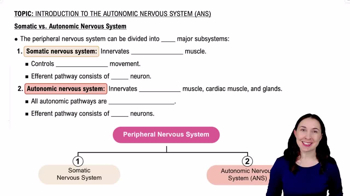
What are the two neurons in each autonomic nervous system (ANS) pathway?
Preganglionic neuron (closest to spinal cord) and postganglionic neuron (closest to the organ it innervates).
Where are parasympathetic ganglia located?
Parasympathetic ganglia are located within or very near the effector organ and are called terminal ganglia.
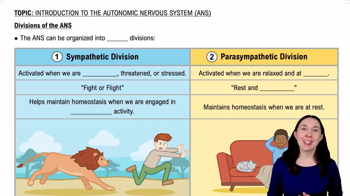
What is the general function of the parasympathetic nervous system?
It promotes rest and digest activities such as salivation, lacrimation, urination, digestion, and defecation (SLUDD), and decreases heart rate, pupil size, and airway diameter.
What is the general function of the sympathetic nervous system?
It mediates the fight or flight response during emergency, exercise, embarrassment, or excitement.
What neurotransmitter is secreted by postganglionic parasympathetic fibers?
Acetylcholine (ACh) is secreted by postganglionic parasympathetic fibers.
What neurotransmitter is secreted by most postganglionic sympathetic fibers?
Norepinephrine (NE) is secreted by most postganglionic sympathetic fibers, except some that secrete acetylcholine.
What are the locations of sympathetic ganglia?
Sympathetic ganglia are located alongside the spinal cord (paravertebral ganglia) and in front of the spinal cord (prevertebral or collateral ganglia).
What is the sympathetic trunk?
The sympathetic trunk is the chain of paravertebral ganglia on each side of the spinal cord resembling 'beads on a string.'
What are autonomic plexuses?
Networks formed by the mixing of sympathetic and parasympathetic postganglionic fibers that supply various organs.
How does acetylcholine affect postsynaptic neurons in the ANS?
Acetylcholine is always excitatory, causing an action potential in the postsynaptic neuron.
How can norepinephrine affect postsynaptic neurons?
Norepinephrine can be excitatory or inhibitory depending on the receptor type it binds.
What is the origin of preganglionic fibers in the parasympathetic division?
Preganglionic fibers originate in the cranial region of the brain or sacral region of the spinal cord (craniosacral outflow).
What is the origin of preganglionic fibers in the sympathetic division?
Preganglionic fibers originate in the thoracic or lumbar region of the spinal cord (thoracolumbar outflow).
What is sympathetic tone and why is it important?
Sympathetic tone is the baseline level of sympathetic activity that maintains blood vessel constriction and blood pressure.
What is vagal tone and why is it important?
Vagal tone is the baseline parasympathetic activity that slows the heart rate under resting conditions.
What distinguishes autonomic reflexes from somatic reflexes?
Autonomic (visceral) reflexes control involuntary organs, while somatic reflexes control skeletal muscles.
Define hormone and endocrine system.
A hormone is a chemical messenger secreted into the blood to regulate distant target cells. The endocrine system consists of glands that secrete hormones.
How do endocrine glands differ from exocrine glands?
Endocrine glands secrete hormones directly into the bloodstream, while exocrine glands secrete substances through ducts to body surfaces or cavities.
What are the major classes of hormones?
Major classes include peptide/protein hormones, steroid hormones, and amine hormones.
How do peptide and steroid hormones differ in their cellular action?
Peptide hormones bind to membrane-bound receptors and use second messengers; steroid hormones bind to intracellular or nuclear receptors to affect gene transcription.
What is the function of second messengers in hormone action?
Second messengers amplify the hormone signal inside the cell, commonly used by peptide hormones.
What are the three major mechanisms controlling hormone release?
Hormone release is controlled by humoral (blood chemistry), neural (nerve signals), and hormonal (other hormones) stimuli.
Where is the pituitary gland located and what are its parts?
The pituitary gland is located below the hypothalamus and has an anterior and posterior lobe.
What is the mnemonic for anterior pituitary hormones?
 Back
Back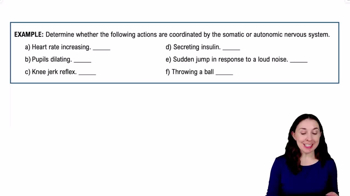
 1:10
1:10