 Back
BackAnatomy & Physiology: Autonomic Nervous System, Endocrine System, and Special Senses
 1:10
1:10
Terms in this set (29)
Controls involuntary functions such as heart rate, digestion, blood pressure, gland secretion, and smooth muscle activity.
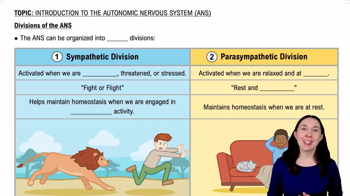
Parasympathetic = Rest and Digest; Sympathetic = Fight or Flight.
Parasympathetic originates from craniosacral regions; Sympathetic from thoracolumbar regions of the spinal cord.
Parasympathetic uses acetylcholine; Sympathetic uses norepinephrine.
Parasympathetic decreases heart rate; Sympathetic increases heart rate.
Preganglionic neuron exits CNS to synapse in autonomic ganglion; Postganglionic neuron extends from ganglion to target organ.
Baseline sympathetic activity that maintains blood pressure and vessel tone.
Parasympathetic influence of the vagus nerve that slows resting heart rate.
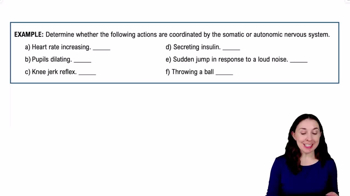
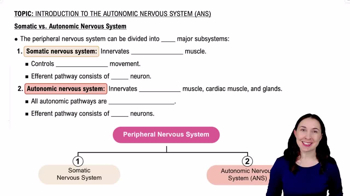
Somatic controls skeletal muscles voluntarily with one neuron; ANS controls smooth muscle, cardiac muscle, and glands involuntarily with a two-neuron chain.
Include cardiac, pulmonary, esophageal, celiac (solar), inferior mesenteric, and hypogastric plexuses controlling various organs.
Endocrine glands secrete hormones into bloodstream without ducts; exocrine glands secrete substances like sweat or enzymes through ducts.
Steroid hormones (e.g., cortisol), peptide/protein hormones (e.g., insulin), and amine hormones (e.g., epinephrine).
Steroid hormones cross membranes and alter gene expression; peptide hormones bind membrane receptors and use second messengers like cAMP.
S: Somatotropin (GH), T: Thyroid Stimulating Hormone (TSH), G: Gonadotropins (FSH/LH), A: Adrenocorticotropic Hormone (ACTH), P: Prolactin (PRL).
ADH increases kidney water reabsorption; Oxytocin stimulates uterine contractions and milk ejection.
Produces T3 and T4 to increase metabolism and calcitonin to decrease blood calcium; iodine is required for synthesis.
Raises blood calcium by stimulating osteoclasts, increasing intestinal absorption, and reducing calcium loss in urine.
Medulla secretes catecholamines (epinephrine, norepinephrine); cortex secretes corticosteroids including aldosterone and cortisol.
Low BP → kidney releases renin → renin converts angiotensinogen to angiotensin I → ACE converts to angiotensin II → vasoconstriction and aldosterone release → sodium and water retention.
Diabetes mellitus: insulin problems causing hyperglycemia; Diabetes insipidus: ADH deficiency causing excessive urination.
Vision, hearing, equilibrium, taste (gustation), and smell (olfaction).
Five tastes: sweet, sour, salty, bitter, umami; cranial nerves involved are Facial (VII), Glossopharyngeal (IX), and Vagus (X).
Located in olfactory epithelium; odorants dissolve in mucus; olfactory adaptation is decreased sensitivity to persistent odors.
Rods provide night vision; cones provide color vision; fovea centralis has highest cone concentration.
Lens shape changes to focus on near or far objects.
Myopia (nearsightedness) corrected with concave lenses; hyperopia (farsightedness) corrected with convex lenses.
Cornea → aqueous humor → pupil → lens → vitreous humor → retina → optic nerve → optic chiasm → optic tract → thalamus → visual cortex.
Mechanoreceptors detect sound and equilibrium; vestibule senses static equilibrium; semicircular canals sense dynamic equilibrium.
Auricle → external auditory canal → tympanic membrane → malleus → incus → stapes → oval window → cochlea → organ of Corti → vestibulocochlear nerve → auditory cortex.