 Back
BackAnatomy & Physiology: Body Cavities, Organs & Membranes
 3:20
3:20
Terms in this set (20)
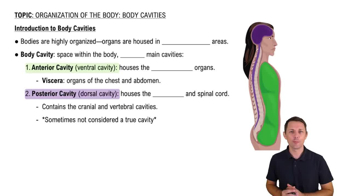
Enclosed spaces that house and protect organs.
Dorsal body cavity and ventral body cavity.
The cranial cavity houses the brain and the vertebral cavity houses the spinal cord.
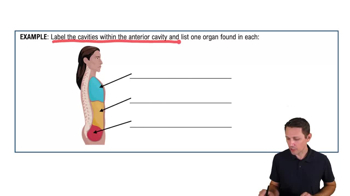
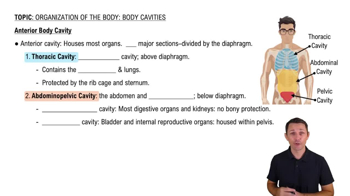
Thoracic cavity, abdominal cavity, and pelvic cavity.
The pericardial cavity contains the heart and the pleural cavity contains the lungs.
The urinary bladder, reproductive organs, and rectum.
Organs consist of two or more tissue types, often all four: epithelial, connective, muscle, and nervous tissue.
Membranes consist of one or two tissue types: connective tissue with or without epithelial tissue attached.
They line inner and outer surfaces of the body and its organs.
They line cavities of organs that open directly to the body exterior, such as digestive, respiratory, urinary, and reproductive systems.
An epithelial layer in contact with the lumen and a lamina propria connective tissue layer.
Avascular and often contains goblet cells that secrete mucus.
A loose areolar connective tissue layer that is vascular and nourishes the epithelial cells of mucous membranes.
They line closed body cavities that do not open to the exterior, such as thoracic and abdominal cavities.
Parietal layer against the cavity wall and visceral layer against the organ.
They secrete serous fluid into the serous cavity to reduce friction and allow smooth organ movement.
Pericardium (heart), pleura (lungs), and peritoneum (abdominal organs).
Membranes made of areolar connective tissue only, found in joints, with no epithelium.
Because they consist of only one tissue type (connective tissue) and lack epithelium.
The skin, with an epithelium of stratified squamous called the epidermis and connective tissue of areolar and dense irregular called the dermis.