Skip to main content
Anatomy & Physiology
My Course
Learn
Exam Prep
AI Tutor
Study Guides
Textbook Solutions
Flashcards
Explore
Try the app
My Course
Learn
Exam Prep
AI Tutor
Study Guides
Textbook Solutions
Flashcards
Explore
Try the app
Back
Anatomy & Physiology: Bones and Skeletal System
You can tap to flip the card.
What are the three types of cartilage in the skeletal system?
You can tap to flip the card.
👆
What are the three types of cartilage in the skeletal system?
Hyaline
,
elastic
, and
fibrocartilage
.
Track progress
Control buttons has been changed to "navigation" mode.
1/27
Recommended videos
Guided course
01:27
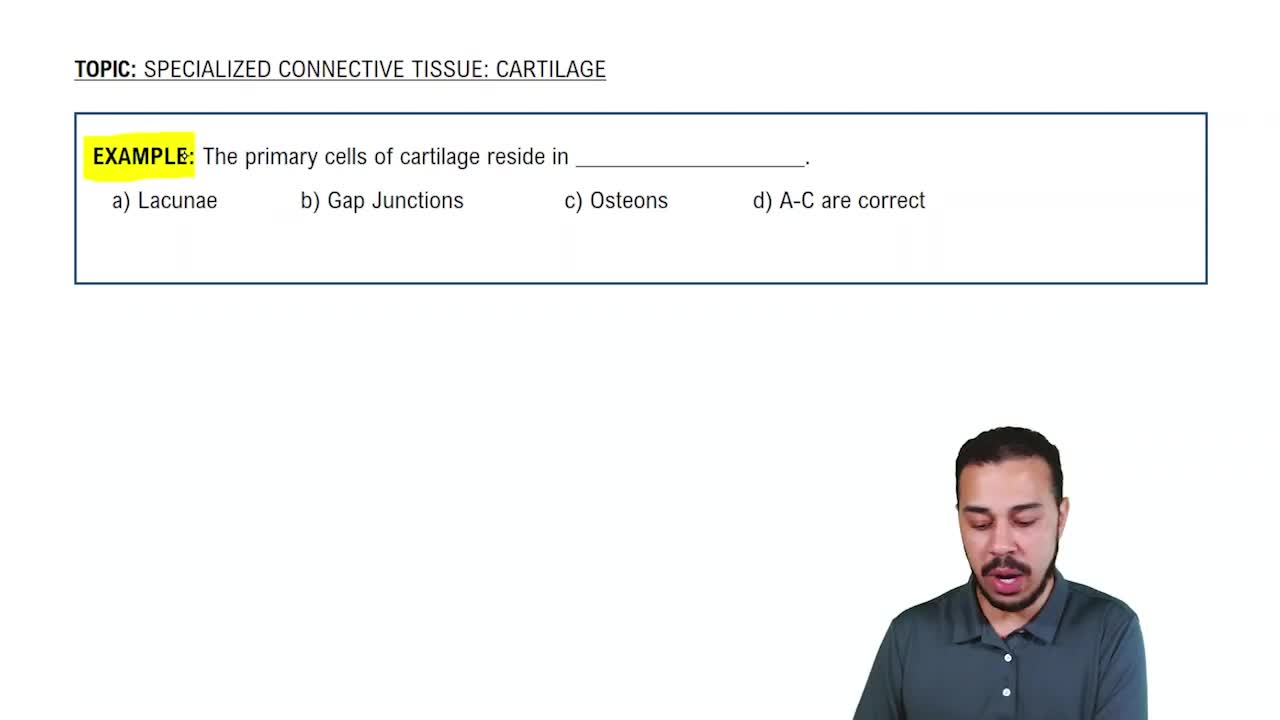
Specialized Connective Tissue: Cartilage Example 1
4893
views
66
rank
Guided course
05:36
Hyaline Cartilage
6396
views
100
rank
Guided course
05:20
Fibrocartilage
5680
views
90
rank
1
comments
Terms in this set (27)
Hide definitions
What are the three types of cartilage in the skeletal system?
Hyaline
,
elastic
, and
fibrocartilage
.
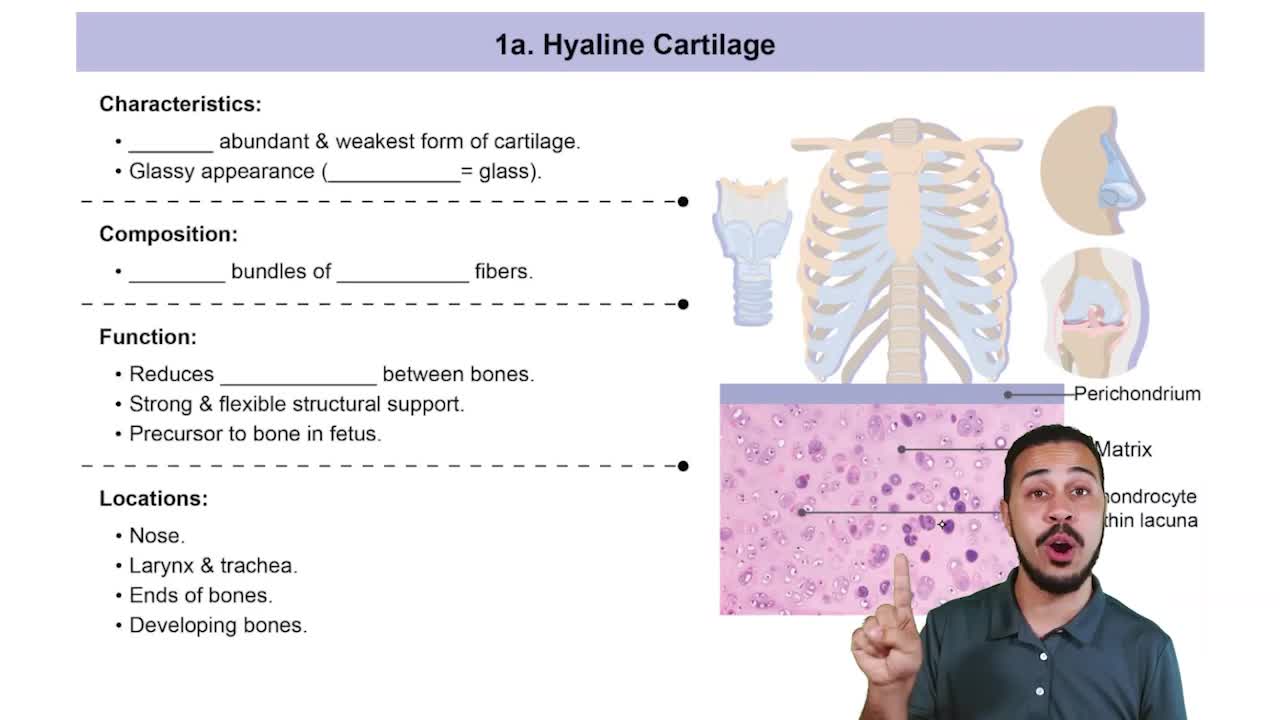
What is the main function of hyaline cartilage?
Provides
flexibility
, reduces
friction
, and absorbs
shock
. It is the most abundant but weakest cartilage.
Where is elastic cartilage found and what is its function?
Found in the
external ear
and
larynx
, it maintains the
shape of organs
and is more flexible than hyaline cartilage.
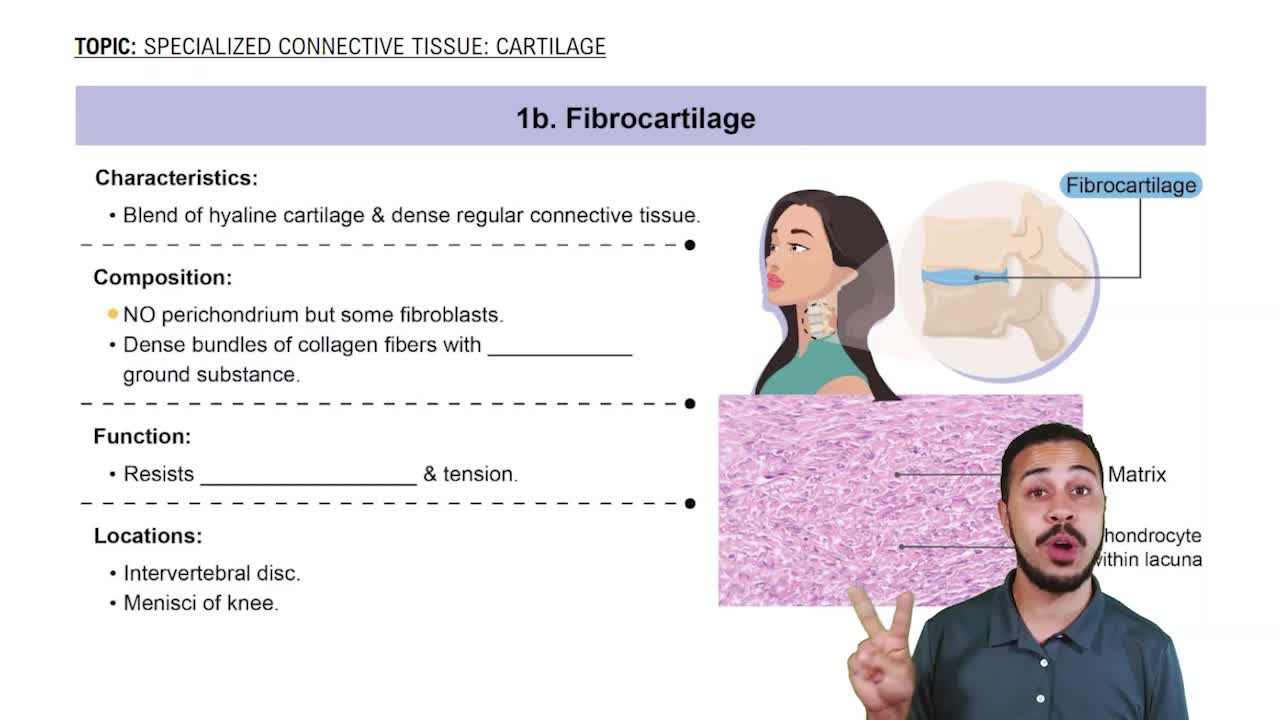
What is the primary role of fibrocartilage?
Provides
strength
,
rigidity
, and resists
compression
and
torsion
. It is the strongest cartilage type.
What tissues compose bones as organs?
Bone tissue, cartilage, dense connective tissue, blood, epithelial tissue (blood vessels), and nervous tissue.
List the main functions of the skeletal system.
Support and protection, leverage for movement, mineral storage (calcium and phosphate), and blood cell production in red marrow.
How many bones are in the adult human body?
There are
206 bones
in the adult human body.
What are the five major bone classifications?
Long, short, flat, irregular, and sesamoid bones.
What are sutural bones?
Small bones located between the bones of the skull.
What are bone markings and their types?
Surface features of bones including
projections
(for muscle/tendon attachment),
openings
, and
depressions
(for blood vessels or nerves).
Describe the diaphysis of a long bone.
The tubular shaft made of
compact bone
surrounding the
medullary cavity
.
What is the epiphysis of a long bone?
The end part of the bone composed of
spongy (trabecular) bone
with a lattice-like structure.
What is the metaphysis in a long bone?
The region between the diaphysis and epiphysis.
What is the epiphyseal plate/line?
The area of linear growth in bones; the plate is active in children, and the line is the remnant in adults.
What is the periosteum?
A membrane covering the outside of bone with an outer fibrous layer and an inner cellular layer containing osteoprogenitor cells.
What is the endosteum?
A thin membrane lining the inside of bone, covering trabeculae and the central canal, containing osteoprogenitor cells.
What are Sharpey’s fibers?
Collagen fibers from the periosteum that penetrate the bone matrix to attach tendons and ligaments.
What are the four main cell types in bone tissue?
Osteoprogenitor cells, osteoblasts, osteocytes, and osteoclasts.
What is the function of osteoblasts?
Bone builders that secrete osteoid matrix and initiate mineralization.
What role do osteocytes play in bone?
Mature osteoblasts that maintain the protein and mineral composition of the bone matrix.
What is the function of osteoclasts?
Multinucleated cells that resorb and break down bone matrix.
What is the composition of the bone matrix?
About 1/3 collagen fibers and proteins, and 2/3 mineralized calcium phosphate forming hydroxyapatite crystals.
What is an osteon in compact bone?
A cylindrical structure of concentric lamellae running parallel to the bone's long axis, containing a central (Haversian) canal.
What are canaliculi in bone tissue?
Small channels connecting osteocytes in lacunae, allowing nutrient and waste exchange.
What is the difference between compact and spongy bone?
Compact bone is dense and solid with osteons; spongy bone is porous with trabeculae and contains red marrow.
Where is red marrow found and what is its function?
Located in the spaces of spongy bone; it is the site of blood cell production (hemopoiesis).
What is yellow marrow?
Marrow primarily composed of lipids, serving as an energy reserve.
 BackBack
 01:27