 Back
Anatomy & Physiology: Brain and Nervous System Flashcards
 0:50

Terms in this set (25)
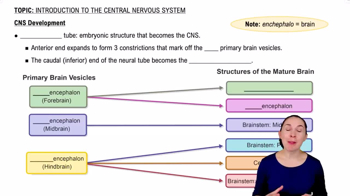
The three primary brain vesicles are the prosencephalon, mesencephalon, and rhombencephalon.
They develop during the early stages of embryonic brain development, around the 4th week of gestation.
The secondary brain vesicles include the telencephalon and diencephalon from the prosencephalon, the mesencephalon remains undivided, and the metencephalon and myelencephalon from the rhombencephalon.
The cerebrum is responsible for higher brain functions such as sensory perception, voluntary motor actions, reasoning, and memory.
The five lobes (frontal, parietal, temporal, occipital, and insula) each have specialized functions like motor control, sensory processing, hearing, vision, and visceral functions.
The frontal lobe controls voluntary motor activity, speech production, and higher cognitive functions like planning and decision-making.
Key projections include the precentral gyrus, which contains the primary motor cortex.
Important gyri include the precentral gyrus (motor control) and Broca's area (speech production).
An association area integrates sensory and motor information to perform complex functions like reasoning and language.
It processes auditory information and is located in the temporal lobe.
The occipital lobe is primarily responsible for visual processing.
The parieto-occipital sulcus separates the occipital lobe from the parietal lobe.
The thalamus acts as a relay station for sensory information going to the cerebral cortex.
The four main regions are the thalamus, hypothalamus, epithalamus, and subthalamus.
Oxytocin and antidiuretic hormone (ADH) are produced by the hypothalamus and released by the neurohypophysis (posterior pituitary).
The infundibulum connects the hypothalamus to the pituitary gland.
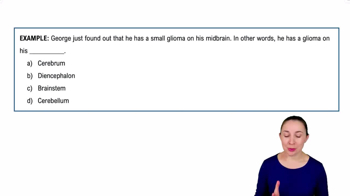
The brainstem consists of the midbrain, pons, and medulla oblongata.
The pons relays signals between the cerebrum and cerebellum and helps regulate breathing.
The medulla controls autonomic functions such as heart rate, blood pressure, and respiration.
The cerebellum coordinates voluntary movements, balance, and posture.
The ventricular system produces and circulates cerebrospinal fluid (CSF) to protect and nourish the brain.
CSF flows from the lateral ventricles to the third ventricle, then through the cerebral aqueduct to the fourth ventricle, and finally into the subarachnoid space.
The choroid plexus produces cerebrospinal fluid (CSF) within the ventricles.
The 12 cranial nerves control sensory and motor functions of the head and neck. Mnemonic: \(\text{Oh, Oh, Oh, To Touch And Feel Very Good Velvet, AH!}\)
Functions mnemonic: \(\text{Some Say Marry Money But My Brother Says Big Brains Matter More}\) (Sensory, Motor, Both)