Skip to main content
Anatomy & Physiology
My Course
Learn
Exam Prep
AI Tutor
Study Guides
Textbook Solutions
Flashcards
Explore
Try the app
My Course
Learn
Exam Prep
AI Tutor
Study Guides
Textbook Solutions
Flashcards
Explore
Try the app
Back
Anatomy & Physiology: Brain Structure and Function
You can tap to flip the card.
Size and weight of the adult brain
You can tap to flip the card.
👆
Size and weight of the adult brain
Approximately
1200 mL
in volume and
1.4 kg
in weight.
Track progress
Control buttons has been changed to "navigation" mode.
1/36
Recommended videos
0:50
Introduction to the Central Nervous System Example 1
13306
views
249
rank
2
comments
2:41
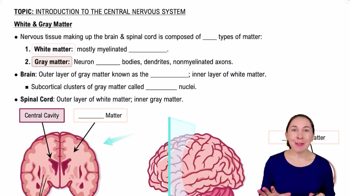
White & Gray Matter
13388
views
245
rank
3:34
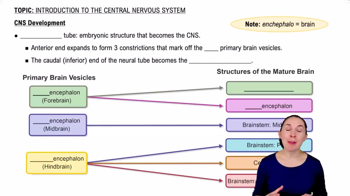
CNS Development
14040
views
280
rank
2
comments
Terms in this set (36)
Hide definitions
Size and weight of the adult brain
Approximately
1200 mL
in volume and
1.4 kg
in weight.
Percentage of body's neural tissue in the brain
The brain contains about
97%
of the body's neural tissue.
Does brain size relate to intelligence?
No,
brain size does not correlate with intelligence
.
Six regions of the brain
Cerebrum, Cerebellum, Diencephalon, Midbrain, Pons, Medulla oblongata
.
Largest part of the brain
The
cerebrum
, making up about 85% of brain mass.
Functions of the cerebrum
Controls
conscious thought, memory, and voluntary movement
.
Divisions of the cerebrum
Divided into
two hemispheres
: left and right.
What is the cerebral cortex?
A thin layer (1–4.5 mm) of
gray matter
covering the cerebrum.
Gyri, sulci, and fissures
Gyri
are ridges,
sulci
are shallow grooves, and
fissures
are deep grooves on the brain surface.
Types of white matter fibers
Association fibers
connect within the same hemisphere,
commissural fibers
connect hemispheres, and
projection fibers
connect to lower CNS.
Function of basal nuclei
Control
subconscious motor movements
and are involved in movement regulation.
Effect of basal nuclei disruption
Disruption can cause diseases like
Parkinson’s
due to dopamine imbalance.
Location and function of primary motor cortex
Located in the
frontal lobe
, it controls
voluntary skeletal muscle movement
.
Sensory functions of parietal, occipital, temporal, and frontal lobes
Parietal:
somatosensory (touch, pain, temperature);
Occipital:
vision;
Temporal:
hearing and smell;
Frontal:
taste (gustatory cortex).
Role of association areas
Interpret sensory information and connect it to appropriate responses.
Functions of premotor cortex
Coordinates
learned, skilled movements
.
Functions of Wernicke’s and Broca’s areas
Wernicke’s area:
language comprehension;
Broca’s area:
speech production.
Functions of the prefrontal cortex
Controls
planning, decision making, and personality
.
Left vs. right hemisphere functions
Left controls
math, speech, and logic
; right controls
sensory perception and recognition
.
Definition of aphasia and dyslexia
Aphasia:
difficulty speaking or understanding language;
Dyslexia:
difficulty reading or writing.
Brain waves and their states
Alpha:
relaxed awake;
Beta:
active thinking;
Theta:
children/light sleep;
Delta:
deep sleep.
What is a seizure?
Uncontrolled, abnormal electrical activity in the brain.
Size and function of the cerebellum
Second largest brain part (~11%), responsible for
balance, coordination, and refining learned movements
.
What are folia and arbor vitae?
Folia:
folds of the cerebellum;
Arbor vitae:
tree-like white matter inside the cerebellum.
Symptoms of cerebellum damage
Ataxia
, which is loss of coordination.
Parts and functions of the diencephalon
Includes
epithalamus
(pineal gland, melatonin),
thalamus
(sensory relay), and
hypothalamus
(homeostasis control).
Functions of the hypothalamus
Controls
autonomic functions
(HR, BP, digestion), regulates the
endocrine system
, produces
ADH and oxytocin
, and manages hunger, thirst, emotions, temperature, and circadian rhythm.
Brainstem parts and their functions
Includes
midbrain
(visual/auditory reflexes),
pons
(connects cerebellum, controls breathing rhythm), and
medulla
(vital functions like heart rate, BP, breathing).
Role of the limbic system
Involved in
emotions and memory
, includes hippocampus (memory), amygdala (emotions), and fornix (connects limbic structures).
What are ventricles and their connections?
Fluid-filled spaces in the brain: lateral, third, and fourth ventricles; connected by the
cerebral aqueduct
.
Functions and circulation of cerebrospinal fluid (CSF)
CSF
protects and cushions
the brain, is produced by the
choroid plexus
, and circulates through ventricles to the subarachnoid space.
Layers of the meninges
Three layers:
dura mater
(outer),
arachnoid mater
(middle), and
pia mater
(inner).
What is the blood-brain barrier (BBB)?
A protective barrier with
tight junctions
that blocks most harmful substances from entering the brain.
Differences between epidural and subdural hemorrhages
Epidural hemorrhage:
bleeding outside the dura mater;
Subdural hemorrhage:
bleeding beneath the dura mater.
What is a stroke (CVA)?
Loss of blood flow to brain tissue causing
neuron death
.
High-yield brain function summary
Cerebrum:
thinking;
Cerebellum:
coordination;
Thalamus:
sensory relay;
Hypothalamus:
homeostasis;
Medulla:
vital life functions.
 BackBack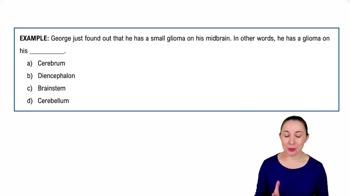
 0:50
0:50