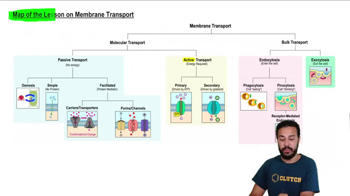
What are the two major active membrane transport processes?
Active transport and vesicular transport, both requiring ATP to move solutes across the plasma membrane.
What is the role of carrier proteins in active transport?
Carrier proteins bind specifically and reversibly with substances, moving solutes against their concentration gradient using energy from ATP.
What is the difference between antiporters and symporters?
Antiporters transport one substance into the cell while moving another out; symporters transport two substances in the same direction.
What distinguishes primary active transport from secondary active transport?
Primary active transport uses energy directly from ATP hydrolysis; secondary active transport uses energy stored in ionic gradients created by primary active transport.
How does the sodium-potassium pump function?
It pumps 3 Na+ ions out of the cell and 2 K+ ions into the cell against their concentration gradients using ATP, maintaining electrochemical gradients.
Why are leakage channels important in cells?
Leakage channels allow Na+ to leak into the cell and K+ to leak out, traveling down their concentration gradients, which the Na+-K+ pump counteracts.
What is secondary active transport and how does it work?
It uses the ion gradient created by primary active transport to drive the transport of other solutes, often with Na+ dragging molecules like glucose into the cell.
What are the three types of endocytosis?
Phagocytosis (cell eating), pinocytosis (cell drinking), and receptor-mediated endocytosis (selective uptake via receptors).
Describe phagocytosis.
The cell engulfs large particles by forming pseudopods that surround the particle, creating a phagosome that fuses with lysosomes for digestion.
What is pinocytosis?
A nonspecific process where the plasma membrane infolds to bring extracellular fluid and dissolved solutes into the cell in vesicles.
How does receptor-mediated endocytosis differ from other types?
It involves specific receptors binding substances, concentrating them in clathrin-coated vesicles for selective uptake.
What is exocytosis and what triggers it?
Exocytosis ejects material from the cell via secretory vesicles, usually triggered by cell-surface signals or changes in membrane voltage.
What is resting membrane potential (RMP)?
The electrical potential energy from separation of oppositely charged particles across the plasma membrane, typically between –50 to –100 mV.
How does K+ contribute to the resting membrane potential?
K+ diffuses out through leakage channels, leaving behind negatively charged proteins, creating a negative charge inside the cell that balances K+ movement.
Why does Na+ have less influence on RMP than K+?
Because the membrane is more permeable to K+ than Na+, so K+ primarily sets the RMP despite Na+ being attracted inside.
How does the Na+-K+ pump maintain electrochemical gradients?
By continuously pumping 3 Na+ out and 2 K+ in, it balances ion diffusion and maintains the steady state of RMP.
What are cell adhesion molecules (CAMs) and their functions?
Sticky glycoproteins on cell surfaces that anchor cells, assist movement, attract WBCs, regulate junctions, and transmit signals for migration and specialization.
What roles do plasma membrane receptors play?
They bind chemical signals for contact and chemical signaling, triggering enzyme activation or ion channel opening to change cellular activity.
How do G protein–linked receptors work?
They activate G proteins that relay signals inside the cell, affecting ion channels, enzymes, or releasing second messengers like cyclic AMP.
What is the glycocalyx and its function?
A sugar coating on the cell surface made of glycolipids and glycoproteins that acts as a biological marker for cell recognition and immune response.
 Back
 02:26