 Back
Anatomy & Physiology: Cell Membrane Transport and Cellular Respiration
 02:44

Terms in this set (31)
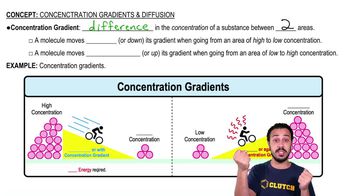
A concentration gradient is the difference in the concentration of a substance between two areas, driving movement from higher to lower concentration.
Passive transport moves substances down their concentration gradient without energy, while active transport moves substances against the gradient using energy (ATP).
Simple diffusion, channel-mediated facilitated diffusion, and carrier-mediated facilitated diffusion.
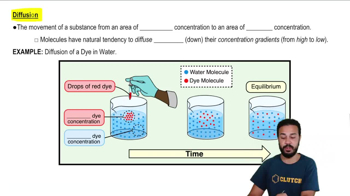
Diffusion is the movement of molecules from high to low concentration down the concentration gradient, driven by kinetic energy of molecules.
Diffusion occurs when there is a concentration gradient and the membrane is permeable to the substance.
Simple diffusion moves small, nonpolar molecules directly through the membrane; facilitated diffusion uses proteins to transport larger or polar molecules.
Size and polarity of the substance determine membrane crossing: small nonpolar cross easily; large or polar require facilitation.
Carrier-mediated uses proteins that change shape to transport molecules; channel-mediated uses protein channels forming pores for ions or water.
Simple diffusion: oxygen; channel-mediated: ions like Na+; carrier-mediated: glucose.
No, diffusion is only effective over short distances due to slow rate over large distances.
Concentration gradient size, temperature, and membrane permeability.
Isotonic: equal solute concentration; hypertonic: higher solute outside; hypotonic: lower solute outside compared to inside the cell.
Osmosis is the movement of water molecules across a selectively permeable membrane toward a higher solute concentration.
Osmosis is driven by solute concentration differences and does not require ATP; it is a passive process.
Water passes directly through the lipid bilayer or via aquaporin channels.
Water moves to balance solute concentrations, causing cells to swell (hypotonic) or shrink (hypertonic) due to changes in water pressure.
ATP provides energy for active transport moving substances against their concentration gradient.
The pump uses ATP to move 3 Na+ out and 2 K+ into the cell via a carrier protein, maintaining ion gradients.
Chloride ions (Cl-) are not pumped correctly, causing thick mucus buildup in airways.
Uses energy from Na+ moving down its gradient to co-transport glucose against its gradient into the cell.
Specificity means carriers transport specific substances; saturation means carriers have a maximum transport rate. Both affect facilitated transport.
Transcytosis is the transport of molecules across a cell by endocytosis on one side and exocytosis on the other.
Endocytosis brings substances into the cell; exocytosis expels substances out of the cell.
Phagocytosis (cell eating), pinocytosis (cell drinking), receptor-mediated endocytosis (specific uptake via receptors).
Vesicles fuse with the plasma membrane to release contents outside the cell; example: neurotransmitter release.
Anabolism builds complex molecules; catabolism breaks down molecules releasing energy.
Aerobic requires oxygen; anaerobic does not require oxygen.
Glycolysis, Krebs cycle (citric acid cycle), and electron transport chain.
Occurs in the cytoplasm and is anaerobic.
Oxygen is the final electron acceptor; carbon dioxide is a waste product from breakdown of glucose.
Vitamin B3 (niacin) for NAD and vitamin B2 (riboflavin) for FAD.