 Back
Anatomy & Physiology: Cell Structure, Transport, and Epithelium Types
 04:59

Terms in this set (22)
Simple squamous, simple cuboidal, simple columnar, transitional, stratified squamous, stratified cuboidal, and pseudostratified columnar epithelium.
Allows diffusion and filtration due to its thin, flat cells; found in lungs and blood vessels.
DNA is transcribed into mRNA in the nucleus, which is transported to the cytoplasm where ribosomes translate mRNA into protein using tRNA carrying amino acids.
tRNA carries amino acids to the ribosome and matches its anticodon with mRNA codons to assemble proteins.
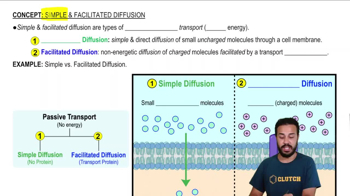
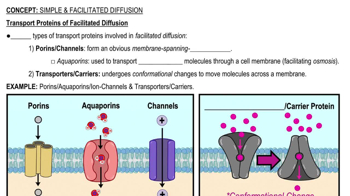
Movement of molecules across the membrane without energy, including simple diffusion, channel-mediated diffusion, and facilitated diffusion.
Active transport requires energy (ATP) to move molecules against their concentration gradient using carrier proteins.
Movement of molecules from an area of higher to lower concentration directly through the lipid bilayer without assistance.
Diffusion of water across a semipermeable membrane from a hypotonic (low solute) to hypertonic (high solute) solution.
Isotonic: equal solute concentration; Hypotonic: lower solute outside causing cell swelling; Hypertonic: higher solute outside causing cell shrinkage.
The control center containing DNA, directing cell activities and protein synthesis.
Sites of protein synthesis where mRNA is translated into amino acid chains.
Chromatin is loosely coiled DNA in the nucleus during interphase; chromosomes are tightly coiled DNA during cell division.
Powerhouses of the cell that produce ATP through cellular respiration.
Modifies, sorts, and packages proteins and lipids for transport inside or outside the cell.
Organelles containing enzymes that digest cellular waste and foreign material.
Passive transport where molecules move across membranes via carrier or channel proteins without energy.
Movement of water and solutes through a membrane by hydrostatic pressure, usually in capillaries.
A network of protein filaments that maintains cell shape, enables movement, and anchors organelles.
Cytosol is the fluid inside cells; interstitial fluid surrounds cells in tissues.
To regulate cell growth and division, ensuring proper replication and function.
Prophase, metaphase, anaphase, and telophase—stages of nuclear division.
Mitosis divides the nucleus; cytokinesis divides the cytoplasm, completing cell division.