 Back
Anatomy & Physiology: Cell Transport, Osmosis, and Microscopy
 04:46

Terms in this set (20)
Diffusion is the passive movement of molecules from an area of higher concentration to an area of lower concentration until equilibrium is reached.
Osmosis is the diffusion of water molecules through a selectively permeable membrane from a region of low solute concentration to high solute concentration.
An isotonic solution has the same solute concentration as the inside of the RBC, so water moves in and out equally, and the cell retains its normal shape.
In a hypertonic solution, RBCs lose water by osmosis, shrink, and become crenated due to higher solute concentration outside the cell.
In a hypotonic solution, RBCs take in water by osmosis, swell, and may lyse (burst) because the solute concentration is lower outside the cell.
Molarity = moles of solute / liters of solution. Calculate moles by dividing grams of solute by molecular weight, then divide by volume in liters.
Milliosmolarity = molarity × 1000 × number of ions (2 for NaCl). It measures total osmotic particles per liter.
Polar molecules dissolve in polar solvents and non-polar molecules dissolve in non-polar solvents; similar polarity leads to solubility.
An amphipathic molecule has both polar and non-polar ends, allowing it to interact with both types of molecules and form structures like micelles.
The four phases are prophase, metaphase, anaphase, and telophase.
Mitosis produces two genetically identical diploid cells; meiosis produces four genetically diverse haploid gametes.
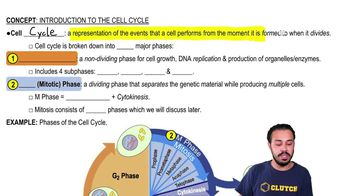
The cell cycle stages are G1 (growth), S (DNA synthesis), G2 (preparation for mitosis), and M (mitosis).
Clean oculars and objectives with ethanol on a kimwipe before and after use; store with oculars facing the back of the cupboard and matching microscope number.
Start with 4X, then 10X, then 40X; never start with 100X to avoid transferring oil to other lenses.
The diaphragm controls the amount of light passing through the specimen to improve contrast and resolution.
Dispose of slides with blood in small biohazard bags; gloves and wipes in large biohazard bags; solutions in labeled beakers; never pour solutions down the drain.
The plasma membrane controls the movement of substances in and out of the cell, maintaining homeostasis.
Ribosomes synthesize proteins, rough endoplasmic reticulum processes them, and the Golgi apparatus packages and ships proteins.
The cytoskeleton provides cell structure and movement; components include microtubules, intermediate filaments, and microfilaments.
The greater trochanter is a prominent bony projection on the femur used as an identification feature.