 Back
BackAnatomy & Physiology: Cells and Tissues
 03:32
03:32
Terms in this set (29)
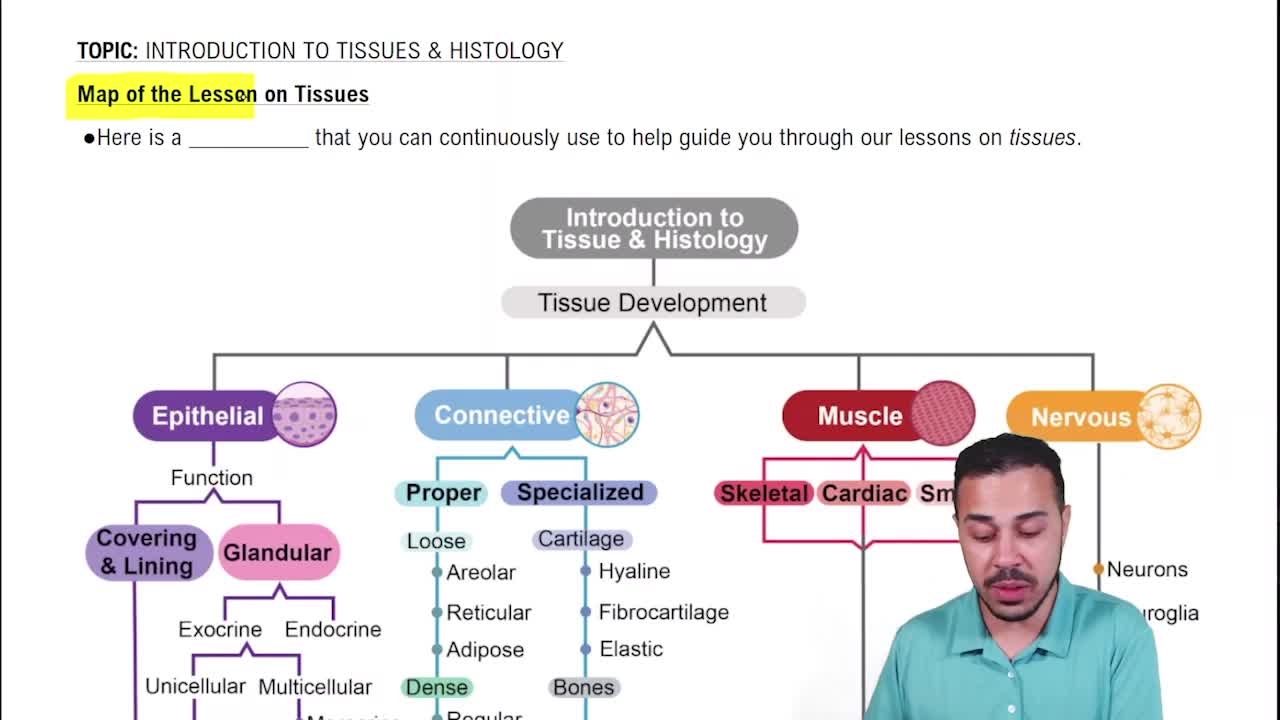
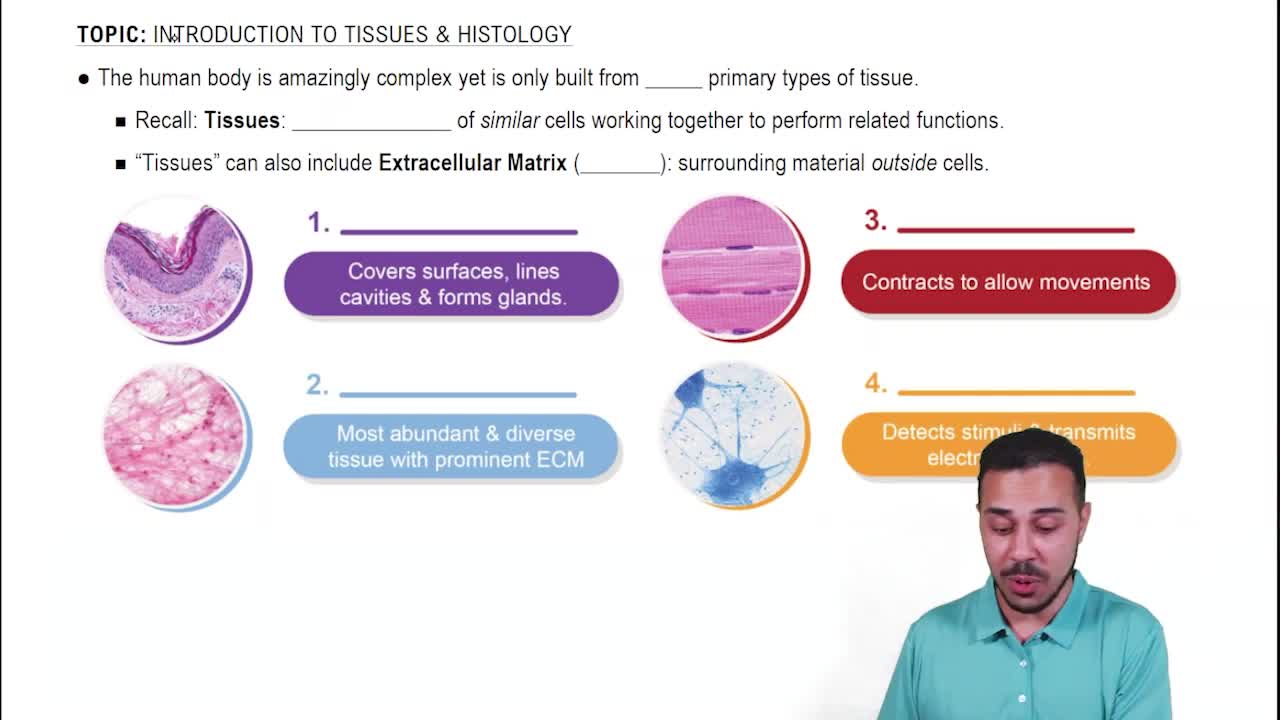
Epithelial tissue, connective tissue, muscular tissue, and neural tissue.
Covers exposed surfaces, lines internal passageways, and produces glandular secretions.
Cells are bound closely together with no intercellular space.
Structural and functional difference between the exposed apical surface and the attached basal surface.
A layer that attaches the basal surface of epithelial cells to underlying connective tissue, consisting of basal lamina and reticular lamina.
Tight junctions, desmosomes (spot desmosomes), and gap junctions.
Prevent diffusion of fluids and solutes between cells by fusing outer layers of plasma membranes.
Fingerlike projections on the apical surface that increase surface area for absorption, found in urinary and digestive tracts.
Simple epithelium has one cell layer; stratified epithelium has two or more layers.
Squamous (flat), cuboidal (cube-shaped), and columnar (taller than wide).
Lines body cavities, heart, blood vessels; reduces friction and controls permeability.
Provides physical protection against abrasion, pathogens, and chemical attack.
Structural framework, transport of fluids, protection, support, energy storage, and defense against microorganisms.
Specialized cells, extracellular protein fibers, and matrix (protein fibers plus ground substance).
Collagen fibers, reticular fibers, and elastic fibers.
Provide tensile strength to resist tension.
Deep dermis, between muscles, around blood vessels and nerves; connects skin to muscle and allows independent movement.
Contains adipocytes storing lipids; provides cushioning and insulation.
Fibers densely packed in parallel; found in tendons and ligaments; provides strong attachment.
Compact bone has blood vessels trapped in matrix; spongy bone does not.
Mucous, serous, cutaneous, and synovial membranes.
Line digestive, respiratory, reproductive, and urinary tracts; resist pathogen entry and keep surfaces moist.
Line joint cavities and produce synovial fluid to reduce friction.
Skeletal muscle, cardiac muscle, and smooth muscle.
Multinucleated, striated, voluntary, incapable of cell reproduction but repair possible via myosatellite cells.
Cardiac muscle cells are branched, have one nucleus, connected by intercalated discs, and are involuntary.
Non-striated, involuntary, tapered cells capable of reproduction; found in walls of blood vessels and organs.
Neurons (transmit impulses) and neuroglia (support and protect neurons).
Repair and maintenance decline; epithelia thin; connective tissues become fragile; cardiac and neural tissues cannot regenerate well.