The CNS performs the integrative nervous system functions, processing and coordinating sensory data and motor commands.
Four divisions of the brain
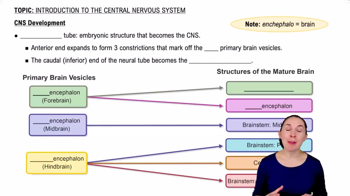
The brain is divided into the cerebrum, diencephalon, cerebellum, and brainstem.
Composition of the CNS
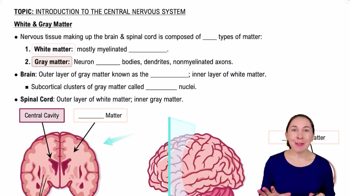
The CNS contains gray matter (nuclei) and white matter (myelinated axons).
Development of the CNS
The CNS develops from the neural tube, which forms primary and secondary brain vesicles by the fourth week of development.
Cerebral cortex function and lobes
The cerebral cortex is the outer gray matter of the cerebrum involved in conscious processes, with five lobes: frontal, parietal, occipital, temporal, and insula.
Types of neocortex
The neocortex includes the primary motor cortex, primary sensory cortices, and association areas.
Basal nuclei and their role
The basal nuclei (caudate nucleus, putamen, globus pallidus) function in movement control.
Types of cerebral white matter fibers
Commissural fibers connect hemispheres, projection fibers connect cerebrum to CNS, and association fibers connect gyri.
Limbic system components and functions
Includes the limbic lobe gyri, hippocampus, amygdala; functions in memory, learning, emotion, and behavior.
Diencephalon divisions and key functions
Includes the thalamus (sensory gateway), hypothalamus (homeostasis and endocrine control), subthalamus, and epithalamus (pineal gland).
 Back
Back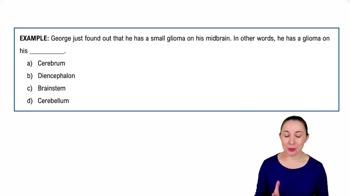
 0:50
0:50